Professor, Maggie and Dick Scarlett Endowed Chair in Speech-Language Pathology, affiliate professor in Literacy Education at the University of Wyoming.
@BethNetherland@TrinaDSpencer2@KJWinEducation @cpatrickproctor @AMWHMe The tragic tale of balanced literacy is a double header, with part one resulting in tragically poor decoding instruction and part two ending with insufficient oral academic language development. The current movement that focuses on science is righting only one of those wrongs.
@DougBPetersen and I got to train in Sydney to the most amazing group of #StoryChamps early adopters. @jdtdobson has the coolest job. Thanks for spreading into Australian classrooms!
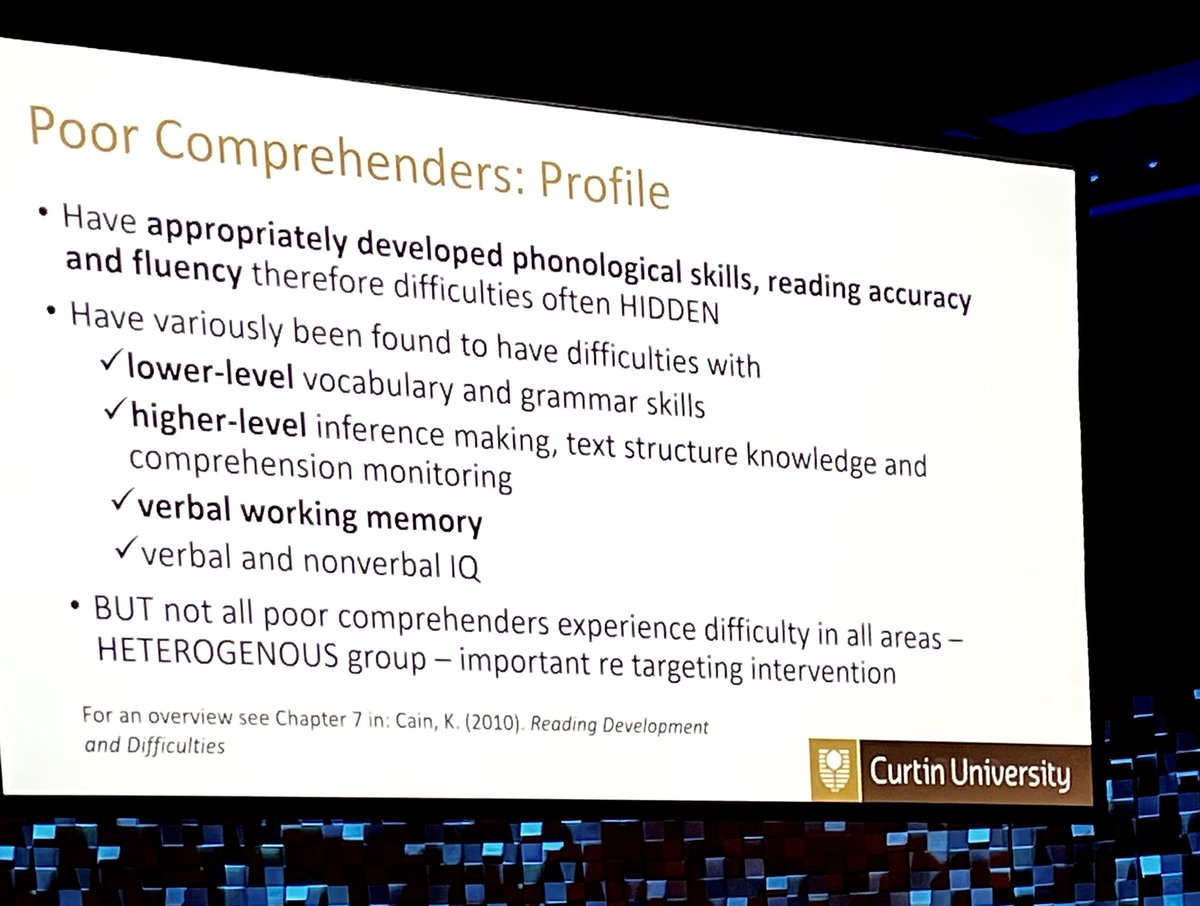
Poor comprehenders are often missed in the classroom, even those who would meet the criteria for DLD. It’s important to measure oral language skills, not just reading! #SPAconf
@DougBPetersen shared with the #SPAconf#SPA2023 crowd our DYMOND (dynamic assessment of oral narrative discourse) that yields >90% sensitivity and specificity for identifying language disability.
More clinically relevant research coming from @DougBPetersen & @TrinaDSpencer2 on dynamic language assessment for children from diverse backgrounds. Looking forward to trialling this ax in some of my school screening projects where we have high rates of EAL/D learners
Can’t wait to access the new Story Champs Curriculum when it’s published. Particularly like the inclusion of information report structure for retell & writing. https://t.co/lEGaMMMYZO
Also hanging out for this paper! @TrinaDSpencer2 @TIDAL_Lab
We're featured in an international research magazine. The power of storytelling written for laypeople. Please share! @TIDAL_Lab https://t.co/8hL9lPkS37
@mandercorn Students in the no-treatment control group received business as usual from their classroom teachers, and then after the study received the intervention.
"Results indicated that students who received Story Champs instruction had significantly higher scores across all outcomes compared to the students in the alternate-treatment and in the no-treatment control groups."
https://t.co/NC6r9JGT2Z
@KirbyLevelsUp @TrinaDSpencer2@AcademicChatter Trina never sent me any flowers. After I defended my dissertation she locked me in a room and made me write a manuscript with her for 12 hours straight.
@TrinaDSpencer2 I do too. But I do want to point out that we can learn new knowledge from reading also. So background knowledge is not exclusively responsible for comprehension.
@TrinaDSpencer2@emilyjsolari @cpatrickproctor @angelrabanas @tiffanyphogan We might just have to do a study that is painfully obvious: Teach children (who can decode) new information through oral language intervention, then assess whether they can still understand this new information in written form. There is an obvious outcome...
@TrinaDSpencer2 @angelrabanas @tiffanyphogan But (laughing), if oral language is not causally related to reading comprehension, you could teach me something through oral language intervention, and then when I read it, I will no longer understand it because it is in writing? This is a ridiculous conversation.
What I was apparently unaware of is that all of the hundreds of audio books that I have listened to over the years were not actually comprehensible. I had no idea that I wasn’t supposed to understand them because the language was originally expressed in written form.
Retrieval-Based #Word Learning in Young Typically Developing Children and Children With #Developmental#Language Disorder I: The Benefits of Repeated Retrieval, by Laurence B. Leonard et al. https://t.co/0uliC12SXg @LifeAtPurdue#JSLHR#slpeeps