Today I cared for a 17 y.o. girl coming from PICU w/COVID pneumonia
Very high risk, also congenial ❤️ dz
Parents worried myocarditis would worsen ❤️ -> not vax
Parents unaware of
-gender differences
-spacing doses
-how bad COVID could be for her
We have to do better than this
@Saikmedi Those graphs were before we could know the answer, but this graph👇 supports your point since we’re far enough out to have complete post-BA.1 data
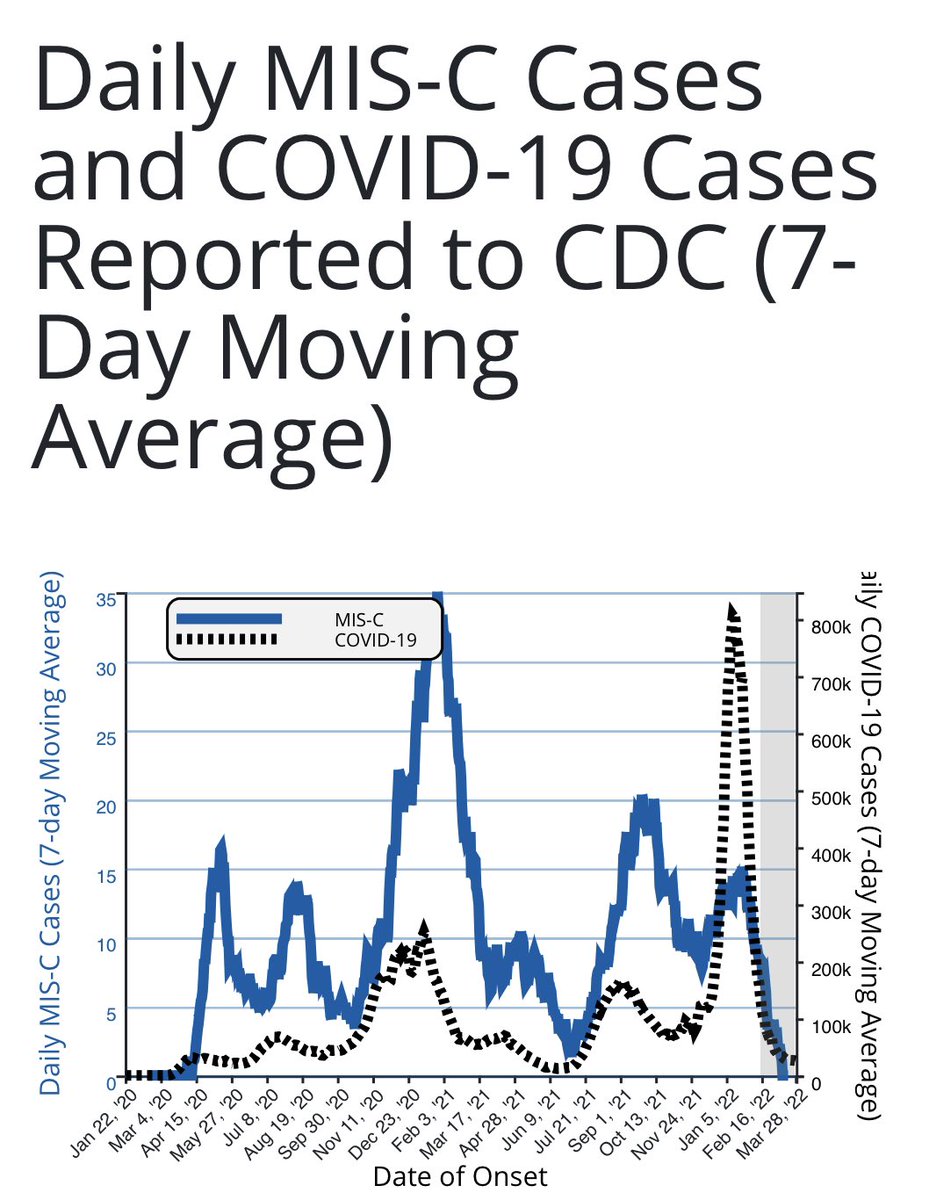
Key thing to recognize is that early 2022 MIS-C peak’s height/location is c/w being due to the Delta upturn just prior to Omicron
@ebennett74@sdbaral As a residency director, this was my focus each year during the 1st hour of new resident orientation
Most complaints I heard from nurses about residents involved them being “cocky” or “overconfident,” but in most cases, it was fake overconfidence trying to cover up insecurity
@daniela127 Unless this was recently fixed, in December, Pennsylvania started requiring a physician or nurse practitioner to certify that a kid with COVID is no longer contagious before returning to an early childhood program.
https://t.co/R7rAnkSocS
@freyas_house @Data_logical0 @MarcusBeam1 For whatever it’s worth, there is solid Delta data on teenager vaccination reducing MIS-C
For Omicron, CDC data recently updated👇but still very incomplete (gray area)
UK and Norway pre-prints do show lower MIS-C from Omicron:
https://t.co/D97VfAhYcH
https://t.co/5GFNwoYwjC
@BenK78457034 @FSBuchholzer That’s certainly plausible, but I’m curious why you feel confident about it.
More importantly, if that’s true, do you expect it to continue with future variants, or are we at decent risk that a future variant will emerge for which somewhat frequent MIS-C triggering is restored?
How frequent is MIS-C post-Omicron?
Anecdotally, rates are low relative to COVID rates, but data is sparse because of 2 types of lag: COVID->MIS-C & clinical diagnosis reporting
3 CDC 📉’s👇(🔵line) illustrate challenge during Delta, w/MIS-C peak & trough both ⬆️ w/updated data
@FSBuchholzer Here’s Norway data in unvax kids showing half as many MIS-C (7 Omicron vs 14 Delta) despite 2x as many infections -> ~75% decreased risk per infection. Doesn’t address if could be due to immunity from prior infection vs inherent differences by variant.
https://t.co/5GFNwoYwjC
@IanRicksecker New study👇 suggests that Omicron generation time was not shorter than with prior variants, which would be consistent with the higher Ro as you had stated in your thread.
https://t.co/Ycw4fX113E
A comprehensive contact tracing study of >23,000 people with Covid and their ~9,000 households demonstrates that Omicron has a similar generation time and period of viral shedding as the Delta and Alpha variants https://t.co/RnSspP1FfN
@JesseRapp15 Yes, but with a smaller absolute difference than in the older age groups, and only really visible at the peak of the Omicron wave.
https://t.co/W9IhNIeAGY
@jenkinshelen I’ve had that same experience
Having advised small organizations serving very different purposes and people — K-8 school, preschool/daycare, community center, camp, house of worship, religious school — I’d add that different organizations will have different goals, values, etc.
@NathanGrubaugh @CovidCT@CTDPH@CDC_AMD@YaleSPH@YaleMed Is there a way to partially crowd-fund this? Maybe a more detailed explanation each week on a subscription Substack?
Your updates are the best thing I’ve found so far for understanding variants in the US, and I bet that I’m not alone in thinking that.
@ebennett74 That asthma has not been prominent in terms of pediatric COVID admits has been really interesting. When planning in March 2020, we anticipated having many contagious kids on continuous albuterol nebs w/a limited supply of negative pressure rooms, but that never really happened.
@JuliaRaifman The problem is only having two options. I’ve seen kids hospitalized for COVID and ones w/truly incidental positive PCRs, including some who likely had asymptomatic infection weeks earlier.
You’re describing a 3rd group, where COVID contributes to/complicates the hospitalization.
@greg_travis Can you explain that number? Maybe I’m mistaken, but I thought WONDER & NCHS had been in the 800s. I know that the data tracker figure was revised downwards, but was the figure from WONDER also revised downwards? Or is this a matter of underlying cause vs contributing condition?
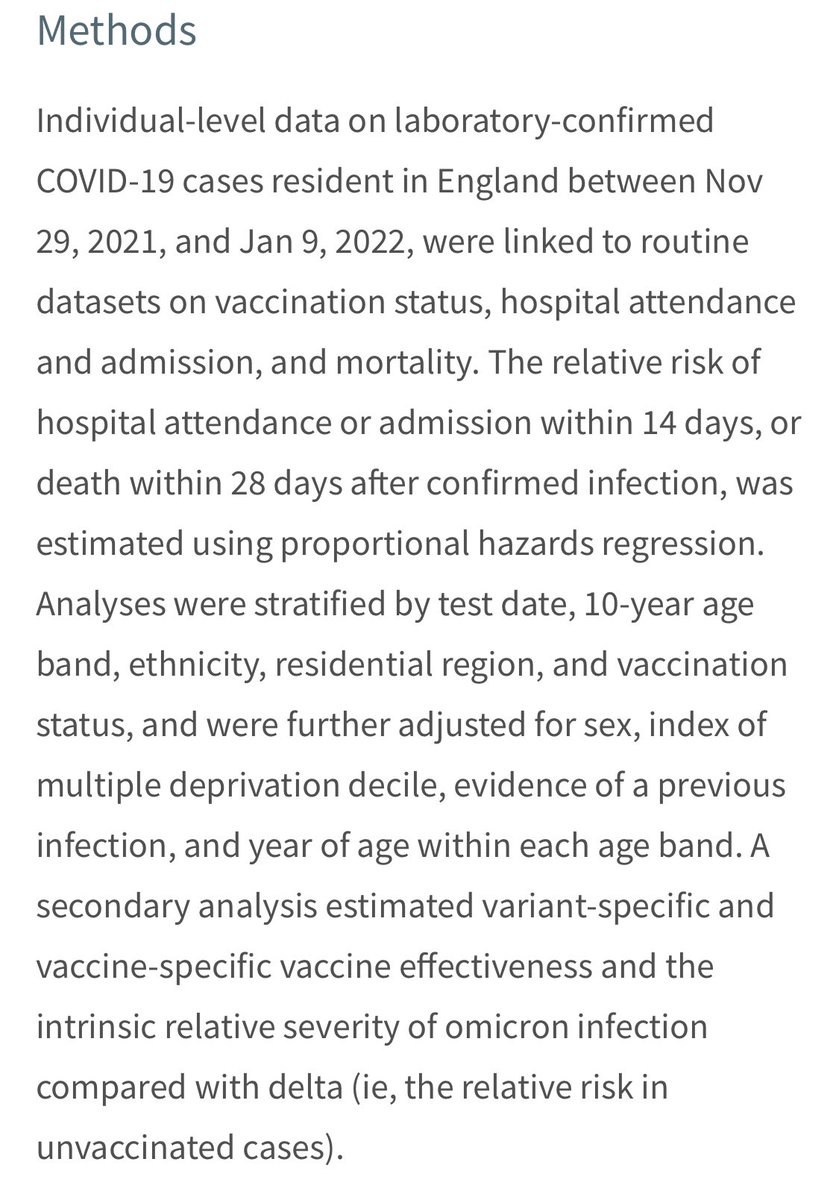
@Michigan_Noah@DrJBhattacharya This is a complex paper that I don’t fully understand, but they did adjust for prior infection👇
My take home points:
- O causes fewer severe outcomes in adults than D
- Vaccines protect against severe outcomes from either variant, but make a bigger difference for D than for O