This is a memorial site to the late Dr. David Neiman. Dr. Neiman was a professor of ancient history, biblical history and the Jewish perspective on Jesus.
Report: “The remains of the church where the First Council of Nicaea was held have been discovered in Iznik, in present-day Turkey”
From Nicaea to Iznik
Nicaea was an ancient city of Bithynia located in northwest Asia Minor. In the fourth century BC, it was rebuilt by Greek king Antigonus I Monophthalmus.
Nicaea is primarily known as the site of the First and Second Councils of Nicaea (the first and seventh Ecumenical councils in the early history of the Christian church), the Nicene Creed, and as the capital city of the Empire of Nicaea.
Ottoman Sultan Orhan invaded and captured Nicaea from the Eastern Roman (Byzantine) Empire in 1331. The name of the town was then Turkified as “Iznik”.
The Hagia Sophia Church, where the Second Council of Nicaea had been held, was converted into a mosque and became “the Orhan Ghazi mosque.”
This historically Greek city no longer has a native Christian population. One major reason for that is Turkey’s 1913-1923 Christian Genocide.
For more info about Nicaea/Iznik, please read: https://t.co/0rVRo5xxTe
Marie Wilcox realized she was the last person on Earth who could speak the Wukchumni language fluently, so at 82, she taught herself to use a computer and spent seven years typing a 6,000-word Wukchumni dictionary, the first written record of the language in history, to save it from extinction.
I'm remastering my father's lectures with the latest audio tools. Take a quick listen to the first five minutes of "Hammurabi of Babylon" and let me know what you think:
https://t.co/m1uNI7yp1r
This small limestone tablet, barely the size of your hand, may be the oldest piece of Hebrew writing ever discovered: 🪨✍️
Found at Tel Gezer in 1908, the Gezer Calendar dates to the 10th century BCE — the era of King Solomon. It lists the agricultural seasons of ancient Israel in seven simple lines: harvest, planting, flax, barley, wheat, pruning. It reads like a farmer's almanac. But it's so much more than that.
It's proof that ordinary Israelites were literate. That Hebrew was a living, written language 3,000 years ago.
That the people of the Bible weren't legends — they were farmers, scribes, and neighbors who kept track of their seasons just like we do.
The Gezer Calendar now sits in the Istanbul Archaeological Museum, a quiet artifact that rewrites everything we assume about ancient literacy in the ancient Near East.
Via: Hidden Tribe
¹מקדש מעט בלב אנדלוסיה: דרישת שלום בעברית מ-1315
לפעמים אתם מגיעים למקום רחוק, ופתאום ההיסטוריה מביטה אליכם בעיניים בעברית צרופה. זה בדיוק מה שקורה כשעומדים מול הלוח המדהים הזה, שנמצא בתוך בית הכנסת העתיק של קורדובה שבספרד.
מדובר באחד משלושת בתי הכנסת היחידים בכל ספרד ששרדו את
Written in 1281 by a Jewish scholar living in Spain, the Mashal ha-Kadmoni presents opinions on various subjects, as voiced by animals. Two centuries later, it became the first printed book in Hebrew to be illustrated. Printed in Italy in 1491.
I came across this crazy find in the Golan Heights that almost nobody ever talks about. There’s this quiet valley called Ein Keshatot, or Umm el-Kanatir, where springs still run clear.
Archaeologists dug there and uncovered the ruins of a large Jewish synagogue from the fifth century. What blew me away is how much of it is still intact.
They found the Torah ark, that special stone niche where they kept the scrolls, right in its original spot. Next to it is the raised bima platform where people stood to read the Torah. You can still see the steps leading up to it and the whole layout facing Jerusalem, just like it should. It’s one of the only synagogues from that whole Sea of Galilee and Golan area that kept its full setup like this.
The village around it was pretty organized. People grew flax and used the spring water to make textiles. They lived there for hundreds of years, praying, working, and building their community. Then in 749 CE a massive earthquake hit. The place got wrecked and everyone just left. Because it ended so suddenly, the synagogue stayed buried and pretty well preserved.
When they excavated it, they even saw signs of an upper gallery, maybe for women or extra seating, which is pretty rare for that time. The stonework is solid, clearly done by people who knew exactly what they were doing for their sacred space.
This place quietly shows that Jewish life in Israel didn’t just disappear after the Temple was destroyed. Communities kept going strong, with real villages, active worship, and deep roots here right through Byzantine times. It’s not some famous tourist spot, but man, it hits different when you realize these stones are even more proof of continuous Jewish history on the land.
If you’re into this stuff, look up Ein Keshatot. It’s one of those hidden gems that makes you think. The land itself keeps telling the story if you pay attention.
This corroborates a famous tale in the Talmud (Yoma 38a) of Nicanor donating the doors for the second Temple and bringing them by ship to Israel.
https://t.co/mKBinAwuuo
Daily archaeology #85
An amazing instance of archeology corroborating the Talmud!
The Nicanor ossuary was discovered in a Second Temple-era burial complex on Mount Scopus in Jerusalem.
The ossuary bears two inscriptions: one in Greek, reading 'The ossuary of Nicanor of Alexandria, who made the gates,' followed by another in Hebrew, written in formal Jewish script, stating 'Nicanor Alexa,' identifying him as 'Nicanor the Alexandrian.'
This corroborates a famous tale in the Talmud (Yoma 38a) of Nicanor donating the doors for the second Temple and bringing them by ship to Israel.
When a storm hit and the ship was sinking one of the doors was thrown into the sea. When they wanted to throw the second door Nicanor held onto it and said they would have to throw him in as well. The storm stopped.
When they arrived ashore the first door was waiting for them.
The gate at the Second Temple was named in his honor: Nicanor Gate.
Even though all the gates of the Temple were upgraded to gold, Nicanor's bronze gates stayed.
Have a blessed Passover 🇮🇱
Those of you who follow me know that I'm a bit of an art nerd.
I spent quite a bit of time putting together paintings that cover the Passover story as they appear in the Hebrew Bible.
Please enjoy and share this thread.
חג פסח כשר ושמח!
Chief Rabbi Lord Jonathan @rabbisacks once shared the following:
“I once heard a wonderful story from Eli Wiesel. There was a time when Sigmund Freud and Theodor Herzl lived in the same district of Vienna. “Fortunately,” he said, “they never met.
Can you imagine what would have happened had they met? Herzl would have said: ‘I have a dream of a Jewish state.’ Freud would have replied: ‘Tell me, Herr Herzl, how long have you been having this dream? Lie down on my couch, and I will psychoanalyze you.’
Herzl would have been cured of his dreams, and today there would be no Jewish state.” Thankfully, the Jewish people have never been cured of their dreams.”
We are a people of dreamers, who make dreams come true.
Photo: @historyinpic9
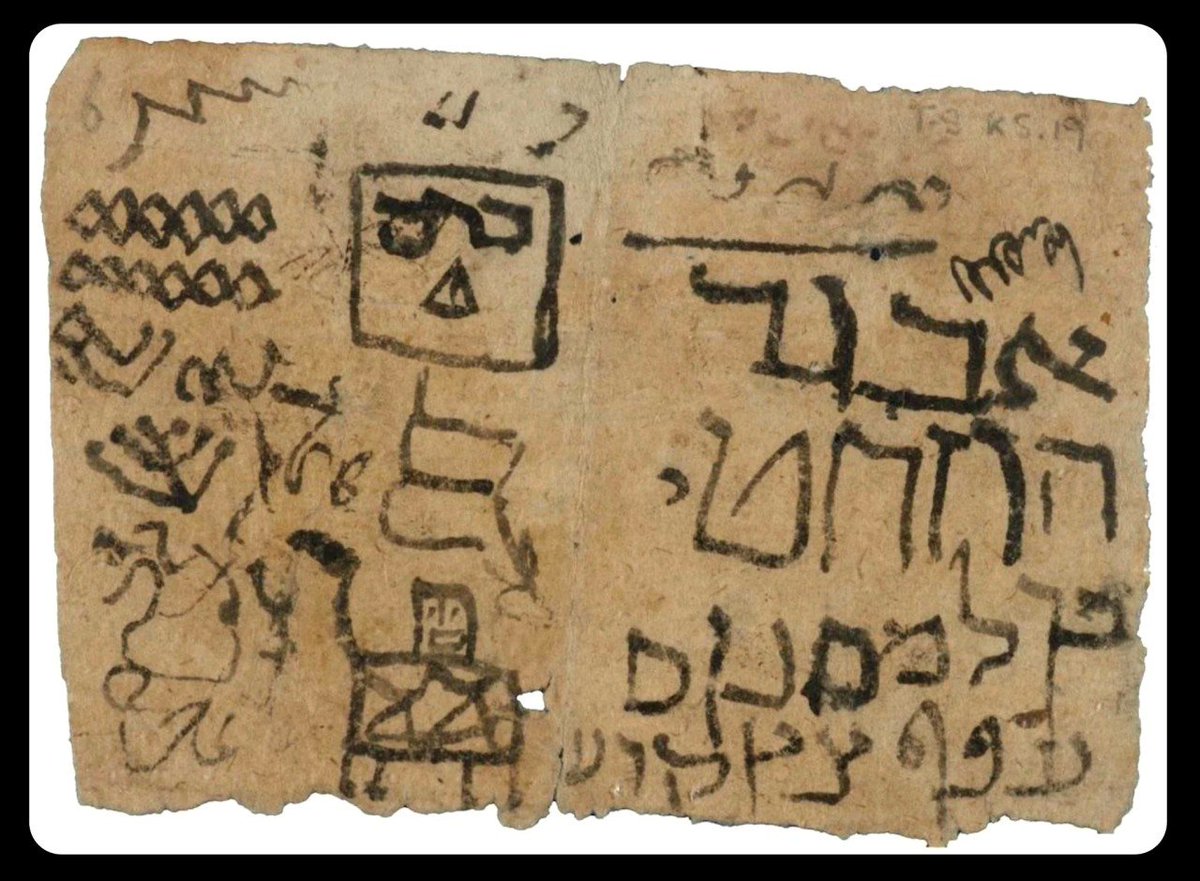
These are the doodles of a Jewish kid in Egypt from 1,000 years ago. The amazing thing about it is that it looks exactly like the doodles of a modern Israeli student. Modern Israelis can read medieval Hebrew texts without any difficulty.