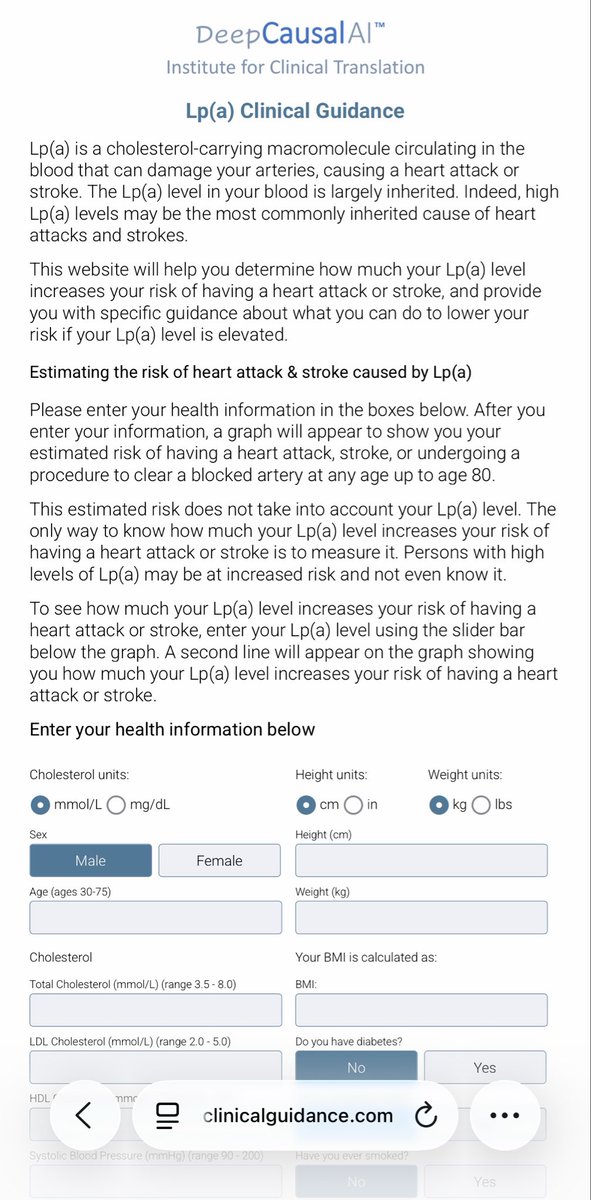
👉Based on the evidence we have today. This free, easy-to-use tool translates Lp(a) into estimated lifetime CV risk and shows how modifying other risk factors can mitigate that excess risk. It is not perfect, but it is clinically useful today while we await dedicated Lp(a)-lowering outcome trials.
☝️It was developed alongside the 2022 EAS Lp(a) Consensus and is based on large-scale epidemiologic/genetic evidence and absolute-risk modelling. This is exactly the point: measuring Lp(a) provides actionable information even before specific Lp(a)-lowering therapy is available
https://t.co/Xs0agorsHz
@society_eas@LpaForum@nationallipid
Powerful speech by Naturalist Chris Packham speaking alongside Zack Polanski on the subject of Climate Change,
"To the disappointment of many, football didn’t come home this summer, but to the pain and suffering of millions, climate breakdown has. And our government and media response has displayed a total dereliction of duty in a time of extreme crisis."
"As we’ve heard, in May and June there were 3,000 deaths attributed to the heat domes that have hung over the UK. Heat exhaustion, heat stroke, stress on the heart and kidneys, and of course those mental health issues that you’ve just talked about."
"In Europe, the figure is somewhere between 14,000 and 20,000 up until the end of July, and it’s expected to double by the end of this summer. So we’re looking at potentially 50,000 deaths across Europe."
"If these deaths had been the result of terrorism or a pandemic, the government would have cancelled its summer holiday, it would have held COBRA meetings, and there would be public information campaigns the likes of which we saw during COVID, designed to protect us in this time of crisis."
"And yet what do we get? We get rumours of possibly more drilling for oil and gas, and we get articles in the Telegraph which suggest that we ought to adapt to a Mediterranean climate. If that isn’t reckless and irresponsible, I don’t know what is."
"What we do need at this point is to listen to the science, not to the ongoing malevolent raft of mis- and disinformation that’s perpetuated in politics, in public life and certainly across social media."
"If we listen to the science, we see that the climate models that were devised in the 1990s have actually proved to be pretty accurate. But those who do try and transmit the information to us, people like the IPCC, which are often derided as alarmists by the right and the far right, have actually been too cautious."
"What we see, for instance, when it comes to the heatwaves, is that they are occurring more quickly and more regularly than those models suggest. We’re updating the science as it happens. What we also see is that it’s not just a lack of water which is leading to the drought, although that might seem painfully obvious. It’s actually being exacerbated by extremely high temperatures."
"And that has an impact on the environment, the environment that I care so much about and we are all dependent upon. Across the world, there have been 35,000 wildfires. In the UK, there have been 66 major wildfires. But let’s not focus on 66, because that sounds quite a small number. In one fire and rescue service, Berkshire, they’ve attended over 250 outdoor fires so far this summer. So the number of grass fires and so forth is going to be significantly higher than that."
"Drawing upon an underfunded, under-resourced organisation at the front line of dealing with a crisis that is impacting all of us. So lives have been lost, homes have been destroyed, businesses have been ruined. The clean-up cost – just look at Palisades in America – is incomprehensible. We simply can’t afford it."
"And then from my perspective, the damage to wildlife, which has got scant mention, of course, because as ever we put human interest first because they’re most immediate. And you might think, well, Chris is bound to bang on about the wildlife because he loves the birds and the bees. Yes, the birds and the bees, which form resilient ecosystems which allow us to produce the food that we eat. We have to protect nature in order to protect ourselves."
"So you might think, okay, the UK, the wildfires – they’ve all been out there on the heaths in Suffolk, they’ve been burning patches of heathland on the Isle of Wight. Not many homes have been destroyed. Well, the Ordnance Survey say that 1.8 million homes are at risk in the UK by looking at their maps and seeing which homes are adjacent to areas which have significant wildfire risk. 1.8 million homes at risk. So far, compared to Europe, we’ve just got away lightly and we’ve just been lucky."
"How many firefighting planes do you think that we’ve got in the UK? How many firefighting planes in the UK, exactly? Zero planes. Which is why, as Zack said, when that fire was burning at Dunwich, the National Trust had to hire a helicopter and pay for it to drag water out of the sea and dump it on that precious piece of habitat, because there are no firefighting planes."
"Is there a public warning system in place which will tell people when there’s a risk of wildfire so that they can be prepared to evacuate and have evacuation plans in place? Well, do you know what? There is. It’s available to the fire and rescue service, but it isn’t available to the public because it’s deemed to be unreliable. Is it unreliable, or is it just a bit too scary? We couldn’t even instigate a ban on disposable barbecues."
"Okay, there are the problems. What about the solutions? Because look, there’s no point in just pointing out the problems. What we must do at this point is offer people real and accessible opportunities to be part of a solution rather than an ongoing part of the problem."
"Well, the first thing already: we’ve got to enact far more rapidly that transition to renewable energy for energy security, to reduce the cost of energy and its volatility that we’ve seen constantly across the world this year, which is having a significant impact not just on the cost of oil, but on the cost of living and global economic stability. It would also generate jobs, as it has in those countries that have invested significantly in those industries, most notably China. Talk of drilling oil – Rosebank, Blackbird, Jackdaw – is simply madness. We’ve got to just stop oil."
"We also need a transition in the way that we eat. This is intricately important when it comes to protecting the environment, everything that lives there, and ourselves. We need a transition to a plant-based diet. It’s healthier for people. If any of you have had bacon or sausage for breakfast this morning, do you know that you’ve ingested a category A carcinogen? That’s it – as toxic as tobacco. You may not. You may have just enjoyed your sausage and bacon. Why do you not know that processed red meat is actually really bad for you?"
"Animal agriculture is responsible for 12% of greenhouse gas emissions in the UK. It is also the leading driver of biodiversity loss. That biodiversity, that richness of life, that resilience in those ecological communities which we use to produce our food – we’ve got to change the way that we eat and produce that food, and we’ve got to provide sufficient support for farmers through that transition. And at the moment, they’re not getting that. In fact, they’re getting less and less and their life is becoming increasingly difficult."
"We’ve got to address the mis- and disinformation, and we’ve got to do that with positive information campaigns. We’ve got to have people’s minds on the front foot so they know what’s true before they hear the lies. Then they will question the lies. Otherwise we know what happens. If you tell a lie frequently enough, it eventually becomes the truth, and that’s what we’re suffering from. We can’t afford net zero? We can’t not afford net zero. And we’re beginning to see that that’s the case."
"We’ve got to sort out the media. I’ve been fantasising this year that we could perhaps criminalise climate denial. We should certainly criminalise irresponsible journalism. I’ve highlighted the Telegraph, but I’m going to leave you with something that I read on the BBC yesterday: ‘How to survive a heatwave wedding.’ How to survive a heatwave wedding. Point number five: beware of buttercream. This popular wedding cake ingredient is likely to melt if not kept cool. Likely to melt? A bit like my patience and all of our hope."
"It’s time for bold, brave, informed leadership. And we are not getting it. We need Andy Burnham to step up before we and our only home burn down. Thank you."
Encouraging all NHS Trusts to participate in the PROFID-EHRA randomised clinical trial testing the effectiveness of primary prevention ICD after #heartattack in severe #heartfailure on optimised pharmacotherapies.
Contact me if you would like to join.
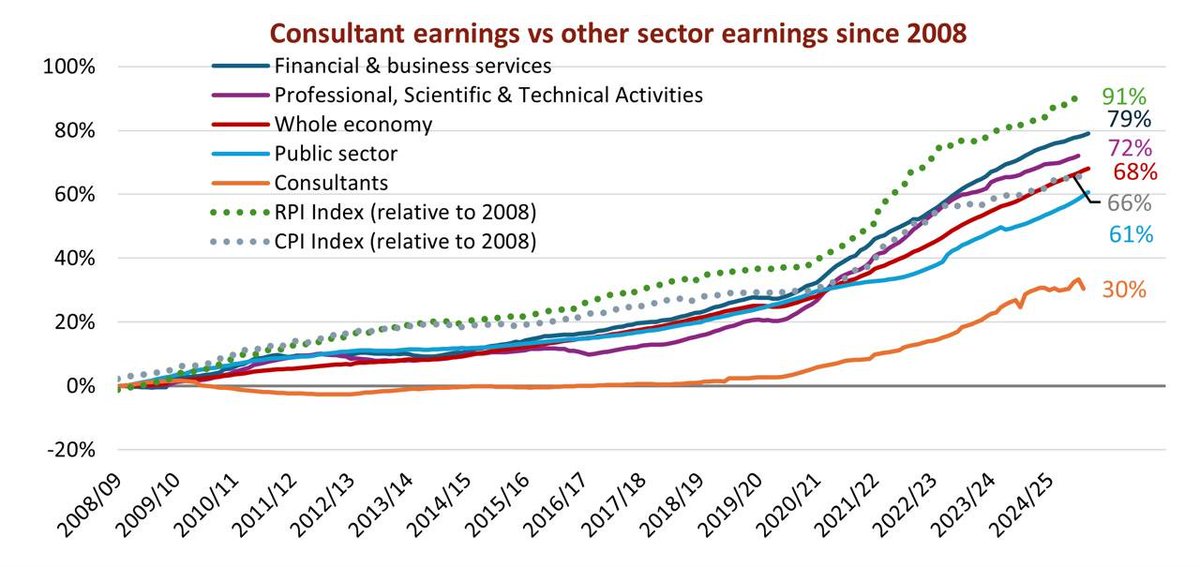
I've been trying with the BMA research team to produce one graph to rule them all. Real terms pay with inflation indexed on the same graph. Look at the CPI dotted line, our pay, the average public sector worker, worker & our comparators. It's not pretty! ONS & NHS digital
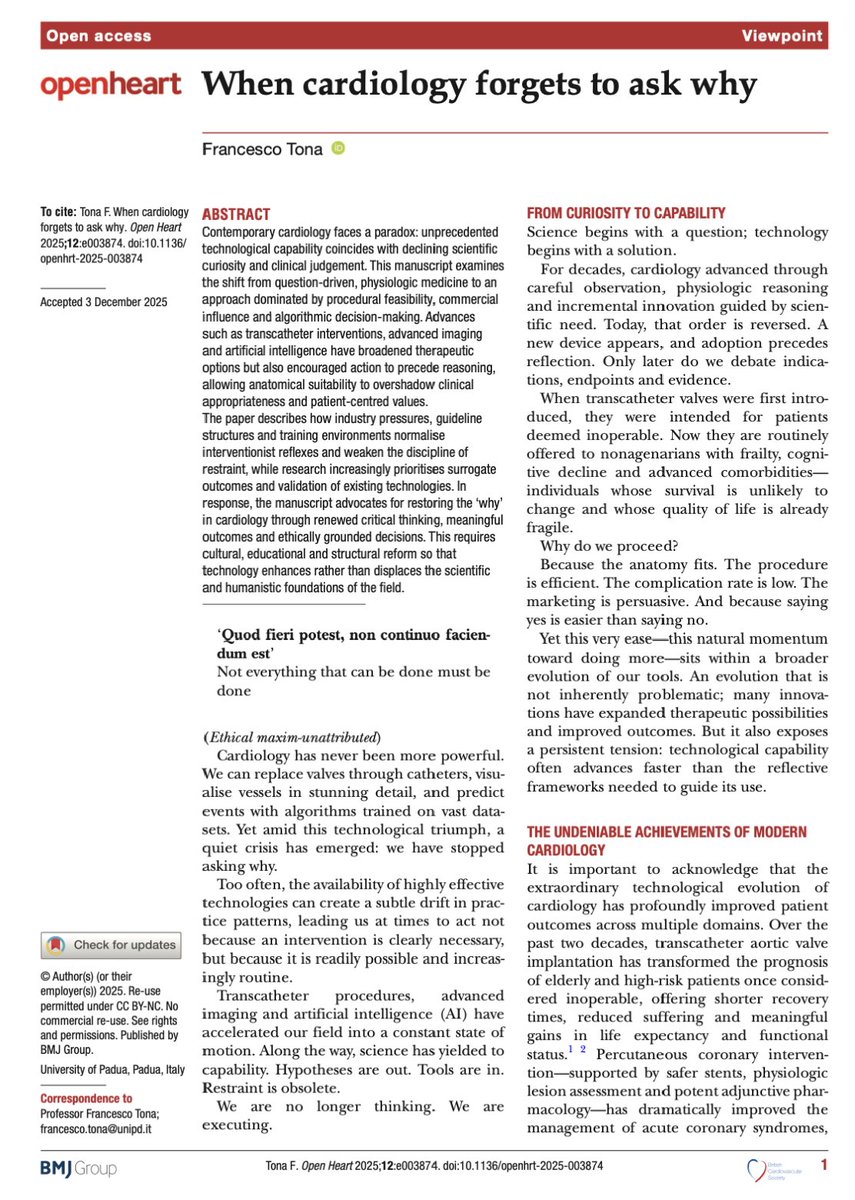
🧠🫀 When cardiology forgets to ask “why”: a timely wake-up call
This 2025 Open Heart viewpoint by Francesco Tona is not an attack on modern cardiology—but a deeply reasoned warning about what we risk losing amid unprecedented technological power .
���️ The paradox
Cardiology has never been more capable. We replace valves percutaneously, map anatomy in exquisite detail, and deploy AI to predict risk. Yet, the author argues, capability is increasingly replacing curiosity. Decisions are often driven by what can be done, not whether it should be done.
🧠 From “why” to “can”
Historically, cardiology advanced through physiologic questions and clinical reasoning. Today, the sequence is reversed:
- A device appears
- Anatomy fits
- The procedure proceeds
- Reflection, appropriateness, and patient-centred benefit too often come after execution—if at all.
🩺 When feasibility replaces judgement
Tona highlights a subtle but dangerous shift:
- Anatomical suitability eclipses clinical appropriateness
- Procedural success is mistaken for patient benefit
- Futility becomes “well-executed” rather than questioned
This is not failure of skill—but failure of restraint.
💼 The silent drivers
Industry influence, guideline structures, and training environments normalize interventionist reflexes. Research increasingly validates existing technologies using surrogate endpoints, while negative or null results fade into obscurity.
🤖 AI: help or shortcut?
AI can augment care—but risks outsourcing thinking. When clinicians validate algorithmic outputs instead of interrogating them, clinical reasoning atrophies. Precision without purpose is not progress.
🔮 The real message
This is not anti-innovation. It’s a call to reclaim the “why”:
Teach restraint as a clinical skill
Design guidelines around meaningful patient benefit
Prioritize outcomes that matter to patients, not systems
🧭 Bottom line
When cardiology stops asking why, it doesn’t become more efficient—it becomes less human.
Technology should serve judgement, not replace it.
Social media personalities have been challenging conventional wisdom on atherosclerosis, but their evidence doesn’t hold up to scrutiny. Full article linked below.
https://t.co/aM60JEws0o
Ok you all, here is my take of the CLOSURE AF trial. On @theheartorg https://t.co/WppsVncNfi
Teaser: this may herald cardiology's biggest medical reversal. Nonindustry funded, non-biased trial. LAAC clearly inferior to best medical therapy (usually DOAC, but 10% no AC.) #AHA25
@LaleTokgozoglu presenting at #AHA25
♥️ choosing medication should be based on magnitude LDL lowering required, in addition to statin tolerance, cost, pt preference, side effects etc
♥️ early & lower LDL is better: we have lots of tools to lower LDL & reduce risk
♥️can personalize tx for the patient in front of us
“Why is it always hard choices for working-class communities — not for multimillionaires and billionaires?”
Zack Polanski calls for a tax on the super-rich on #BBCQT
Gary Lineker on winning the National TV Award,
"It's not lost on me why I might have won this award"
"Aside from presenting Match of the Day, the most iconic football show for 26 years"
"Also, I think it demonstrates that perhaps it's ok sometimes to use our platform to speak up on behalf of those who have no voice"
@GaryLineker Legend 👏
It’s a question I’m asked by members and constituents every, single week and I simply, don’t have a credible answer:
@AndyMcDonaldMP “What more evidence does our front-bench need to call this what it is, ethnic-cleansing, genocide and apartite?”
I am so tired….
People like me speak out because children are dying
Not Israeli children
Not Palestinian children
Just children. Innocent. Terrified. Gone.
We’re not politicians. We don’t have power
We’re just doing our best to call out a genocide
This isn’t about “taking sides”
It’s about taking a stand for humanity and for the basic principle that no child should be bombed, burned alive or starved
So when we speak out and are met with accusations of antisemitism, and
when our grief is twisted, our intent questioned, and when we are called terrorist sympathisers because we can’t bear to see another lifeless little body
It’s not just offensive
It’s f*cking depressing
We’re not driven by hate
We’re driven by horror
And we’re using the only tools we have - our words, our platforms, and our refusal to look away
Because if we don’t speak now,
we become the silence that history will condemn.
@SeguraCardio@escardio I find the definition recently published by @society_eas consensus very interesting: BMI PLUS...One anthropometric measurement, among which, waist-to -heigt measurement would stand as the most reliable, because it's independent of sex and ethnicity.
https://t.co/uy6Nr6ly1O
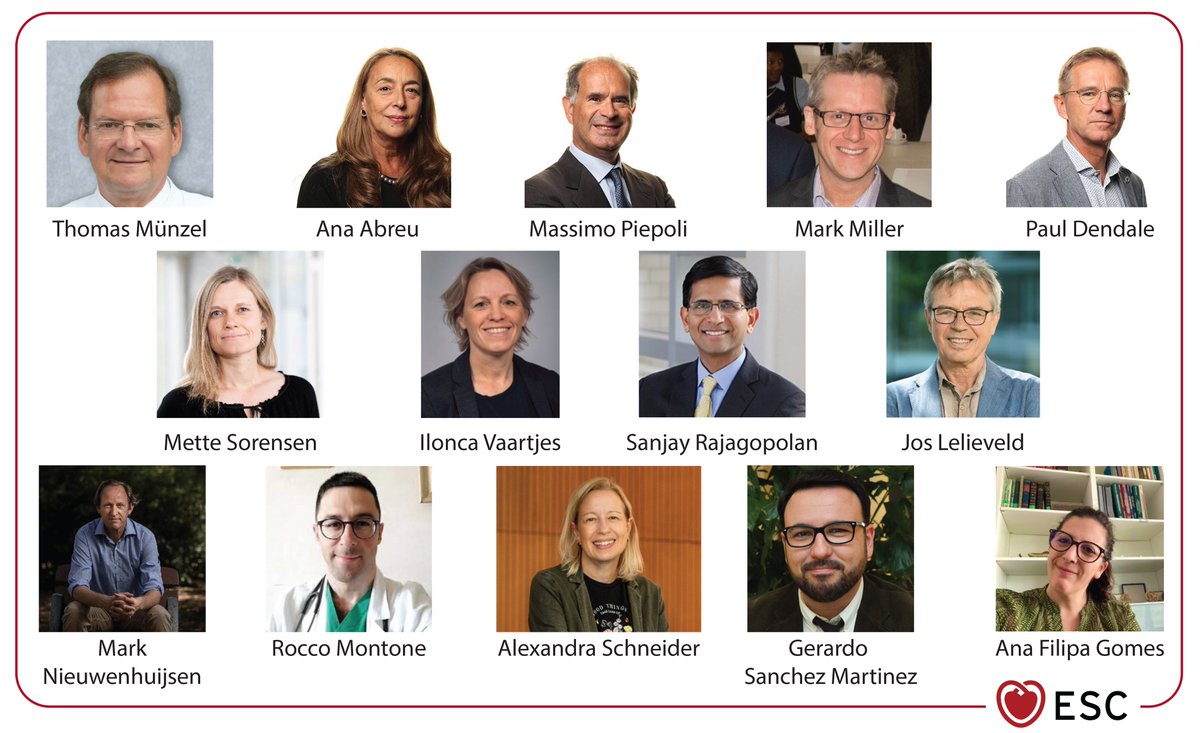
Championing environmental sustainability in cardiology: the ESC Task Force’s vision for a healthier future. A Task Force with a mission.
Read more in #EHJ
👉 https://t.co/BmK2WvzKP9
@RoccoMontone@ehj_ed