A few thoughts
The generics vs. branded drugs quality study has stirred up a hornet's nest and with it, multi-pronged criticisms...
...mostly from a section of doctors who have been prescribing expensive branded drugs all their lives...
...also from people who, have all their lives believed that generics (especially from Government) was poor quality (based on cherry picked studies, personal experiences, second- and third-hand stories)...
...and also those who are always critical of whatever Government does.
Because of this, the whole discussion has now moved into the "regulation of drugs" space, and completely misinterpreted what the Citizens project actually looked at.
We looked at the same medicine (single batch, 22 different types, based on 8 therapeutic categories) from different sources for non-inferior pharmaceutical quality, as prescribed by national standards. Batch-to-batch variation was not our objective (we can take this up in the future with larger funding).
The study does not claim to fix the regulatory system; it claims to test the product the patient holds in their hand. The data shows those products were not inferior to similar expensive brands. The study was on "quality assurance" which relies on established scientific standards and protocols. It was not on why we have different regulations and why we should improve regulations - this is a different argument.
We have shown independently, that commonly prescribed generics were good enough as the branded counterparts. The testing was done as per IP 2022 standards. There is no other methodology apart from what the standards warrant.
Clarifying a common argument here in brief:
For example in-vitro dissolution is the internationally accepted quality control standard (USP, BP, IP) precisely because it mimics the release of the drug in the physiological environment. Asking for in-vivo on top of this is "crass argument." On the question of in-vitro in-vivo correlation, for many drug classes, particularly those we tested, there is a robust, scientifically proven correlation between how a drug dissolves in the lab and how it is absorbed in the body. Dismissing this fundamental tool of pharmaceutical science ignores decades of evidence that links dissolution profiles to clinical performance.
Due to a hectic clinical schedule, teaching programs, research writing and meetings, I was unable to prepare the final summary document of the study and the full original reports of all 131 drugs evaluated. I just completed my outpatient for the day and will complete the documents tonight. It will be up on the https://t.co/ifs3PUzAw9 website latest by Thursday night.
The manuscript to be sent for peer review was completed a day before (I spend most of the weekend writing it) and is now circulated among my co-authors for suggestions, revisions and modifications. We will submit the paper (to an open access journal) for peer-review the coming week.
Once again, our study is an independent quality assessment for the end consumer, not a regulatory body granting market authorization. When a generic drug passes these stringent dissolution and assay tests, it objectively demonstrates that it is not 'inferior' in its physical and chemical properties. Denying this data hurts patients by perpetuating an unfounded fear of affordable medicines that have been proven to meet quality standards.
Yes, generics fail quality. Sometimes brands also do. But these must be considered rare events and not the routine. This is what the study showed.
The study was cross-sectional and it never claimed everyone need to opt for generics now. It just showed that for people who cannot afford expensive brands, there are choices for them to continue their deserving treatments. Cross-sectional studies have their limitations, but for now, this is the best evidence we have against all the negative testimonials and second-hand anecdotes.
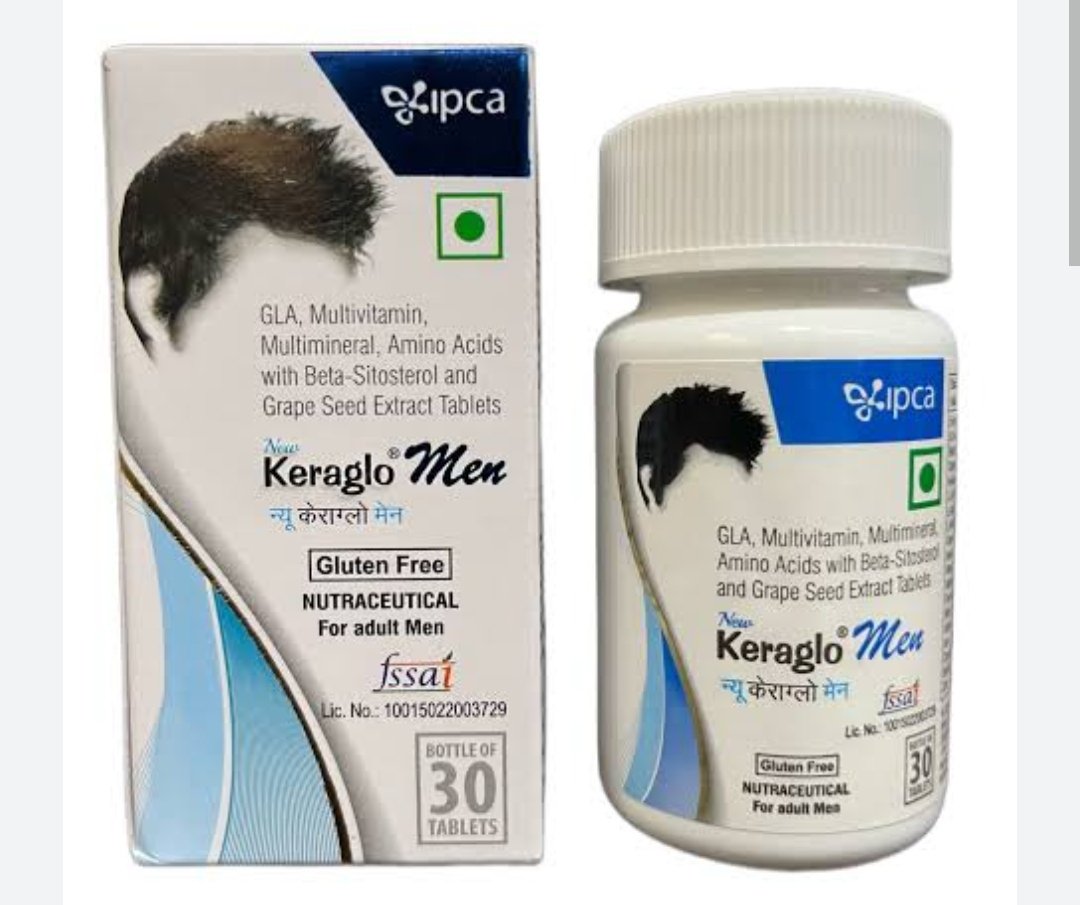
In April 2022, I posted about a young man who died of liver failure after consuming a hair growth supplement containing green tea extracts & borage oil. It created a storm in Dermatology circles in India. Green tea extracts in nutraceuticals are a great concern for drug-induced liver injury globally.
I just found out that the manufacturer has modified their flagship product by removing both these toxic components. I appreciate this. This is exactly what is required of pharmaceutical companies when logic and reason is used to drive pro-public-health decisions.
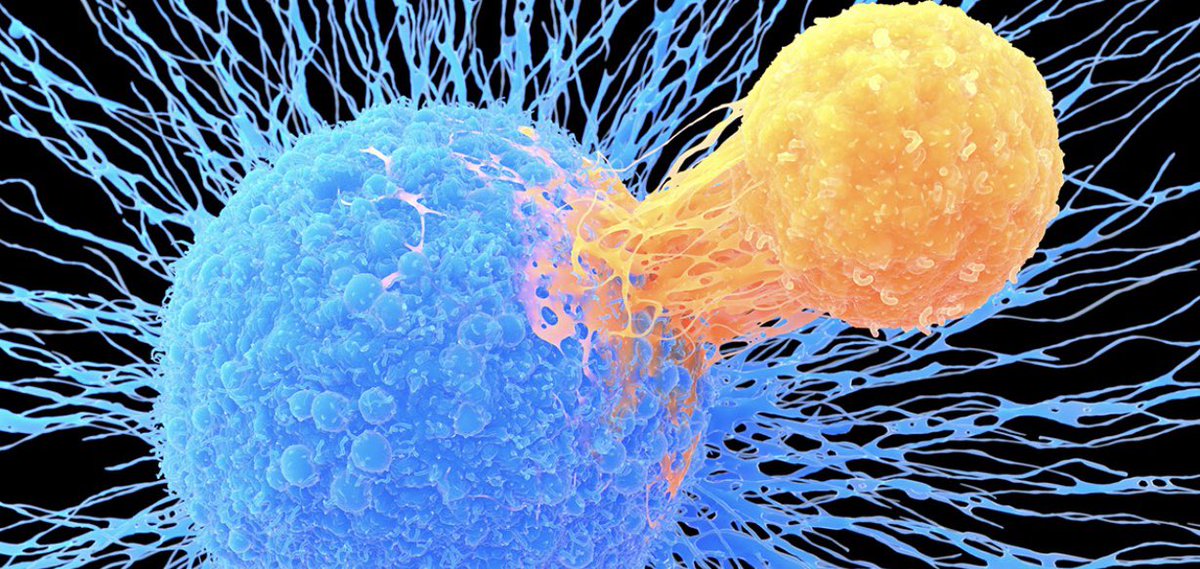
New study finds immune T cells engineered to kill zombie senescent cells 🧟♀️ can reverse key aspects of aging in mice 🐁 including metabolic & physical decline. Imagine a single treatment that protects from aging, for life…see thread https://t.co/suabdxqLDy
Sudden spike in news about ‘bad’ Indian medicine – from US, Gambia, Indonesia, Sri Lanka - and emergence of Indian origin American ‘hero’ #DineshThakur.
Story of biggest assault on #IndianPharma, aided and abetted by Indian media, particularly, The Wire.
A Thread:
If you live in Delhi, it's time to get out of the city. Surgeon says when he started in 1988, most of his patients were in their 60s or above. Today, he's seeing lung cancer in people in their 30s. "It's rare to see a pink lung. Almost everyone has a black lung."
1/30
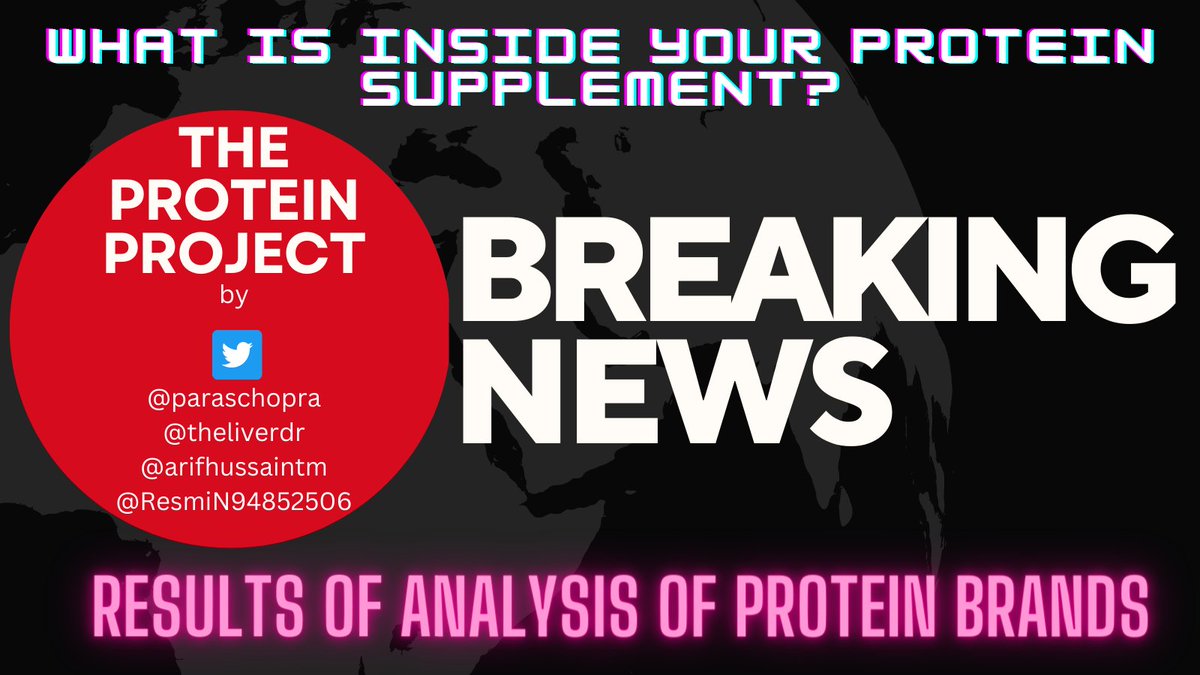
Our "Protein Project" report is here
What is it?
Unique public-health project funded by @paraschopra to analyze common/well-known protein supplements sold in India
Who did it?
Me & team at The Liver Institute with world class, independent food/drugs testing Neogen Labs.
@SGChu1234 You have to find that yourself. You can study the business & compare the valuations, operating profit margin, revenue growth, with similar players.
Here are some facts.
https://t.co/otV5akON9c
At CMP of 143, Piramal pharma trades at 24.3 EV/EBIDTA.
Other CDMOs with >35% OPM trades at lower valuations
Piramal management guided margin of 25-26% in the long run. Calculate the fair value on your own.
20 EV/EBIDTA~Mcap 13,215 ~110/share
18 EV/EBIDTA~Mcap 11,455 ~96/share
@Rahul814596881 You have to find that yourself. You can study the business & compare the valuations, operating profit margin, revenue growth, with similar players.
Here are some facts.
https://t.co/otV5akON9c
At CMP of 143, Piramal pharma trades at 24.3 EV/EBIDTA.
Other CDMOs with >35% OPM trades at lower valuations
Piramal management guided margin of 25-26% in the long run. Calculate the fair value on your own.
20 EV/EBIDTA~Mcap 13,215 ~110/share
18 EV/EBIDTA~Mcap 11,455 ~96/share
PPL is going through lot of challenges right now. Keep your expectations low & make your investment decisions based on entry valuations,ability to suffer& wait.
1.Inflationary raw material & energy prices.This will continue as per managmnt
2.Slower decision making by customers
I reckon these facilities are facing
1.Attrition of critical talents & finding the replacements & training them may take some time & effort.
2.Higher operational costs due to highly inflationary situation in UK & USA.
3.Power crisis. Pharma manufacturing is power intensive.
Piramal pharma.
I shared neg info the other day. So here are some positive info as well. I owe you this.
PPL is one of the few players having capabilities to manufacture all 4 gen of inh anaesthesia products.
Vertically integrated to make specialty fluorochemical KSM as well.
Modern fluorinated anesthetics are longer-lasting still and almost insoluble in blood, which accelerates the awakening.
Examples- sevoflurane, desflurane, enflurane, and isoflurane
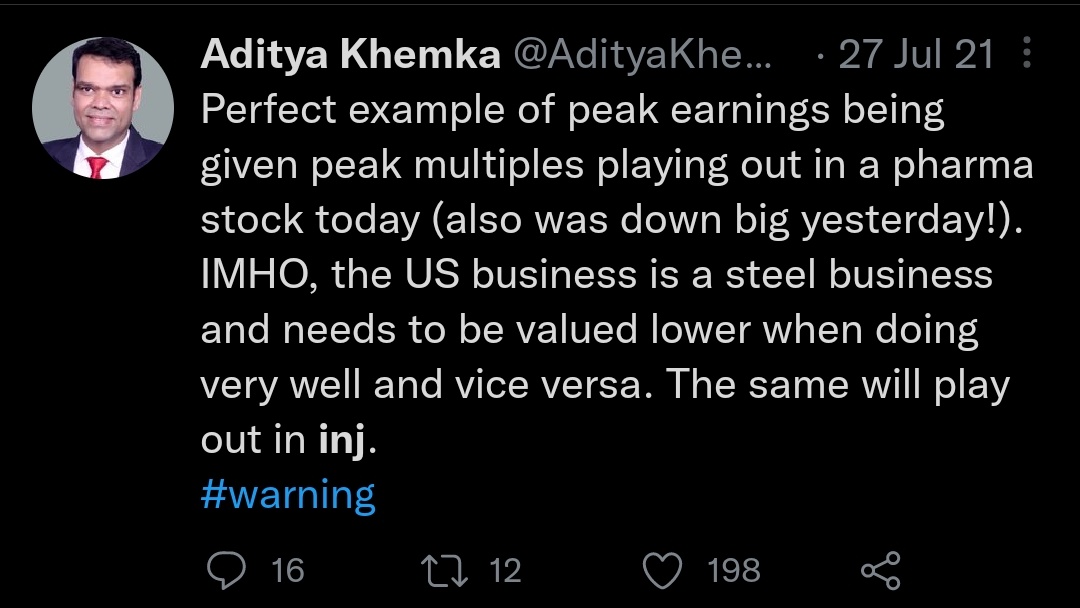
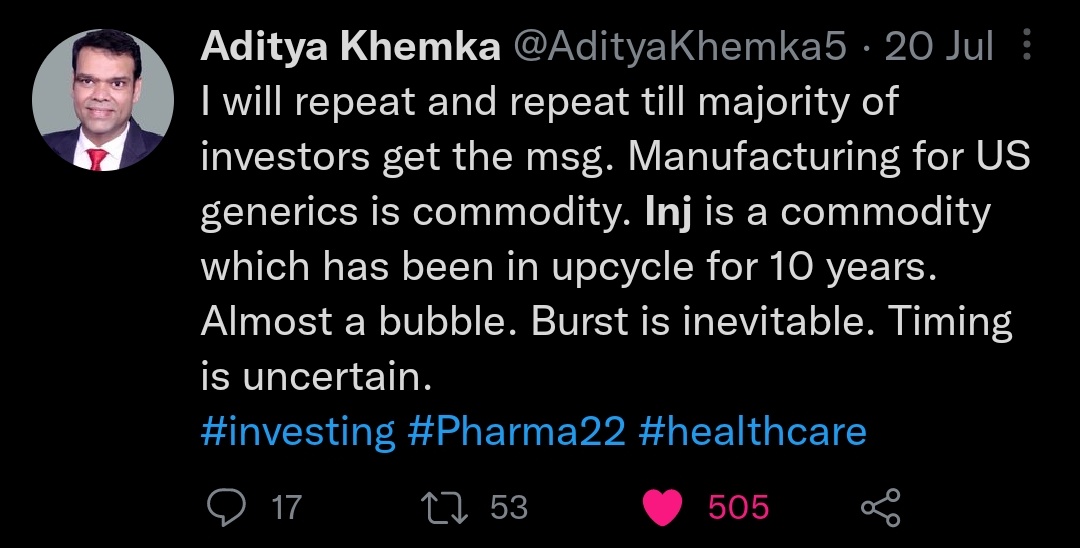
@anil_tummidi@unseenvalue@ishmohit1@DrdhimanBhatta1 Past margins can't be extrapolated into future. Injectable US generics may also face competition as supply increases. This may also become commodity like business.
May be, @AdityaKhemka5 sir can guide more.
(Not talking about inhalational anaesthesia & intrathecal therapy)
@J_S_Krishna It's completely your decision & my posts are not investment advices either.
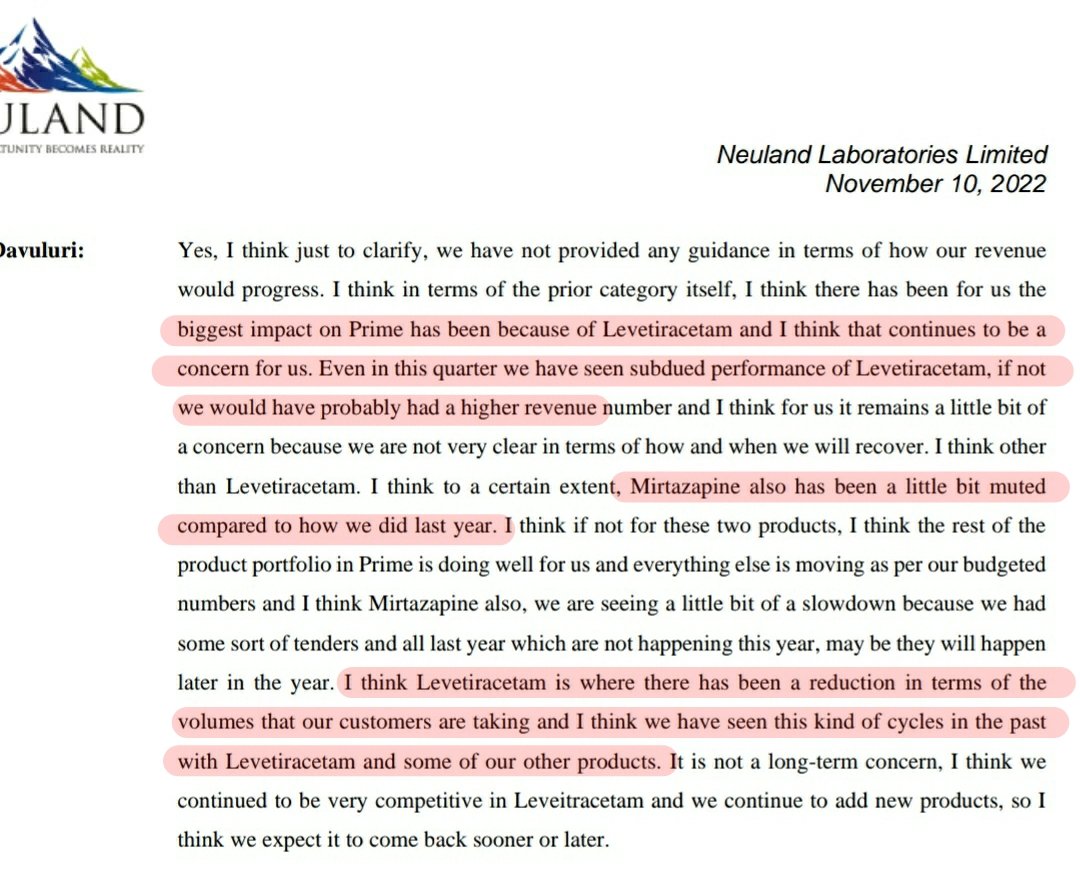
I had shared my antithesis on Neuland much earlier also.Levetiracetam & Mirtazapine sales are muted even this quarter also.Every biz becomes opportunity at some price,for that u need to understand biz 🙏
3 trends playing out in cdmo business now.
1. Increased enquiries from companies looking for China+1 strategy. These are players currently sourcing something from China & looking for an alternative extra source.
They had increased enquiries like that in recent CPHI conference.
In the west, innovators were facing supply chain disruptions ovr last 2yrs.
Innovators who want low vol for less chronic or rare dis or pre approval vol would be looking for cdmo players in the west, for the sake of supply chain stability.
So reshoring preference is happening.
2. At the end market, their cdmo customers are at some pricing pressure because of fiscal deficits & the money being
spent in other areas & inflation reduction act & some of the other equivalents in other
countries.
They expect in due course there to be pressure on value.