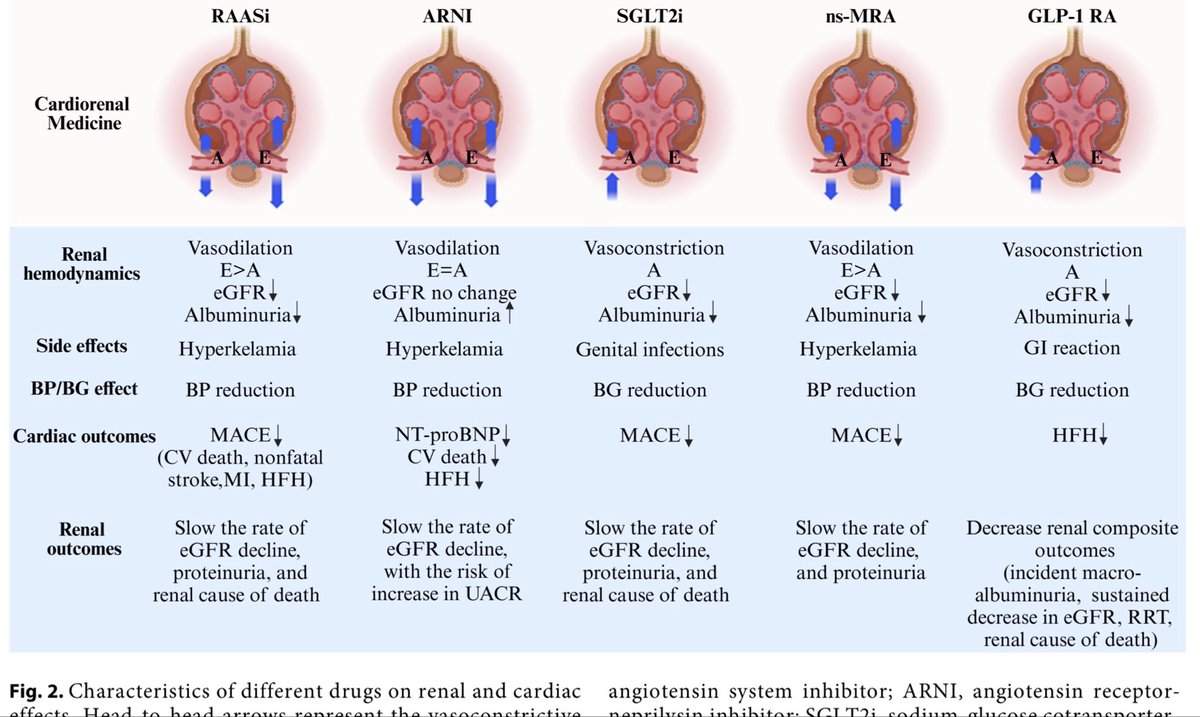
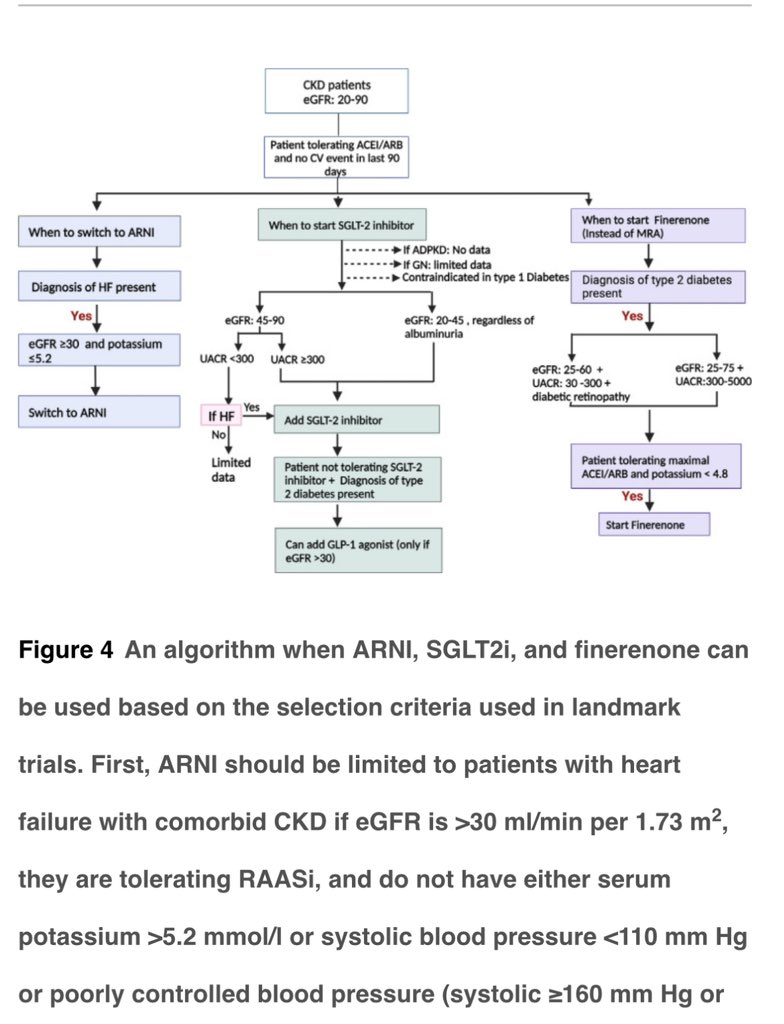
Which drug does what to the nephron & heart?
This single graphic shows the differences:
🟥 RAASi — eGFR dip, MACE↓
🟧 ARNI — NT-proBNP↓
🟩 SGLT2i — proteinuria↓
🟦 ns-MRA — fibrosis↓
🟪 GLP-1 RA — HFH↓
🔗 https://t.co/ruDprocbLm 🆕
#CardioRenal#HFpEF#HFrEF#CKD
☝️Oral PCSK9 Inhibitors: A New Era in Lipid-Lowering Therapy?
👉Key takeaways:
1️⃣ Enlicitide (MK-0616) reduced LDL-C by ~56% in Phase III trials, with additional reductions in apoB, non-HDL-C, and Lp(a), showing efficacy comparable to injectable PCSK9 monoclonal antibodies.
2️⃣ Laroprovstat (AZD0780) achieved up to 50% LDL-C reduction and is currently advancing through Phase III development (AZURE Outcomes program), representing another highly promising oral PCSK9 inhibitor.
3️⃣ Other emerging oral agents—including DC371739, CVI-LM001, CiVi008, and the previously studied NNC0385-0434—highlight the growing diversity of strategies targeting the PCSK9 pathway and related lipid-regulating mechanisms.
👉The future may lie in simplified oral combination therapy: a statin + ezetimibe + oral PCSK9 inhibitor could potentially achieve 70–80% LDL-C reduction, bringing injectable-level efficacy into a convenient all-oral regimen.
👉 Ongoing cardiovascular outcome trials will determine whether these impressive lipid improvements translate into reductions in major cardiovascular events.
☝️Bottom line:
The next generation of lipid-lowering therapy may not be another injection—but a powerful triple oral combination capable of transforming cardiovascular prevention.
🔓🔗 https://t.co/gJyhZcIiph
@society_eas@nationallipid@ESC_Journals@escardio
BREAKING
🧬 Scientists just edited a gene in living humans — and LDL "bad" cholesterol dropped by 62%.
One injection.
One time. No daily pills.
Effects lasting 18 months.
This isn't science fiction.
It's a Phase 1b trial published in the NEJM this week.
Here's what just happened 🧵
New @TheTGFLab pre-print in BioRxiv! 🧬
In this paper led by Josh Graham we establish that not all #CRISPR delivery systems are created equal and that editing efficiency alone is insufficient for delivery system selection.
Check it out! ⬇️⬇️
https://t.co/HctkLohTYp
Here’s a tightened version optimized for scientific X/Twitter audiences with DOI integration and cleaner translational framing.
🧬 A major inflection point for cardiovascular CRISPR therapy.
The Phase 1 NEJM data for CTX310 suggests we are entering the era of in vivo “one-and-done” cardiometabolic gene editing.
CTX310, developed by CRISPR Therapeutics, uses lipid nanoparticle (LNP)-delivered CRISPR-Cas9 editing to permanently disrupt ANGPTL3 in hepatocytes.
Why ANGPTL3?
Human loss-of-function genetics have long shown that reduced ANGPTL3 activity is associated with:
📉 lower LDL-C
📉 lower triglycerides
📉 reduced ASCVD risk
Now we are seeing that biology translated directly into the clinic.
Reported Phase 1 outcomes:
✅ ~50% LDL-C reduction
✅ ~55% triglyceride reduction
✅ Durable ANGPTL3 suppression after a single infusion
This is bigger than another lipid-lowering drug.
For decades, cardiovascular prevention depended on chronic adherence:
- statins
- ezetimibe
- PCSK9 antibodies
- siRNA therapeutics
CTX310 represents a fundamentally different paradigm:
permanent genomic rewriting of hepatic lipid metabolism.
What makes this moment especially important is the broader convergence now happening across the field:
🧬 Verve → PCSK9 base editing
🧬 Intellia → KLKB1 editing
🧬 CRISPR Therapeutics → ANGPTL3 knockout
Together, these programs suggest CRISPR is transitioning from rare monogenic disease toward population-scale chronic disease intervention.
Of course, major questions remain:
⚠️ long-term off-target safety
⚠️ durability over decades
⚠️ immune responses
⚠️ retreatment feasibility
⚠️ ethical deployment in preventive medicine
But one thing is becoming increasingly clear:
The future of cardiometabolic medicine may not simply involve taking better drugs.
It may involve rewriting the risk architecture itself.
DOI:
10.1056/NEJMc2518635
Refs:
Kunimasa K. Phase 1 Trial of CRISPR-Cas9 Gene Editing Targeting ANGPTL3. N Engl J Med. 2025.
Bader J et al. Extracellular vesicles versus lipid nanoparticles for nucleic acid delivery. Adv Drug Deliv Rev. 2024.
DOI: 10.1016/j.addr.2024.115461
"Geçmiş asla geçmemiş ve geçmeyecek olandır. Ben bunu anladığımda her şey çoktan geçmişti."
#Terapist afişi yayında! Terapist, Ocak'ta Gain'de! #GAİNdeNelerNelerVar 🎈
Erection Pump
Erection pumps, also known as vacuum pumps, are devices used to treat erectile dysfunction (ED) in men. These pumps work by creating a vacuum around the penis, which causes blood to flow into the tissue, resulting in an erection.
The RETRY protocol for radial artery occlusion recanalization, based on ultrasound-guided distal radial access and DCB angioplasty, is feasible, safe, and associated with excellent technical success and favorable short-term patency. https://t.co/EzP2NstK7F
1/8 🧵 Are beta-blockers still universally necessary after a heart attack if your heart function (LVEF ≥ 40%) is preserved?
A 2026 systematic review and meta-analysis of 4 major contemporary trials—encompassing 22,730 patients—re-evaluates this decades-old standard.
Let's dive in! 👇
Estimated Lifetime Cardiovascular, Kidney, and Mortality Benefits of Combination Treatment With SGLT2 Inhibitors, GLP-1 Receptor Agonists, and Nonsteroidal MRA Compared With Conventional Care in Patients With Type 2 Diabetes and Albuminuria
https://t.co/ZUf9AOF2qR