AST SpaceMobile Announces Definitive Commercial Agreement with Verizon to Support Space-Based Cellular Broadband Across the Continental United States
https://t.co/KQcCr4YYSF
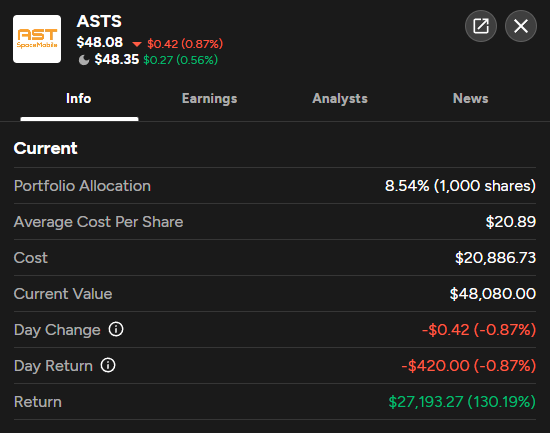
WHY I KEEP THINKING I DON’T OWN ENOUGH $ASTS
So what does AST SpaceMobile actually do?
When you hear “space-based internet,” the default comparison is Starlink. But while both beam data from orbit, they’re building entirely different businesses at different layers of the telecom stack.
AST SpaceMobile is building the first space-based cellular broadband network designed to connect directly to unmodified smartphones. Every major telecom has spent decades pouring billions into towers, fiber, and spectrum, and yet half the world still lives with patchy or nonexistent service. ASTS cuts around that model altogether, launching satellites with massive phased-array antennas that act like orbiting cell towers, delivering broadband straight to the device in your pocket. No dishes. No satellite phones. No new hardware at all.
For carriers, this means coverage expansion without more capex. And after this quarter, it’s clear the company is moving from narrative to execution: manufacturing cadence is real, satellite capacity has leapt forward, and spectrum rights -- including global S-band -- are shaping into one of the most defensible moats in telecom. With $1.5B in liquidity, the buildout of 45–60 satellites by 2026 now looks funded.
That’s what makes ASTS more of a telecom company disguised as a space startup. It’s not about selling satellites. It’s about embedding itself directly into the revenue streams of $T, $VZ, Vodafone, Rakuten, and over 50 other MNO partners -- a base that already represents ~3 billion subscribers. Every deal compounds the network effect, turning dead zones into revenue overnight. Once ASTS is integrated, churn disappears. Because it’s not an add-on. It is the network.
Now contrast that with Starlink. Its model is hardware-first, customer-direct, and capital-heavy: every new user requires a dish, a router, a supply chain solution. Starlink climbs the mountain of customer acquisition one install at a time. ASTS flips the economics entirely. It defines the edge as the smartphone itself -- a device already in the hands of five billion people. One carrier contract inherits tens of millions of users. It’s not retail. It’s scale. It’s routing, not sales. And in telecom, that distinction is everything.
We’ve seen this dynamic before. $BB built the device. $T owned the pipe. But it was $AAPL that rewrote the economics, not by out-engineering the networks, but by embedding itself into them. That’s what ASTS is doing. It doesn’t need to out-SpaceX Starlink. It just needs to become the universal, carrier-native orbital layer.
ASTS is now entering stage two: commercial scale. The physics are proven. The path is about locking in distribution, deploying satellites, and monetizing spectrum across billions of subscribers. Vertical integration, spectrum control, commercial adoption, and now government demand are reinforcing each other.
And that’s why the market is re-rating $ASTS so aggressively this year. It’s no longer being valued as a speculative satellite launch story. It’s being recognized for what it is -- a telecom infra layer with inevitability building quarter by quarter. The shift from “if” to “when” is already underway, and the stock is finally starting to price that in.
Hey @olgakharif, for the $GME article you assisted @Robserved with, can you please explain how George Sherman "sold almost $12M in shares, benefiting from a run-up ... fueled by day traders" when he didn't sell a single share at all? 🙄
https://t.co/PPd4jQW4X5 via @markets
$GME to be debt free as of 4/30: https://t.co/6n7Dbveeqe
Why is it so important to pay off the 10% notes due March 15th, 2023?
Page 16 of the 10-K (it significantly increases flexibility):