@Humble_Analysis more than 1 in 5 were hospitalized. measles is almost always symptomatic except in rare cases of 'vaccine breakthrough', where symptoms can be mild or absent. reporting is mandatory for physicians and laboratories, so we do not think that a substantial number of cases is missed!
In 2024, Austria experienced its largest measles outbreak in at least 24 years (542 cases - all over Austria, different age groups, several independent outbreaks!). So we wondered: is there an immunity gap in our population? #Measles#immunizationweek
https://t.co/yXCBsurD0S
@BettyB2007 Good point! Rubella (and mumps!) might even wane faster than measles. I think the question is still open if we can expect life long immunity even in elimination settings without sporadic contacts with the virus.
So, what have we learned? We need to close immunity gaps in young and middle-aged adults — and protect future generations. Even as an adult, now’s a great time to check if you’ve had 2 MMR doses. The goal: eliminate and eventually eradicate measles! #ImmunizationWeek#Measles
Is this due to the pandemic? Yes and no. In Austria, we don’t see major differences in immunity rates between children born before or during the pandemic — though it might still be too early to say for sure.
However, nearly 40 million children missed their measles immunization during the pandemic, causing large measles outbreaks worldwide. As always, nobody is safe until everyone is safe!
https://t.co/672EhbHXds
What about infants? They're partly protected by maternal antibodies after their birth—but for how long? This matters, since early vaccination can be less effective. We found that almost none of the infants older than 6 months were protected against measles!
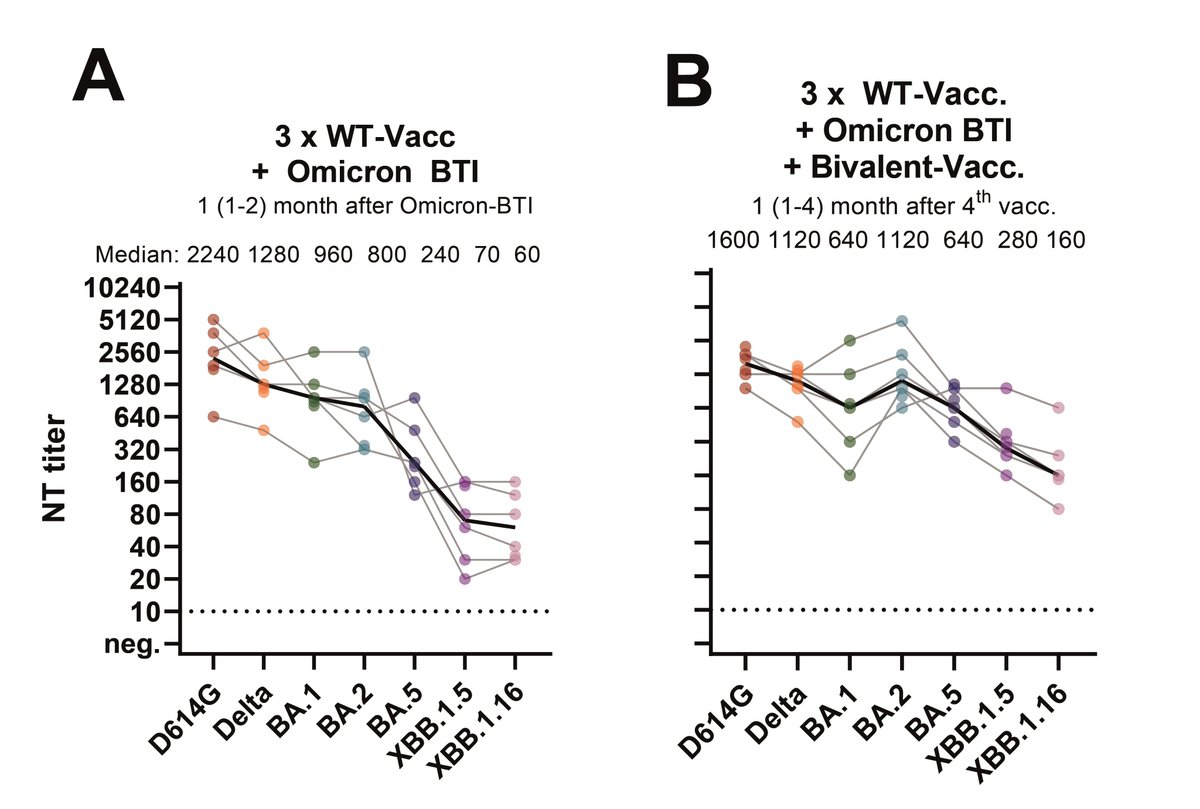
Do omicron-adapted vaccines broaden the antibody response even in individuals who have already recovered from an Omicron vaccine breakthrough infection (i.e. bivalent vaccination on top of "hybrid immunity")? Yes, to some extent! (1)
https://t.co/gRVhaSyf1q
Importantly, titers against XBB variants were higher after the bivalent vaccination compared to after the infection with an earlier Omicron variant (BA.1 - BA.5), even though the vaccine was based on BA.5 (and not XBB). This means that immunity was broader after the booster! (3)
We evaluated the benefit of a booster vaccination (BNT162b2bivalent) in a study with paired serum samples from people (30-60 yrs) who already had an omicron infection
@DSprngr@IrisMedits#KarinStiasny and #LukasWeseslindtner@LancetMicrobe
https://t.co/KrEsTU1cdb
A very insightful perspective on variants and booster vaccination @ScienceMagazine by @florian_krammer and Ali Ellebedy
https://t.co/risI7Zwclz
"Broadly protective vaccines, potentially given mucosally (e.g. intranasally) are urgently needed for #SARSCoV2."
✨ 🏆 Congratulations to Marianne Graninger who was just named the Abbot award winner at #ESCV2023 for her work on genetic variants that affect NK response in Herpes simplex encephalitis! #ESCV2023@m_graninger 💐 👏 @MedUni_Wien
@RolandSB13@AberleJudith @stefanct @Nature_NPJ@IrisMedits@AberleStephan The antigenic map is a 2d- visualization of multidimensional (here: wildtype, delta, ba1-5, xbb) nt data. it's a nice way to express similarities in nt data ('antigenic distances') as geometric distances between the variants and sera.
@RolandSB13@AberleJudith @stefanct @Nature_NPJ@IrisMedits@AberleStephan Basically, if titers against different variants are similar (e.g. D614G and Delta) then the antigenic distance is low and they are placed closer together. it's only about relative distances, so the rotation or center does not matter.