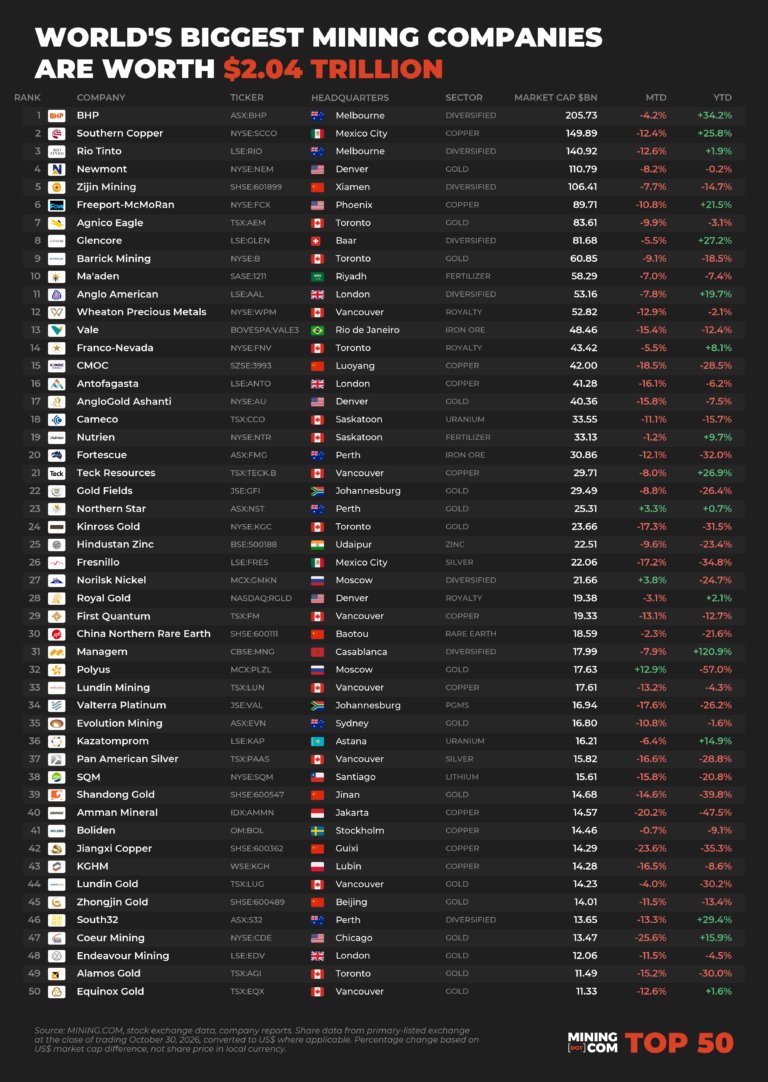
$712 billion has been wiped off the world’s 50 largest mining companies since their end-of-February peak.
The fifty are down 26% and trade near one-year lows. October alone took $226 billion off the group.
In October, hotter US inflation data hardened bets on another Fed rate hike, oil prices climbed and a rout in tech stocks forced funds to sell metals.
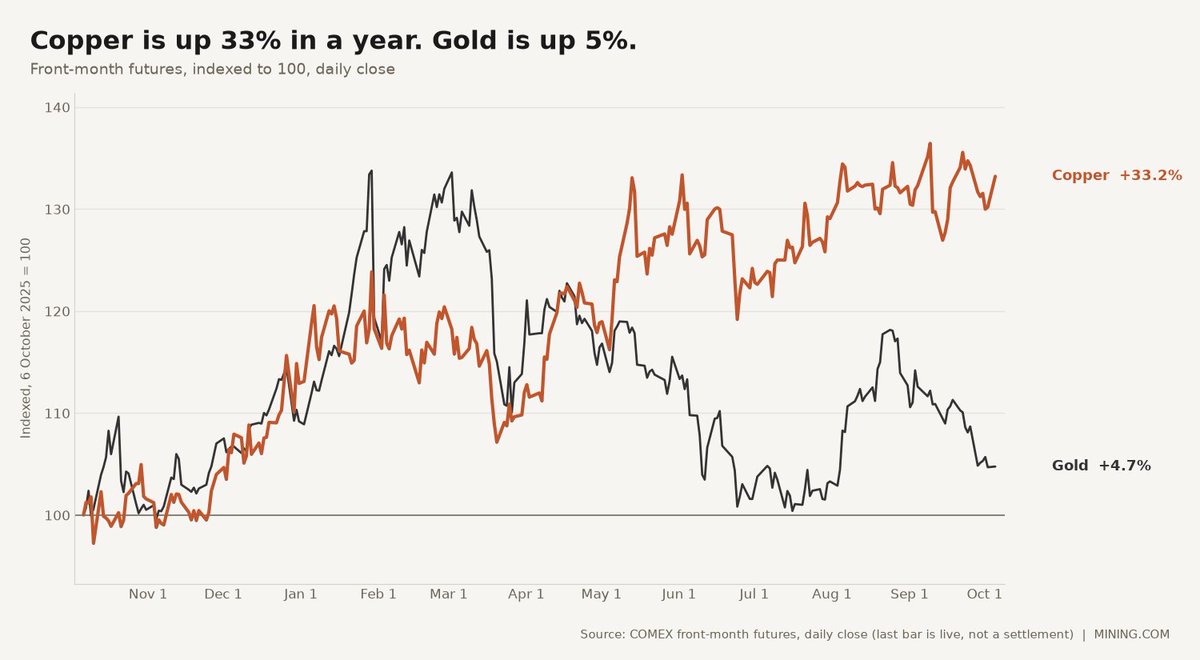
Gold miners gave up $55 billion as gold closed the month at $3,884 an ounce, its worst October since 2008. In October, lithium carbonate fell 24%, palladium 19% and silver 18.2%.
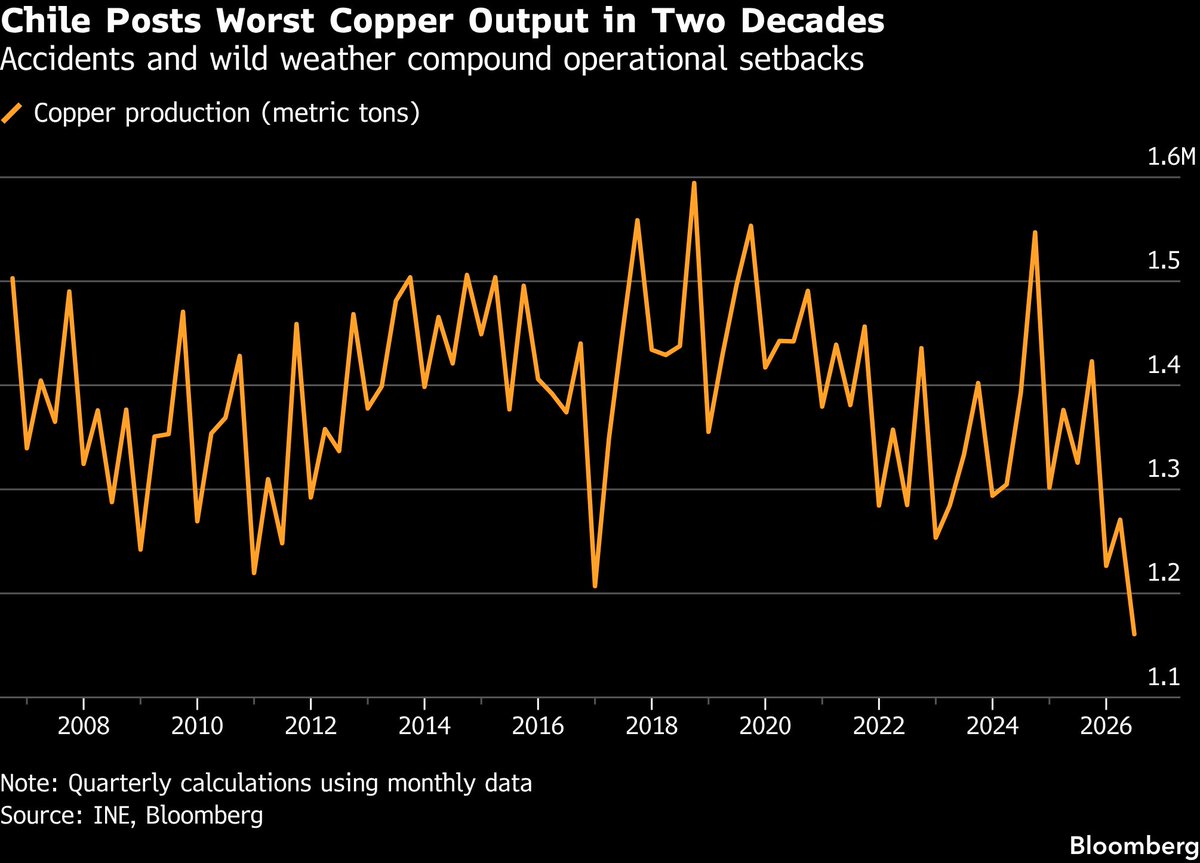
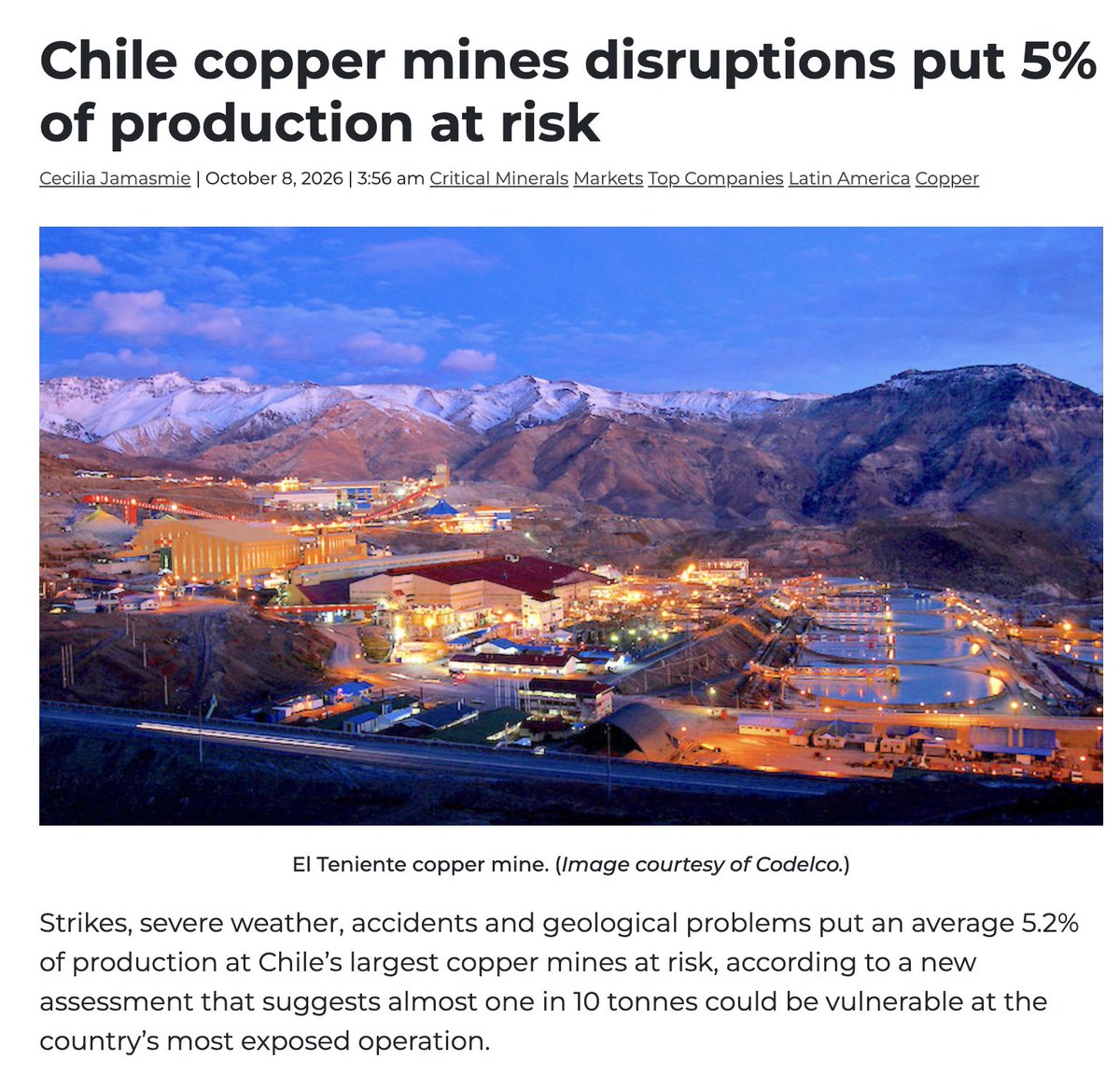
Chile’s copper output is now forecast to fall 8.4% this year, against a 2.6% decline projected in August.
Chile’s copper commission Cochilco now expects 4.94 million metric tons this year, down from 5.27 million in August, and 5.08 million next year, down from 5.55 million.
It also raised its 2027 copper price forecast by 17% to $5.95 a pound from $5.10.
BMO Capital Markets says the downgrade could leave Chile with its weakest annual copper production in more than two decades.
Source: Cochilco, Bloomberg
The global copper market is extremely tight:
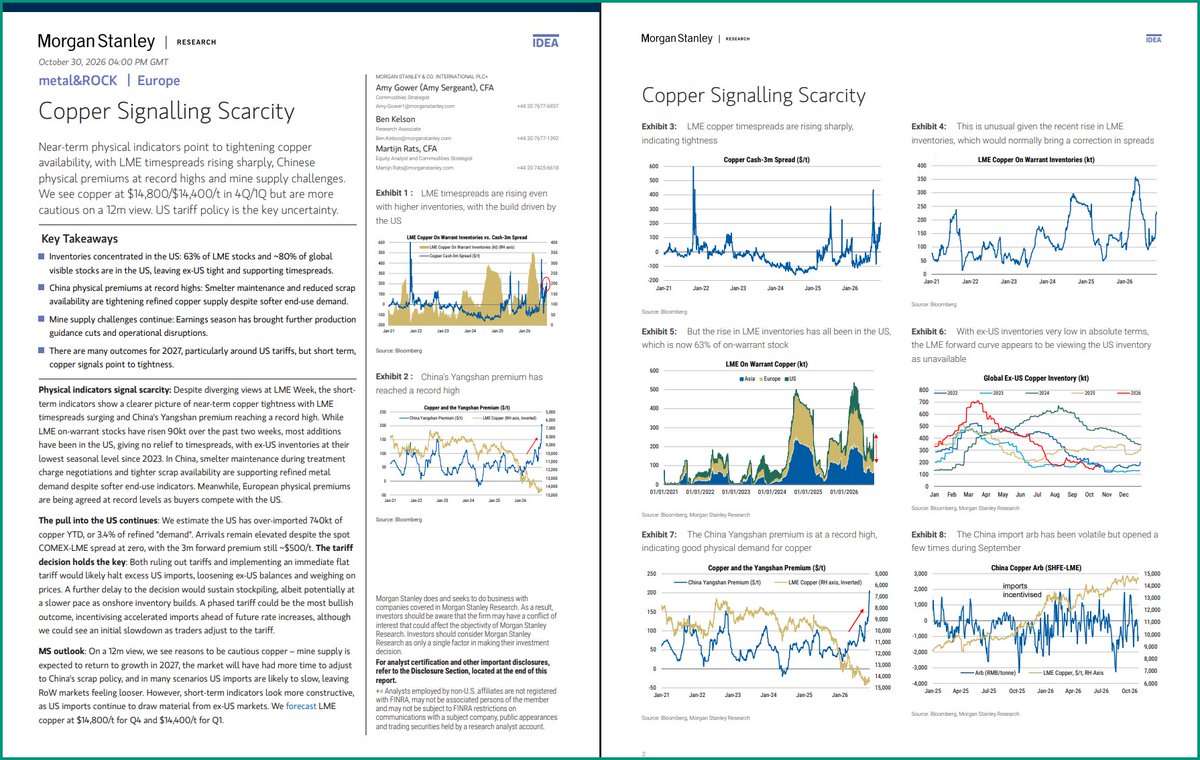
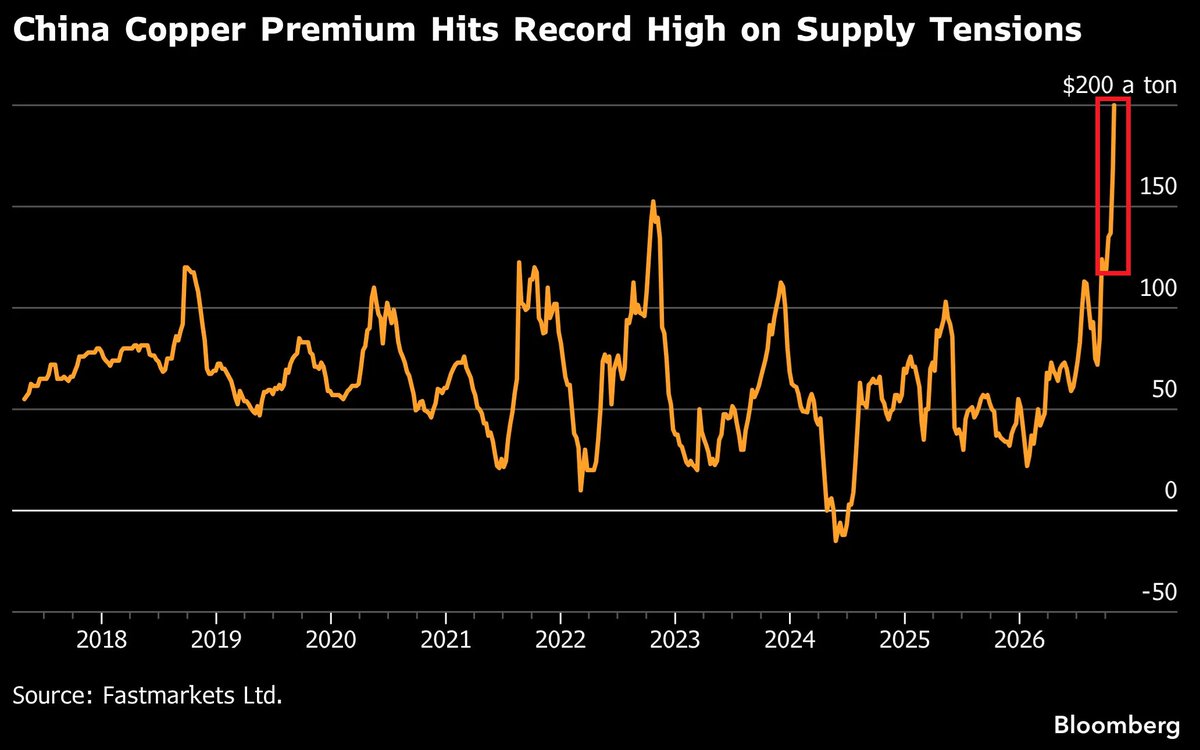
China's copper import premium over London Metal Exchange (LME) prices has surpassed $200 per ton, the largest premium on record.
The Yangshan premium, named after a Shanghai port that serves as a major hub for Chinese copper imports, has more than doubled over the last 3 months.
Since the beginning of 2026, this figure has surged +700%.
Furthermore, the premium of spot prices over three-month futures on the LME widened to $217 per ton, the largest since mid-August.
This has been driven by strong Chinese copper demand and domestic inventories falling below typical seasonal levels.
At the same time, expectations of potential US tariffs on refined copper have redirected hundreds of thousands of tons of copper to the US, leaving global inventories heavily concentrated in the country.
The physical copper supply squeeze is far from over.
🚨 COPPER IS SIGNALLING SCARCITY.
MS's latest copper report highlights a growing disconnect: inventories are rising, but physical copper availability is tightening.
Key signals 👇
🔹 63% of LME copper stocks are concentrated in the US, leaving ex-US markets increasingly tight.
🔹 ~80% of global visible inventories sit in the US, distorting the global supply picture.
🔹 China's Yangshan copper premium has hit record highs, signalling strong physical demand.
🔹 LME cash–3M spreads are surging, pointing to near-term supply tightness.
🔹 The US has potentially over-imported 740kt of copper YTD, equivalent to 3.4% of global refined demand.
🔹 Mine supply disruptions and Chinese smelter maintenance are adding pressure.
MS forecasts copper at $14,800/t in Q4 2026, before easing to $14,400/t in Q1 2027.
The biggest wildcard? US tariff policy.
A tariff decision could reverse inventory flows and reshape global copper pricing.
The question isn't whether copper exists. It's whether copper is available where it's needed.
#Copper #Commodities #Metals #Mining #GlobalMarkets
Chile’s copper commission, Cochilco, cut their 2026 production forecast by another ~330,000 tonnes to 4.94 million tonnes (5.27 million tonnes previously).
2026 is set to be the weakest year for Chilean copper production in more than two decades.
The 2027 forecast was also reduced by ~470,000 tonnes to 5.08 million tonnes (previously 5.55 million tonnes).
https://t.co/OjYYRwZf8u
China is putting a floor under the gold price and most people haven’t noticed.
Every time gold dropped China accelerated its purchases.
March: 4.98 tons. Gold at $5,400.
April: 8.09 tons. Gold at $4,600.
May: 9.95 tons. Gold at $4,400.
June: 14.93 tons. Gold at $4,200.
July: 19.91 tons. Gold at $4,100.
August: 20.22 tons. Gold at $4,300.
September: 23.02 tons. Gold at $4,300.
The lower the price, the more they bought.
September marked China’s largest monthly purchase in 3 years.
23 consecutive months of official gold buying is not trading.
China is draining physical gold from global markets to build a gold backed financial system to replace the dollar.
Retail investors are selling gold because interest rates rose.
China is buying every ounce they can find.
You need to be stacking gold for what is coming...
China is absolutely dominating copper refining.
They control over 50% of global refining capacity, with Asia accounting for almost 80%.
That means much of the world's mined copper concentrate has to be shipped to Asia... most likely China, to be refined into usable copper cathodes.
No copper, no AI, no military, no electrification.
And without China, the West would struggle to build any of it.
In other words, reshoring copper refining is becoming a matter of national security.
But to rebuild our manufacturing base, we need enormous amounts of copper.
We don't own enough copper for what's coming.
🧠 Cisco Lithium Project Facts:
👉 $75M cash on hand (most recent financials)
👉 Inferred MRE: 295 Mt at 1.36% Li20
👉 Largest spodumene lithium project in the Western Hemisphere and 4th largest globally
👉 Unparalleled location advantage
👉 PEA coming soon
$QTWO.V
🎥 GUNNISON COPPER: PRODUCING TODAY. BUILDING FOR TOMORROW. 🇺🇸
CEO Craig Hallworth joins @CEOTechnician to discuss Johnson Camp production, six drill rigs advancing Gunnison & our NYSE American listing under $GUNN.
▶️ https://t.co/oY4sFmTQMg
#GUNN #Copper #AmericanCopper #NYSE $GCU.TO $GCUMF
Morgan Stanley is the latest sell-side bank to raise its copper price forecasts, citing persistent long-term deficits and capex failing to translate into higher volumes. Its new long-term price (i.e. 2030 onwards) is now up 15% to $5.73/lb.
They warn that even at these new estimates, incentive prices may still not be high enough to support development of several brownfield and greenfield projects. They cite a whirlwind of escalating cost headwinds, such as a sulphur squeeze, diesel export bans, grade declines, royalty changes, a super El Niño and strategic stockpiling, all driving further cost pressures.
We think that, given all these factors, the copper price should be even higher… So which will be the straw that breaks the camel’s back?
@MgnStnlyIdeas
Copper prices are soaring📈
⚠️The biggest miners are producing less.
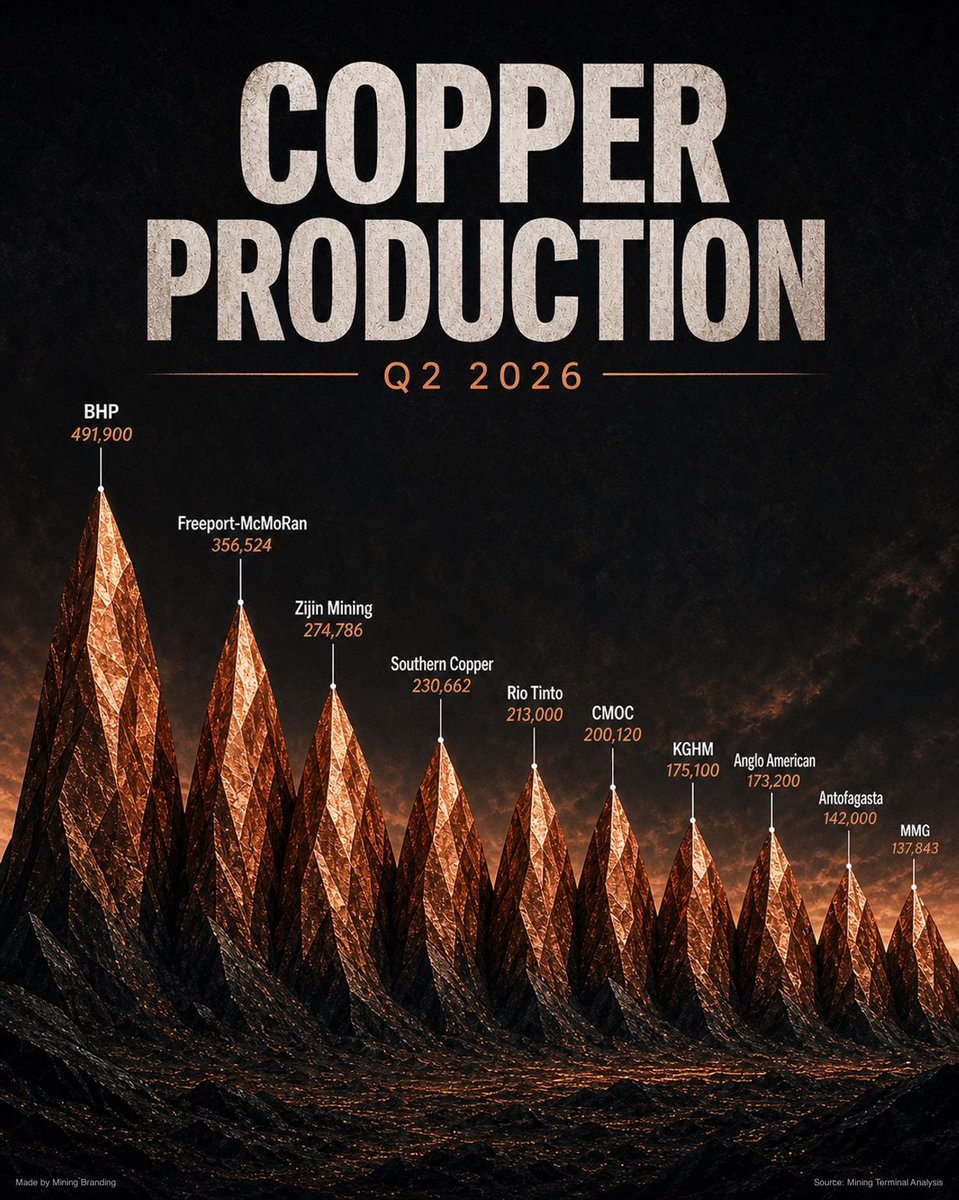
🇦🇺BHP, the world's largest copper miner, produced 492kt in Q2. That's down 5% year on year.
It expects to produce 1.65 to 1.80 Mt next year, against 1.95 Mt this year.
🇨🇱Codelco's own mines produced 564kt in H1, down 11%.
Freeport's output fell after the mud rush at 🇮🇩Grasberg.
Meanwhile prices have jumped.
BHP's average realised copper price was $5.74/lb this financial year, up 35%. Freeport got $6.17/lb in Q2, against $4.54 a year earlier.
The reason is geology.
The giant mines are getting old.
At Escondida, the world's largest copper mine, ore grade fell from 1.02% to 0.90%.
That means more rock moved for less metal.
New mines take more than a decade to build, so high prices can't fix supply quickly.
The incentives point one way… Miners earn more from fewer tonnes: Codelco's H1 EBITDA rose 68%.
Grids, data centres and EVs all need copper, and US power demand alone is heading for a fourth straight record.
Deutsche Bank's head of metals research says the US and China have probably locked up about 70% of the world's aboveground copper.
His target: $22,050 a tonne by Q2 2027, almost 50% above today.
Ghali calls it the most acutely scarce copper market since the 1980s.
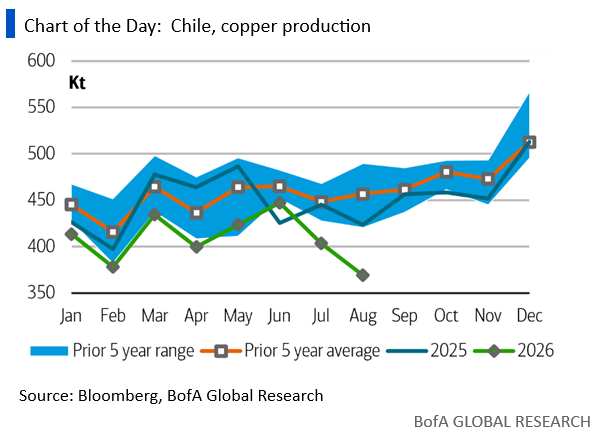
In August, copper output from Chile fell to a multi-year low of 369,500 tonnes, the lowest level in 15 years (see chart 👇).
Chile’s Mining Minister, Daniel Mas, has attributed the decline to “temporary [weather-related] problems” and says he has “good expectations for [a recovery in] production next year”.
@BankofAmerica forecasts a 4.2% growth in global copper supply next year, supported in part by an expected recovery in Chilean production. Yet... Bank of America still expects the global copper market to REMAIN IN DEFICIT.
The Chilean authorities have historically been more likely to revise copper production forecasts DOWN than up.
In other words, the expected recovery in Chilean production is critical to the global supply-growth outlook, especially since the country is the world's largest copper producer. So, even if the recovery in copper production materializes, which the country's track record of underperformance suggests it won't, next year's global copper market will remain firmly in deficit.