There are a few reasons why political elites often seem disconnected from public sentiment on immigration.
First, many policymakers view immigration through an economic lens. Treasury departments, business groups, universities, property developers, and employers often see immigration as a way to:
Increase GDP growth
Fill labour shortages
Support an ageing population
Increase housing demand and economic activity
Maintain tax revenues
The problem is that GDP growth and quality of life are not the same thing. A country can become richer in aggregate while many citizens feel worse off because:
Housing becomes less affordable
Infrastructure becomes overcrowded
Wages face downward pressure in some sectors
Social trust declines
Cultural change occurs faster than people can comfortably absorb
Second, there is a fear among politicians and media organisations that criticism of immigration can slide into ethnic hostility. Because of that risk, some institutions became reluctant to discuss immigration levels at all. The result is that many voters feel legitimate concerns about numbers, housing, infrastructure, and social cohesion are dismissed rather than debated.
Third, modern political culture often treats questions like “What kind of society do we want?” as morally dangerous because they touch on identity, culture, religion, ethnicity, and values. Yet historically every society has asked exactly those questions. Countries routinely make choices about:
Who can immigrate
How many people arrive
What values newcomers should adopt
How integration should work
The difficulty is defining an “ideal society.” Different groups want different things:
Some prioritise economic dynamism and openness.
Some prioritise social cohesion and stability.
Some prioritise cultural continuity.
Some prioritise humanitarian obligations.
Some prioritise individual freedom over collective identity.
The political challenge is balancing those competing goals.
One thing worth noting is that public opinion in many democracies is not necessarily anti-immigration. Often it is more nuanced than that. Polling frequently finds people support immigration in principle but want:
Lower overall numbers during housing shortages
Stronger emphasis on skills
Better integration
Enforcement of existing rules
Immigration levels linked to infrastructure capacity
That is a different position from opposition to immigration itself.
The deeper issue may be that modern politics often frames immigration as a moral question (“good people support it, bad people oppose it”) when many citizens see it primarily as a practical question (“what level can our housing, infrastructure, labour market, and social fabric absorb?”).
Once a policy debate becomes a moral identity debate, it becomes much harder to discuss trade-offs honestly. That is probably why the conversation feels taboo to many people even though the underlying questions are neither new nor unique to any one country.
We are witnessing globally , countries getting these policy settings completely wrong . It should mean we at least pause , slow down and review what we are getting wrong and what others are getting wrong globally . Governments globally have become manic , they simply refuse to listen or review what’s working and what isn’t .
@david_parker@ZubyMusic For when he gets a little older, Shel Silverstein's Where the sidewalk ends and A light in the attic are classic. My boys also really liked When you're a pirate dog by Eric Ode. They're poems (I'm not usually a poem guy) but they are silly/hilarious kid poems.
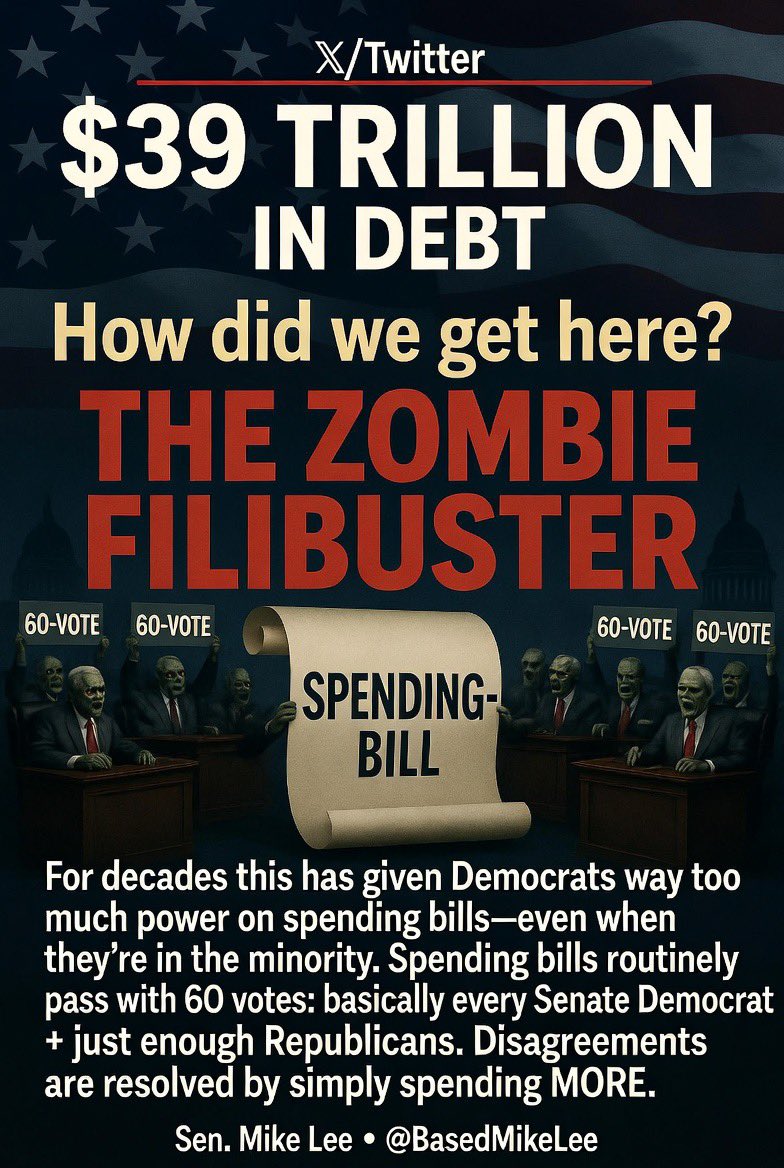
How did we get to be $39 trillion in debt?
The zombie filibuster—coupled with a chronic unwillingness among senators to break through it by putting in the hard work—has contributed to it substantially.
For decades, this dynamic has been giving Senate Democrats way too much power when it comes to spending bills—even when they’re in the minority.
Spending bills in the Senate routinely get to 60 votes—regardless of who’s in the majority and who controls the House and the White House—with votes coming from (1) basically every Senate Democrat and (2) a much smaller group of Republicans (predominantly members of the Appropriations Committee), in many cases just a few more than whatever it takes to achieve cloture.
As a result, disagreements on spending bills tend to be resolved by simply spending more—to give those voting for it what they need to vote for it.
This is one of many reasons why I’ve been pushing so hard on the talking filibuster which, if fully utilized and given the time it needs to work, could help us pass the SAVE America Act.
But the benefits wouldn’t end there, as they could help us avoid not only the kind of shutdown hell we’re now experiencing, but also rein in our debt and deficit—at least while Republicans are in charge.
Share if you’d like to see the Senate use the talking filibuster—to fully fund DHS, to pass the SAVE America Act, to reduce spending, and otherwise!
Two things can be true at the same time:
1) Nebraska had multiple opportunities to take control of the game and couldn't score.
2) It is physically impossible to play 20 minutes of basketball and only commit one foul.
@MatthewBerryTMR can you use your pull at NBC to convince them to cancel out the high pitch whining noise from the drones at the Olympics? #Olympics2026
I think this thread is posted in at least a simulacrum of good faith, so I'll give a substantive response.
It is obviously true that in the moment of crisis, leaders face tremendous pressure to do something dramatic to address the crisis, and often those decisions turn out, in retrospect, to be wrong.
In the case of the covid crisis, the problems were confounded by a determined unwillingness of scientific and public health leaders to respond to data -- in real time -- that showed that core assumptions underlying the lockdown strategy were wrong.
Here is a short list of facts about covid that undermined these leaders' core assumptions:
* covid is airborne,
* covid spreads asymptomatically,
* covid infection fatality rate << case fatality rate,
* covid has a sharp age gradient in its infection mortality risk,
* lockdowns cannot suppress covid spread or protect the vulnerable for long,
* lockdowns crush the lives and well-being of children, the poor, and the working class, and almost everyone other than the laptop class
* lockdowns cause a form of psychological terror that guarantee they could never last just two weeks
The WHO and public health leaders got all of these facts wrong in 2020, which I suppose is understandable.
What is not understandable is that these same leaders conducted "devastating takedowns" of even well-credentialed outside critics who pointed out that the WHO's core assumptions were incorrect, and accepted these assumptions as true even as overwhelming data to the contrary emerged in real time.
What is not understandable is the utter confidence that the WHO and public health leaders expressed in these ideas and lockdown policies to the public as the only way to protect the population, going so far as to call for censorship of contrary voices on social media and elsewhere.
The closest analogue I can think of is the set of "best and brightest" advisors who told Pres. LBJ that victory in the Vietnam War was just around the corner, based on a whole host of faulty information.
Leaders who come out of such situations having embraced such a litany of catastrophically failed ideas and policies have a few choices on how to handle the post-crisis era.
1) They can, in good faith, admit their failures and work to reform systems so the disaster never happens again. This would be best, though I would understand why the public would want a new set of leaders to design and implement the reforms. I personally am very happy to work with and learn from public health leaders who choose this option.
2) They can pretend to have done nothing wrong, clinging to power for as long as they can, hoping against hope that history will vindicate them, crushing public trust in the institutions they lead.
3) They can try to pretend they never recommended or adopted the catastrophically failed policies, hoping that the public has a short memory. This is the current strategy that the @WHO is taking.
4) They can appeal to the difficulty of the job of handling a crisis under considerable uncertainty, not in a spirit of reform, but rather as an excuse to avoid responsibility for their failed crisis management. This is the approach that Koopmans is taking in her thread.
I have very little sympathy for the covid crisis leaders who choose options 2, 3, or 4. Their job was to manage the uncertainty with wisdom and humanity, which they failed to do. They cannot, at this juncture, turn around and expect public sympathy because their job was hard, or expect the public to forget their failure. These leaders have destroyed public trust in public health, and should step aside as a new set of public health leaders works to fix the damage they caused.
@BaldyNFL@RamsNFL@ChicagoBears@KevinByard 73 let the first defender right by, then instead of blocking up the field he's just watching the play and let's another defender get by who gets the tackle