@vtchakarova You can have a bond market with a bad economy, but you can’t have an economy with a bad bond market. They’re gonna need to save the bond market and they know it
And people thinking RUS-UKR is about to wrap up soon…odds are against that.
@JacobShap@TheMichaelEvery Jacob, do you disagree with Michael when he says this action is “US insistence on Canada sticking to a common external tariff (vs China) like the EU insists on”?
Should the US be unconcerned with transshipping?
Back when celebrities were famous because they were actually talented. She didn’t complain, didn’t demean others, just got it done, with style.
What a woman! RIP Dolly
China’s accession to the WTO and the granting of Permanent Normal Trade Relations were sold to the American people as steps that would make trade fairer and the world safer. Instead, we left our workers to compete against state-led subsidies, excess capacity and practices that distort trade and undermine reciprocity. It is called “regression toward the mean.” And it was perhaps the most critical factor in the decline of the middle class. It pitted American workers against low-wage workers around the world, and over time reduced American wages closer to the mean of foreign wages, which led to wage stagnation.
Manufacturing in foreign countries and giving our technologies to our competitors was never a government strategy; it was the absence of a strategy. All government administrations back to Reagan supported free trade and never developed a plan to protect our vital technologies, our industries or the American people.
https://t.co/eeExhl2HtG
@BuBarrelBull US lost control of the oil trade??
US - Number world 1 producer
US - rule of law protects new investments
Largest competitors are much more dependent on oil trade and have significant problems and higher costs moving product to their customers
Helen Andrews’s thesis on the feminisation of Western institutions helps explain something increasingly obvious about progressive politics in both the US and Europe.
Politics is becoming less a contest between competing ideas and more a system of social conformity: you are either with us or against us. Disagreement is no longer merely disagreement. It becomes evidence that there is something morally wrong with you.
That mechanism matters because it allows emotionally compelling narratives to substitute for intellectual coherence. Wind and solar are “green”, therefore questioning their economics, intermittency or system costs makes you a climate denier.
Mass migration from low-trust societies is framed as compassion, therefore questioning its fiscal, social or institutional consequences becomes evidence of moral deficiency.
The contradictions inside the policies matter less than the emotional legitimacy attached to supporting them. Emotions matter, not facts.
Once politics operates this way, social enforcement becomes more powerful than argument. People do not need to believe every proposition. They merely need to understand the reputational cost of challenging it. Nobody wants to be expelled from the respectable tribe.
This is where Timur Kuran’s concept of preference falsification becomes so powerful. People publicly endorse positions they privately doubt because dissent carries a social price.
The apparent consensus then intimidates the next person into silence, making the consensus look stronger still. Eventually you have preference falsification at scale: weak ideas protected by powerful social conformity.
The extraordinary feature of this system is that policy can remain emotionally successful long after it has become economically or socially destructive.
The moral narrative is immediate; the consequences arrive with a lag. By the time energy costs rise, institutions deteriorate, fiscal burdens compound or social trust erodes, years of policy have already been locked in.
It’s a fucking nightmare but it is how a society can keep voting for the Greens or Democrats or Labour etc, subsequently destroy the best nuclear plants, de-industrialise entire sectors, welcome barbarians at the gates etc until the state discovers that the constant false virtue signaling does not balance a budget.
This is a multi-decade support line. Any significant breach will require the powers that be to cool down the economy in order to save the bond market.
You can have a bond market with a bad economy, but you can’t have an economy with a bad bond market
$TLT
$TLT remains under bearish pressure after the bearish engulfing candle at the 50 EMA confirmed sellers defended a key resistance level.
Last week’s spinning top signals consolidation rather than a reversal, with bears still controlling momentum.
The MACD has crossed below its signal line, reinforcing the bearish outlook, while price has yet to reach meaningful support.
Adding to the weakness, price continues to trade within a descending triangle, a pattern that typically resolves to the downside.
Until bulls reclaim the 50 EMA and invalidate the pattern, rallies are likely to be viewed as selling opportunities.
$TLT $IEF $SHY $GOVT $VGIT $VGLT $EDV $SCHR $SCHQ $SPTL $ZROZ $TLH
For this decade, there will be weeks where the US and China appear to be coming closer together and weeks where they appear to be moving to a complete rupture
Thru it all, we have to learn to live in the same world together, the great adjustment will be the middle countries
The Coming of a Bipolar World and the Crisis of the Middle Powers (2026 - )
There has been a lot of discussion about middle power strategy recently, but this isn't a new phenomenon. It's a historical recurring theme that occurs whenever the world consolidates toward two dominant powers, and a tier of middle powers gets squeezed into a crisis. In Paul Kennedy’s classic, The Rise and Fall of the Great Powers, he discusses two middle-power crisis periods, 1885-1918 and 1919-1942. Both were transitions into a bipolar world. The Cold War didn’t produce a middle power crisis because by 1945 the sorting was finished and everyone knew their rank and had a stable home, and the secondary powers actually got a generous deal. The crisis occurs during the reorganization, where rank is up for grabs, guarantees are being renegotiated, and secondary powers don’t know where it will stand or what it’ll have to pay.
We’re now in another transition to a bipolar world, and it's no coincidence that we are witnessing a middle powers crisis once again.
The first middle power crisis, 1885-1918, was due to industrialization resetting the threshold required to remain a first rank power, and most of countries were below it.
The second crisis, 1919-1942, resulted from a withdrawing or absent protector as the US pulled into isolation and the USSR turned inward.
The solutions the middle powers reached for were: 1) empire - seize territory 2) coalitions and alliance blocs 3) appeasement. And running underneath all three, rearmament as the middle powers rebuilt the capacity to act on their own.
We're now in another transition, except each of the historical forces are hitting the middle powers simultaneously. The security umbrella is weakening as the US, forced to concentrate against China, is making its backing conditional and pushing allies to carry their own weight. And the middle power economies are slipping in relative terms (Europe, Japan, Canada, Russia, ect.) and losing ground to both the US and China as the threshold to compete economically has risen. They face a world where they struggle to compete with China in old economy industry and they lack the scale and tech industry to compete with the US and China in AI, space, advanced industry. So, it's both forces from the historical cases running together.
And we're seeing the middle powers reach for the same solutions they did before.
Russia is reaching for the seizing territory solution. When you've fallen under the threshold and your only assets are the old kind (mass, territory, resources) the temptation is to manufacture scale by seizing population and land. Putin's attempt to reconstitute the USSR parallels with Chamberlain's imperial strategy and Germany's Lebensraum. A power below the bar trying to buy its way back with the only currency it still has. At the same time it's running the coalition move, building out ties with Iran and North Korea to dilute its dependence on China, all under loose Chinese backing.
Meanwhile, the alliance solution is already in motion in the Eastern hemisphere, and it’s forming horizontally. Japan with Australia, Japan with India, India with Vietnam, Indonesia in it. Middle powers are seeking each other out, not gathering under the US. And they're doing it because they fear the US backing is now looser and more conditional. So they're building mutual guarantees among themselves as a hedge. And mutual guarantees among secondary powers, absent a giant sitting on top to restrain them, is the precise structure of 1914.
Loose guarantees between the middle power and the superpower causes the middle powers to build tight guarantees with each other, and those horizontal ties are the ones that transmit the war upward. The looseness at the top creates rigidity in the middle.
And China's building its own coalitions in parts of Asia completes the 1914 analogy. So now you have loose bloc-systems forming horizontally, meeting along contested seams (the South China Sea, the Himalayan border, the Taiwan Strait) with the ignition sitting in the hands of the most desperate small player on either side, and the horizontal ties ready to transmit a local clash up into the coalitions and then into the giants.
Everyone worries about the superpower war, US and China, Thucydides trap. But the historical pattern suggests that the great power war ignites in the middle, from the desperation moves of powers that have fallen below the bar and are reaching for exits that don't exist. A Russia running the seizure play. Or cornered middle powers, uncertain of their giant's backing, build horizontal coalitions with each other, and those mutual guarantees become the transmission mechanism that turns a small clash between weaker players into a great power war the giants get dragged into.
A conflict starts small. But the horizontal coalition means it doesn't stay bilateral. Japan is tied to Australia is tied to India, so the local clash pulls in the coalition. And then the giants. The US is loosely behind the coalition; China is behind its own clients. The war climbs the ladder from the bottom: clash over a shoal, to coalition, to superpowers exactly the way Sarajevo climbed from an assassination to a world war. The middle powers are the ignition, the horizontal alliances are the transmission, and the giants are the explosion at the top.
Loose vertical guarantees don't reduce the danger; they relocate it, driving the middle powers to couple tightly sideways, where the giants can least control the escalation. Asia is where this is furthest along, with horizontal coalitions forming on both sides, contested seams, and plausible ignition points. Which makes it, the most probable birthplace of the next systemic war.
Conclusion
The middle power crisis is a symptom of the transition to bipolarity, it has recurred every time that transition has happened, and it's recurring now for the same structural reasons. The real danger it carries is not a deliberate US-China war. It's that cornered middle powers, uncertain of their protector and unable to compete alone, reach for the same escapes they reached for before…coalition, seizure, accommodation, rearmament…and those moves, not the giants' ambitions, are what historically ignited world wars.
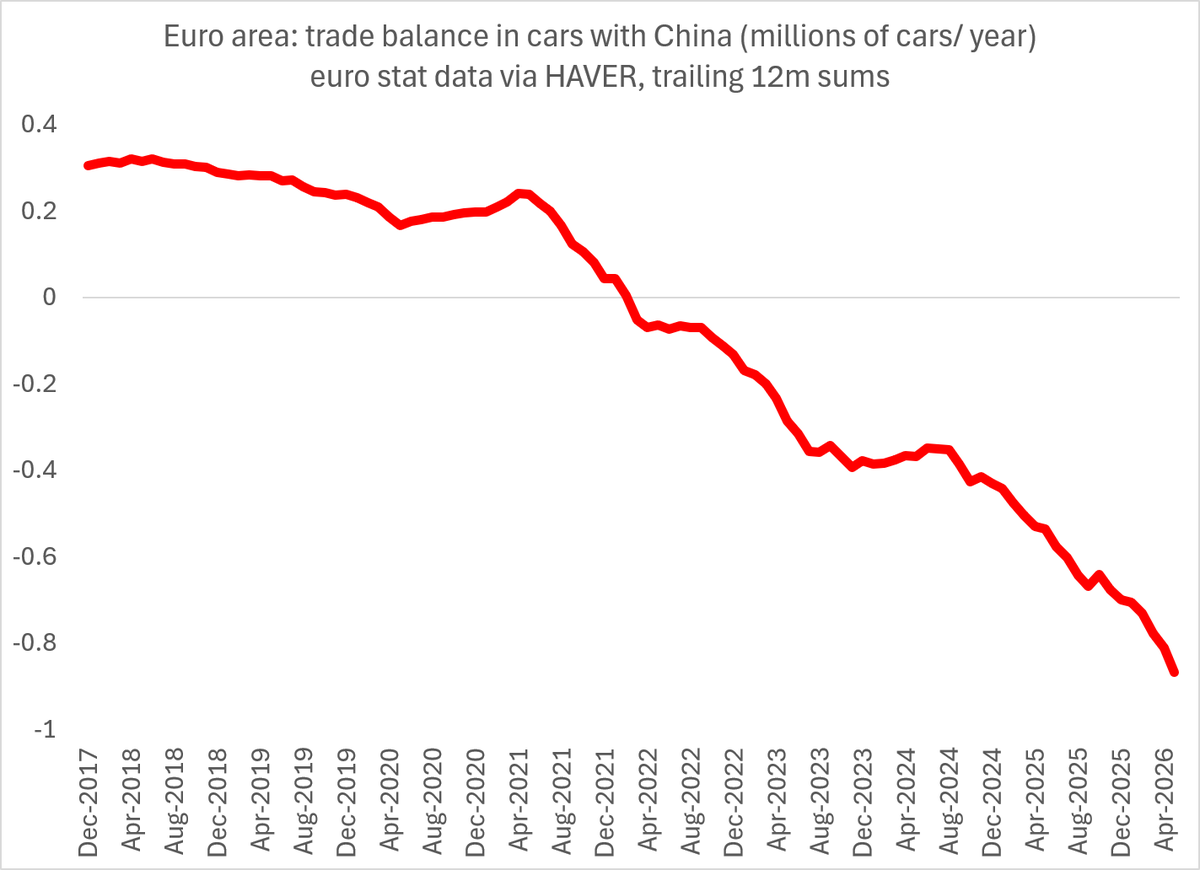
The euro area's "real" trade balance in autos with China -- the numbers of cars exported v the number of cars imported.
Just a massive swing. And the shock isn't over. No signs it is self correcting
Agree with every word of this podcast. Trump closed the strait on purpose to demonstrate to China that it could choke it, like China can choke the US on REE. It happened straight after Venezuela. This mutual choking activity is dynamic; it's a to-and-fro. Ukraine targeting Russian ships isn't disconnected from LNG ship attacks in Hormuz- everything is interconnected. Somewhere in Virginia and Washington, this is being war-gamed. Nobody wants a collapse in Iran . Most of all, take zero notice of what any side says. Trump must throw out lines, as does Iran. Well done @anasalhajji
حياكم الله أستاذ عبد الرحمن... بالتأكيد ستستغلها إيران بهذه الطريقة..
ولكن:
- الحروب التجارية ضد دول عدة
- الحظر الاقتصادي على دول عدة
- التعرفة الجمركية على دول عدة
- قناة بنما
-منع الغاز المسال الروسي من عبور البحر الأحمر بنما يمر النفط الروسي
- فنزويلا
- الصين
- روسيا
- نوردستريم 1
- نرود ستريم 2
- خط الغاز الأوكراني
وكل هذا توجته استراتيجة الأمن القومي التي نُشرت أجزاء منها في العام الماضي والتي تتكلم تحديدا عن "الهمينة" عن طريق الطاقة والذكاء الاصطناعي، وتتكلم لأول مرة عن "فتح مضيق هرمز" قبل أن يغلق بثلاثة شهور.! إغلاق هرمز حقق لولايات المتحدة هدف الهيمنة في الطاقة والذكاء الاصطناعي... والزراعي أيضا.
أنا لا أتكلم هنا عن نظرية مؤامرة... خاصة أنني نشرت تقارير قبل عام كامل تقول أن الصين مقتنعة تماما أن مضيق هرمز سيغلق، ولكن من سيغلقه ليس غيران، وإنما الولايات المتحدة.
منافع الولايات المتحدة من إغلاق هرمز وتدمير مصنع الغاز المسال والهليوم في قطر لاتقدر بثمن رغم التكاليف على المدى القصير. لايمكن صناعة أي من رقائق الكمبيوتر في تايوان أو كوريا الجنوبية بدون هليوم.
فإذا كانت إيران من أغلق مضيق هرمز، فهي عاقبت حليفتها الصين وأفادت الولايات المتحدة. كيف نفسر هذا؟
Important explanation of under currents driving the US/China relationship, and US realignment on trade. Globalization isn’t dying because Trump.
China has effectively leveraged their weakness (overpopulation) to create western dependency after WTO accession. We’re in a new world
“There is a vulnerability at the heart of the U.S. economy so profound it imperils our national sovereignty, and most Americans have no idea it exists.
The public is well aware of China’s manufacturing dominance. The scale is alarming, yet it is not the real danger. The deeper, more insidious vulnerability is that China has secured control over a narrow set of manufacturing chokepoints that the entire U.S. industrial base relies on to function.”
My latest report for @commonplc breaks down the mechanics of this leverage and the national security logic behind US industrial policy:
https://t.co/bgPIeXvs0q
Jim has made some great calls in recent years, but it feels like we are going to need a little more capitulation before oil can bull again. China has a real problem and they’re running out of levers to pull
When the market is strong, you want high inventory and production at reasonable cost, you hold margins and push your advantage
Only reason to lower price below competition is fear
the market has turned. Then you push out inventory and reduce higher cost production