A short letter we wrote. I wish people would listen. I wish academia to be what it can and should be. A place where terror is condemned, and everyone feels safe. And most of all, I wish for the hostages to be released. Bring them home, make it stop! 😢
https://t.co/OmsSwXG6kT
Here is our work on two-site Kitaev chains in 2DEGs: https://t.co/uHz0eF8GK2 . What I find so reassuring is that physics works! We see the same phenomena that our colleagues saw earlier this year in nanowires: https://t.co/TxlRXxHWjH
And that’s not all! You should also check out the work of @srijitgoswami lab, where they demonstrate a two-site Kitaev chain in a 2DEG for the first time: https://t.co/O8Y7wadrp4. Very exciting times ahead!
Very excited to share our latest work! We form a two-site Kitaev chain using Yu-Shiba-Rusinov states. We observe “poor man’s Majoranas” with a large gap (70 ueV!) and drastically suppressed susceptibility to charge noise. https://t.co/Z2dS0pAONY
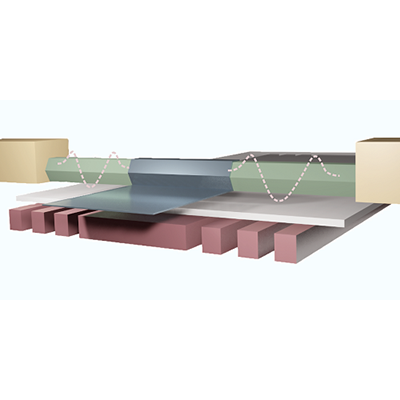
A demonstration that certain electron-transport processes can be tuned in a hybrid semiconductor-superconductor system could be useful for developing quantum computers.
Read https://t.co/q7F1Y4U3h8
@PhysicsMagazine Synopsis https://t.co/FELjjdA8oa
#PRXqst#PRXjustpublished
Our paper on Cooper pair splitting in superconductor-semiconductor hybrids is now online: https://t.co/l982nFQl21
As a follow up we have now been able to controllably tune the interactions between the quantum dots to create localized Majorana bound states...stay tuned for more.
💬 Tom Dvir: “QuTech is unique in tying everyone to a common vision.”
Tom Dvir has been a post-doctoral researcher in the qubit research division in QuTech for the last three and a half years.
Read the full interview in our annual report 👇
https://t.co/xjdpJQephF
In our recent @NatureComms paper, we present a comprehensive study on InSb based semi-super hybrids. In particular, we show how to tune the devices from hard to soft gap regime through gating! We are also reporting an induced gap reopening! Check it out! https://t.co/YKvlC5Uqzd
Take a look at our group’s talks at the @APSMeetings today!
Majoranas, three-site Kitaev chains, and charge sensing Andreev bound states! https://t.co/Nds6VkDrS4
A recent paper along with the unavoidable press release https://t.co/1oxU60NRRF claims the observation of 'poor man's Majoranas' following the CMTC prediction from 2012 , we have no opinion right now on the claim, but we will soon https://t.co/FZ5nLGoSRF
https://t.co/YbsX2z0kNR
@rodrigoad_ Eventually, the desired length of a Kitaev chain is related to the usage. They chain needs to be long enough such that overlap of the two Majorana states is not a limiting factor for a quint coherence, for example. I don’t know what is that length yet.
@rodrigoad_ Strictly speaking, a topological phase is only there for infinitely long chain. Three dots, begins to show topological-like properties: it has bulk and boundaries which behave differently, and it slightly less fine-tuned.
“Poor man's” Majorana gets richer—the demonstration of this nontopological cousin of Majorana fermions by @DvirTom@tudelft and others may spur new directions in the field. @FlensbergK calls it a "breakthrough for Majorana research." https://t.co/vgG1RK8GC2