Je vois déjà la haine arriver, mais on s'en fout des cons, j'ai 100% foi en vous les mecs et les victoires aux worlds n'en seront que meilleure! #kc#karmine
The reason software eats RAM is the same reason factories used to dump chemicals in rivers. The cost is externalized.
Every mass of inference compute shows up on an engineering manager's AWS bill, broken down to the cent, reviewed quarterly. Every mass of RAM consumed on YOUR machine shows up nowhere in anyone's budget. Chrome could cut memory usage by 60% tomorrow and Google's revenue wouldn't move a single basis point.
Docker's 2GB idle footprint costs Docker Inc. exactly $0. Electron's 500MB todo list costs the Electron team exactly $0. The user paid for the RAM. The user pays the electricity. The user deals with the fan noise. The company ships faster because they chose the laziest possible runtime.
The token-optimization obsession makes this even clearer. Companies optimize inference cost because inference cost hits their margins. They'll spend six months shaving 200ms off a model response. They won't spend six days reducing a desktop client's memory footprint because that memory belongs to someone else's hardware.
This is why the 16GB vs 32GB debate is a trap. You're asking consumers to buy more expensive hardware to subsidize the software industry's refusal to optimize for a resource they never have to pay for.
The market will never fix this on its own. The people writing the checks and the people running out of RAM are on opposite sides of the transaction.
for a while i've had a slight fear that the bluetooth from my airpods could be frying my brain
this weekend i pulled the raw data from a $30m government study of 1,679 mice blasted with cell phone radiation and reanalyzed it
what i found was...not what I expected?
🧵
When I was on the ISS for my nearly year long mission, there was a telomere experiment comparing my telomeres to my earth baseline and my twin brother as a control. Hypothesis was they would get damaged and worse due to the environment. Turns out they got better. Initially NASA thought maybe it was due to exercise and diet. After I returned we learned JAXA had a telomere experiment on some small worms the same time I was there. Their telomeres got better too. Never saw the worms doing any exercise. After further study determined it was the radiation.
@allTheYud A proper answer to this post would require more than the allowed number of characters allowed but you are indeed wrong on multiple accounts. No ego here, i sincerely mean it as someone who respects you.
@AllTheAnime When are you guys giving us The color within from Naoko Yamada with french subs? It has already been out in dvd for a month in the us with french subs.
@wayofftheres@EMBurlingame Former co-worker. Constantly going on and on about gun control. One day he looks at me and says "You're probably one of those preppers right?" Me: "Why would I be a prepper? You've told me over and over how you don't own guns. I'll just come take your stuff." The look on his face
@TSoS_ It's a classic Denis Villeneuve imagery. In Sicario, Emily Blunt's character wears a blue t shirt that gets less and less bright throughout the movie and ends up being grey at the end to communicate her character state of mind toward her ideals and believes.
i keep thinking about this post
only 1-3% of reddit users actually post
most of wikipedia's content is written by 0.003% of the users
poasters are outliers
https://t.co/hLtiPMLr8K
Scott Alexander: The Prophet Who Wasn’t
a scattered set of idle thoughts almost but not quite cohering into a satisfying whole
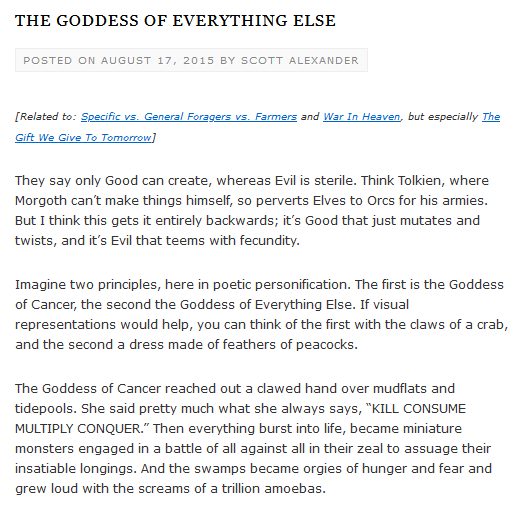
Scott Alexander is one of the most gifted and prolific writers of our day—compelling and strikingly original on any number of topics. Had he wanted to, he would have unquestionably been capable of forging a movement from the ground up, and a lot of his earlier writing gestured somewhat in that direction. Things like “The Goddess of Everything Else” gesture at a framework he would, had he chosen, been able to build into a sort of religion.
He was also one of the earlier people to notice and write in depth about the issues in the progressive social justice movement that have since taken over much of mainstream conversation. If he had wanted to lean into the culture war, he could have taken a prominent position within it.
But he has at every step taken pains to minimize his own prominence and subordinate his writing to the movements he developed within—Yudkowsky’s rationalism and Effective Altruism. He focused away from both his most original and his most culturally hot-button writing, he avoids most self-promotion and appearances in media other than his blog, he discouraged his fans from discussing heated cultural topics in his subreddit. His focus for years has been on lower-profile legwork for the movements he is within, particularly via grant programs and essay competitions.
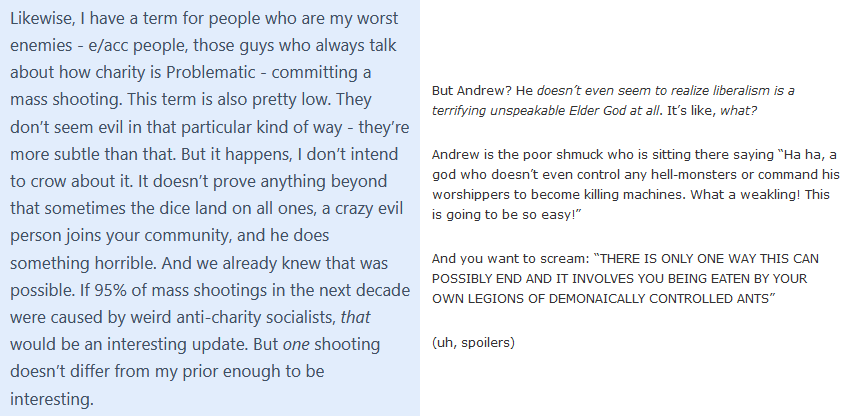
Some of the key ideas he leans in on are AI safety and prediction markets—classic rationalist topics—but they feel almost unnatural coming from him even now. Like—when he lists his worst enemies: nobody who read the passion with which he decried Arthur Chu can be convinced that he dislikes e/acc in the same visceral way—or that e/acc could ever muster the scorn some progressives have for him. It reads as him playing the role he feels he ought—honest in his adherence to his framework, honest in his recitation of the mantras of that framework, but never quite saying them with the same devotion or eloquence as he manages elsewhere.
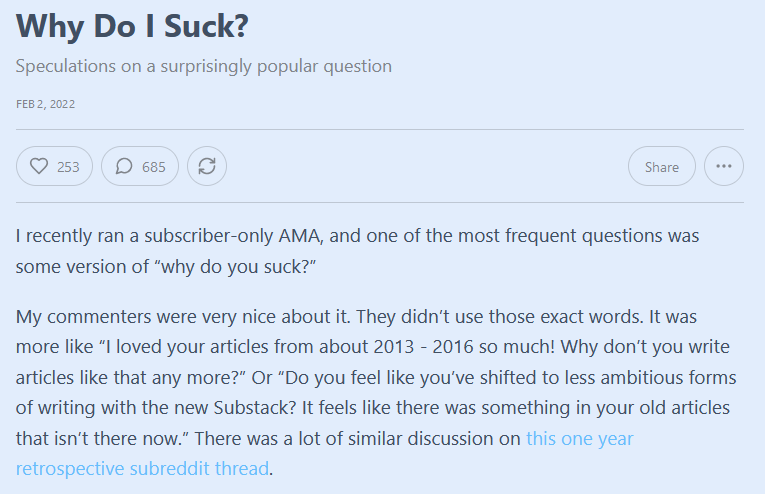
Enough of his readers said something about him falling off that he wrote an entire essay on it (“Why do I suck?”). I think what they sense is not any drop-off in writing quality—he is as skilled as ever—but a subordination of vision and a lack of will to power. Will to power is a dangerous trait, one that often leads in grim directions, particularly for charismatic and persuasive writers. But people compelled by someone’s ideas want that will to power. They want writers to lean into their most original or culturally relevant thoughts, and Scott persistently and deliberately has not. He could have been a prophet of sorts, if he had wanted. That’s not true of many people, but it was of him.
It is at once admirable and frustrating that he has leaned so far away from that route at every inflection point. He works seriously and quietly to do good within his movements, but there's an inevitable nagging feeling of "What if?" when I survey his career. I like the rationalists, and I like the effective altruists, but I have never been convinced that his most compelling work comes from him leaning into that framework.
I don't know that he could take any other route while still being himself. We all have our styles, and his is more admirable than most. If he had wanted to become more, that may have destroyed much of what is good about his writing. But it's a curious thing, you know, to look at a thinker who could define a movement and realize he has actively chosen to subordinate himself to one instead.
@ESYudkowsky Seems like the best thing to do if you actually want people to go vote. "I won't let them tell me what to do!" especially if it paints the other side as evil cheaters.
Amazing.
A while back, it was found that, among Russian ministers, obesity and corruption were associated.
Then it was found that, across countries, corruption and public officials' BMIs were associated.
Now, an anti-corruption campaign inadvertently reduced officials' BMIs!