Can one astronaut inspire a generation? 👩🚀✨
Almost 9 in 10 Europeans believe that sending astronauts from their own country into space can inspire young people to pursue science and technology.
That’s why we’re boosting European space exploration. 🚀
On 15 December, ministers from our Member States meet in Rome for #IMM26, where their choices will help shape Europe’s future in space.
Read more here: https://t.co/rm74DfuEz4
Command received 🫡
Mars became the perfect playground for @esa's deep space ground station in Australia, which commanded two spacecraft at once.
How does our #ExoMars Trace Gas Orbiter benefit from this interplanetary connection?
📶 More reliable transmissions
🧩 Simpler operations
⏱️ More efficient ground station time
📣Big news! @esa's Deep Space Antenna 4 (DSA 4) can now send commands to two spacecraft simultaneously in X-band. 📡🛰️🛰️
DSA 4 is part of the global #Estrack network connecting ESA’s #ESOC with spacecraft across the Solar System.
Read the full story 👉https://t.co/UkYP1aPvX9
The world is not waiting for Europe.
We have the talent. We have the technology. The question is whether we have the ambition to shape what comes next.
On 15 December, Europe has a choice to make about its future in exploration. Let us be bold enough to grasp the moment.
https://t.co/tVD3hDz3GF #IMM26
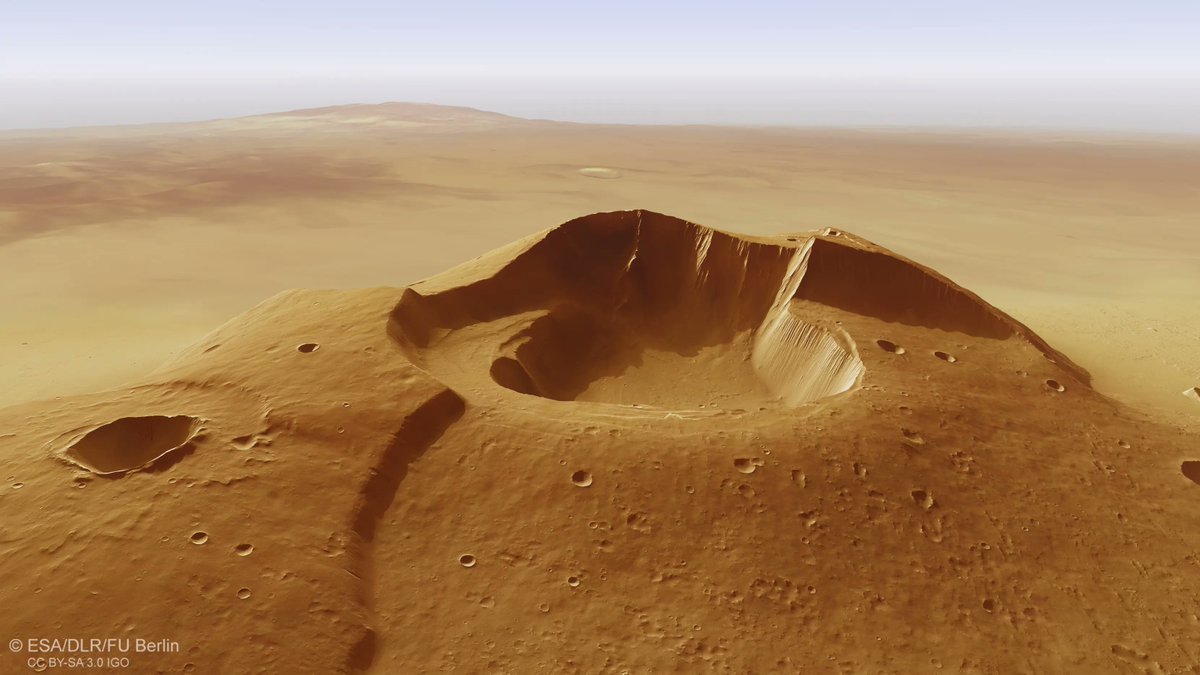
This month, #MarsExpress takes us over Tharsis Tholus. At 8 km high, this volcano is modest by Mars standards, but comparable to the highest peaks of Earth's Himalayas!
Discover more, including 3D views and an interactive tour of the image below 👉 https://t.co/wwUi8zgVQ1
This volcano gives us strong Dune vibes! We are taking the interactive tour, hoping not to bump into any sandworms 😱
Far from Tharsis Tholus, we have spotted hints of volcanic activity on Mars from orbit 🌋👇
https://t.co/0pdtpYq3nE
Searching for life's big answers, on Mars 🔴
Europe is exploring our planetary neighbour’s past, present and future to find out if life ever existed there 🧬
https://t.co/amY6zSjTx5
Scientists and engineers regularly run simulations of the #ExoMars Rosalind Franklin mission, each lasting several martian days. On their to-do list 📝:
🔬 Prepare the rover's laboratory
⛏️ Deploy the drill to collect first martian samples
🪨 Crush and analyse samples
🗺️ Plan for the long-term: what are the best places to drill?
🔴 Life on Mars? Humans on the Red Planet? And what exactly are the “seven minutes of terror”?
We explore it all with Orson Sutherland, @esa’s head of the Mars and beyond projects department, in the latest #ESAExplores.
🎧 Listen now: https://t.co/0JDWled60D
A milestone worth celebrating! 🎉✨
Members of @esa's astronaut reserve have completed their Astronaut Reserve Training, celebrated with a special ceremony at the European Astronaut Centre in Cologne 🇩🇪
Congratulations to the Chameleons! 🦎🚀
🔗 https://t.co/CM8NcCkD6z
Inspector Mars gadget 🕵️♀️
Our rover also needs legs to land on Mars. European industry fast-tracked these sturdy legs 🦿
They will be the first part of the #ExoMars spacecraft to touch the martian surface in 2030 🔴
https://t.co/HXCWUSHNwX
📸: Sener
🛞 Amalia tackled slopes, boulders and Mars-like gravity, driving onto simulated martian terrain more than 20 times during a two-month test campaign with @Thales_Alenia_S at @ALTECSpace 🇮🇹
Human for scale 🧍
Chiara meets Amalia 🤝 @esa ExoMars rover engineer Chiara Lombardi stands next to Amalia, a twin model of the Rosalind Franklin rover, after it drove off its landing platform.
This will be one of the most critical moments of the mission when the rover reaches Mars in 2030.
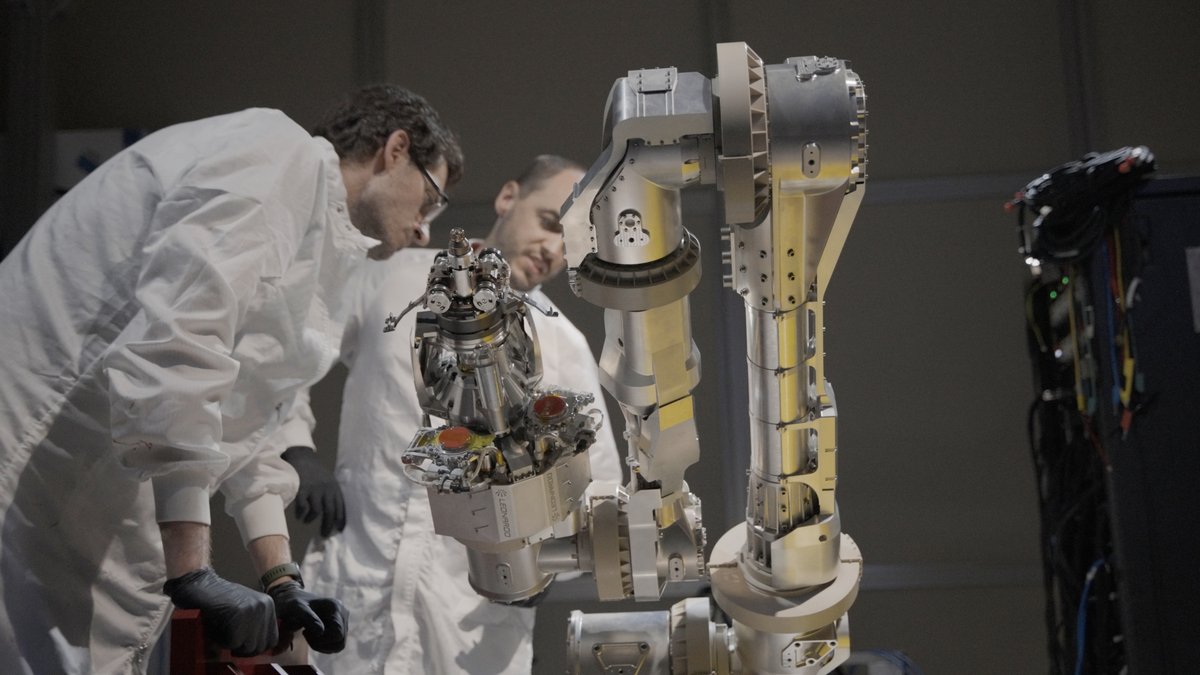
Europe's most sophisticated robot arm has a shoulder, elbow and wrist, along with built-in brain and eyes 🦾
With a reach of up to 2.4 metres, the Sample Transfer Arm performs a large range of movements with millimetre precision 🎯
Here's a closer look at its gripping hand: https://t.co/7uJsWMJu9d
📸: @esa/@LDO_Space
The new finding combines atmospheric and geological analysis with a bit of intuition.
This is where Daniel Mège, a planetary scientist with a passion for volcanism and jazz, storms into the room to confirm what the science community had long suspected: Mars is not geologically dead.
https://t.co/9DV2grlhqm
🔴 There is hot news coming from Mars.
For the first time, orbital data is revealing signs of young volcanism. Deep down, Mars might not be geologically dead, just sleeping.
@esa’s Trace Gas Orbiter detected hydrogen chloride, a gas that escapes from volcanic vents on Earth: https://t.co/0pdtpYq3nE
@esa@esascience@ESA_TGO@ESA_ExoMars@NASAMars@NASA 🎉 To wrap up a Mars-velous decade, we celebrated with the teams ten years since the Trace Gas Orbiter arrived at the Red Planet.
https://t.co/lfEB6qieRH
🔴 40 000+ Mars orbits
🌅 30 000+ sunrises and sunsets
📊 600+ gigabytes, more than all other Mars spacecraft combined
Meet the #ExoMars Trace Gas Orbiter, @esa's largest and most sophisticated martian explorer.
@esa@esascience@ESA_TGO@ESA_ExoMars@NASAMars@NASA Radiation watcher ☢️
Astronauts on a return mission to Mars would be exposed to at least 60% of the recommended radiation dose limit.
Radiation measurements from TGO confirm the paradoxical finding that travelling during solar maximum is the best time to go.