Balaji has created a supreme geopolitical asset. A portable Silicon Valley.
A dense, mobile network of founders, engineers, capital, and techno-optimists that countries can now bid for.
This is the most sought after asset, governments try spending billions to manufacture an innovation ecosystem.
Network School can show up with one.
Ironically, this whole drama with Balaji literally validated the network state thesis.
The whole idea of a network state is taking a dense group of talent and capital, and collectively negotiating with states. The Malaysia drama set up Balaji to negotiate better terms with another state to copy and paste the network there.
This now looks like a much more stable setup.
Guess I'll be visiting Kazakhstan!
Learning to Accurately Recognise Commercially Commensurate Arrangements is Key. Many people don't have this ability and often propose ridiculously incommensurate arrangements without having an accurate humble assessment of their true abilities before making a request or pushback
BTC doesn’t bottom on extreme fear, but on a final shift to an overall lack of interest
There should be a “no interest indicator” on the fear and greed slider on the most extreme end of the fear scale
Some are good builders
Some are good spotters
The good spotters don’t necessarily make the best builders
So to keep up, invest in builders to ride the pace
The scariest version of bad agent prompting isn't the agent doing something wrong. it's the agent doing exactly what you asked and you slowly accepting its framing of what you wanted.
that's not a technical failure. that's how you end up optimizing for the wrong goal with perfect execution
The Strait of Hormuz has been closed for 8 days. Everyone thinks this is about oil. This is about what oil becomes. 92% of the world's sulfur comes from refining oil and gas. Close the Strait of Hormuz and you don't just lose 20 million barrels of crude per day. You lose the feedstock for sulfuric acid, the single most produced chemical on Earth. Sulfuric acid is how we extract copper. It's how we extract cobalt. Without it, you can't make transformers, EV batteries, or the substrates inside every data center on the planet. One chemical, made from one feedstock, shipped through one chokepoint. The cascade goes further: Qatar ships 30% of Taiwan's liquefied natural gas through Hormuz. Taiwan has 11 days of reserves left. TSMC, the company that makes 90% of the world's advanced chips, draws 8.9% of Taiwan's total electricity. No gas, no power, no chips. Then food. 33% of the world's nitrogen fertilizer feedstock moves through the Strait. Half of all humans alive today exist because of synthetic nitrogen. Sulfur, semiconductors, food. That makes three supply chains, one 21-nautical-mile chokepoint, and zero domestic alternatives at scale.
Some people get offended at poor communication skills / incompetence
Poor communication & incompetence create a world of arbitrage - through information gaps, value x pricing mistakes, and slow reactions to opportunities
I am not a fan of Bitcoin and other Cryptocurrencies, which are not money, and whose value is highly volatile and based on thin air. Unregulated Crypto Assets can facilitate unlawful behavior, including drug trade and other illegal activity....
The biggest lie of the Industrial era: new tech growth always creates jobs. Exhibit A “computer programmer” employment: Peaked at dotcom, didnt track with proliferation of software/mobile, declined for 20+ years now at ~1980 levels (chart) AI likely much accelerate this trend. The next form factor of tech diffusion may not increase employment even inside its own domain. No one doubt AI will massively grow GDP, but the question is who gets paid?
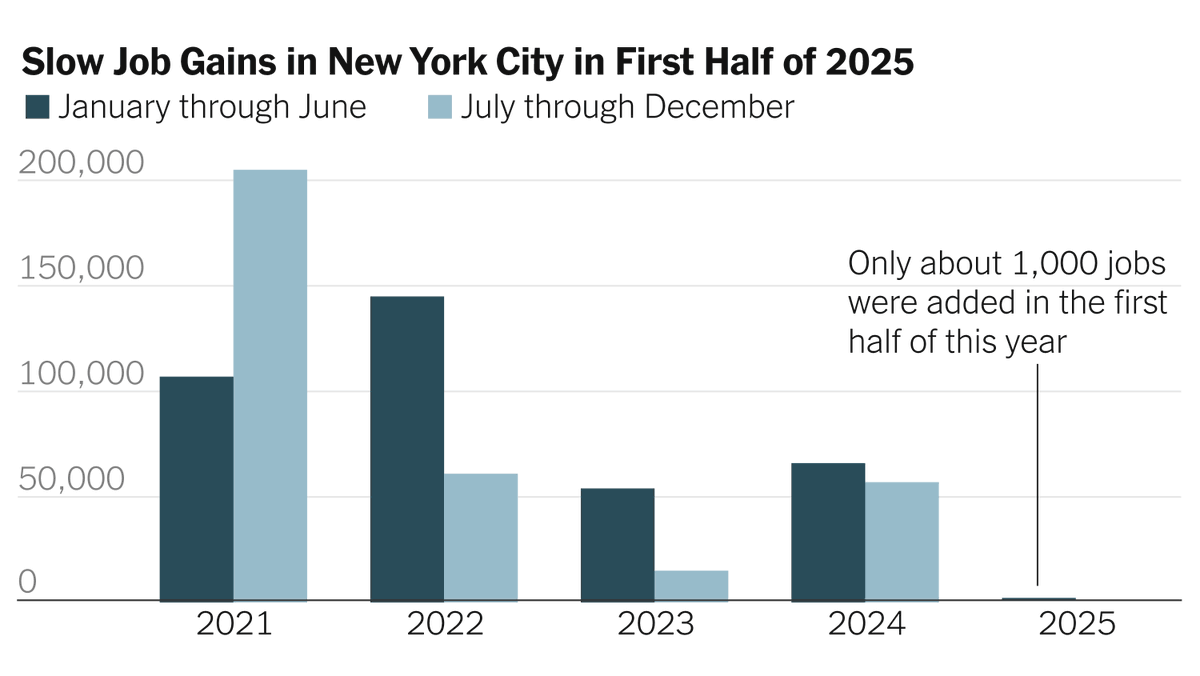
Since the Industrial Revolution, “high economic growth = high employment” was somehow the default mental model for new workforce, the big crash/depression/stagnation kill jobs. Think that assumption may break over the next few decade as we may be entering an era of ultra-high growth, ultra-high unemployment, unless “work” itself, and the structure of talent supply, can adapt fast. Both Big Tech and Big Fin are sharply cutting new-grad hiring already. NYC reportedly added only ~1,000 new jobs in the first half of last year
Didn’t expect the inflection to arrive this soon