Hello everyone 👋
Wanted to share something we’ve been quietly building for the past 6 months.
We’d love your support 🤲
Back in September 2025, a few of us got together with a simple question:
Why is cybersecurity education still so broken? People take courses and earn certifications but still struggle to land real jobs. Meanwhile, quantum computing is about to reshape how we secure dat and almost no one is preparing for it.
So we started EyrieQ.
We’re a small team of 13 people
- 4 core members with real 3-6 years cybersecurity experience building two things:
→ A cybersecurity learning platform that teaches how security actually works in real companies, not just isolated topics.
→ A quantum security R&D lab focused on post-quantum cryptography the next generation of encryption.
What we’ve done so far:
1. Built our complete product architecture and requirements from scratch.
2. Designed our GRC framework aligned with ISO 27001.
3. Launched a quantum security research program with 10 dedicated researchers.
4. Completed CTF infrastructure; frontend and backend development in progress.
5. Assembled a passionate, consistent founding team.
All of this with zero external funding just a team that believes in the mission.
We’re aiming to launch our MVP (beta version) by the end of this year. More details will share soon in the future.
If you’re into cybersecurity, quantum security, or just curious about what we’re building, stay connected. This is just the beginning.
EyrieQ – Securing Tomorrow’s Data, Today
from India 🇮🇳 🦅
We believe the future of enterprise computing will bring AI, HPC, and quantum together.
That’s why, today, Quantinuum and @Oracle have announced a multi-year strategic partnership to bring quantum computing to Oracle Cloud Infrastructure customers and accelerate the commercial adoption of hybrid quantum-AI computing.
As part of the collaboration, our Helios quantum computer will be deployed in a U.S.-based Oracle AI data center, alongside OCI’s HPC and GPU infrastructure, and made available through OCI’s quantum service to give OCI customers a practical and secure way to explore how high-fidelity quantum computing can complement existing AI and HPC workloads—using the governance and access controls they already rely on.
Read the joint announcement: https://t.co/Tgl4lYF6py
Like an orchestra, quantum processors must stay perfectly in tune. Our research uses reinforcement learning to continuously correct system drift, akin to tuning the instruments while the music plays.
Read the blog: https://t.co/yA8vJ0nX5Y
Last month, we hosted our annual Quantum Summer Symposium (QSS) at @DatalandMuseum, bringing together our partners, collaborators, and the broader quantum community. Watch the highlight reel to see a recap of the updates and discussions from the event: https://t.co/PD6hlEcRwh
What is quantum advantage?
As we see it, it’s a collective understanding that quantum systems can solve some problem(s) classical computers simply cannot. 🧵
Deeptech startup Pantherun expands into railway signalling, 5G networks with $220 million order pipeline
Bengaluru-based deeptech startup Pantherun Technologies is expanding beyond surveillance encryption into railway signalling systems, metro collision-prevention networks and 5G telecom infrastructure projects across Europe and the US with an order pipeline of nearly $220 million that will be executed over the next three to four years
By @BhavyaDKumar
https://t.co/0GddjOU7yW
$200,000 on the table. 5 enterprise challenges. $40,000 per winning team.
The 2026 Global Quantum + AI Challenge brings together five global enterprises, each posing a high-value operational problem and backing teams to solve it through structured proof-of-concept development.
Enterprise Challenges will come from:
* @Airbus
* @ClevelandClinic
* @eonenergyuk
* @HSBC
* @VWGroup
Applications are now open. Teams can review full problem statements, eligibility criteria, and submission guidelines and submit proposals via here: https://t.co/FoEZlrSE54 👇
#globalquantumaichallenge
Every organisation has different systems, vendors, dependencies, legacy constraints, performance requirements, and compliance needs.
A bank is not the same as a hospital.A payment terminal is not the same as a cloud API.
A software update pipeline is not the same as an IoT device. A cryptographic migration plan that works in one environment may fail in another.
So the work requires research, testing, tooling, frameworks, labs, and hands-on validation.
The challenge is not only “which algorithm is secure?”
The challenge is:
-> Where is vulnerable cryptography used?
-> Which data needs long-term protection?
-> Which systems must migrate first?
-> Can existing devices handle new cryptographic requirements?
-> Can current key management infrastructure support larger keys and new signatures?
-> Can software supply chains move to quantum-safe signing?
-> Can organisations prove that migration was successful?
-> Can security teams detect downgrade risks, misconfigurations, and incomplete deployments?
-> Can engineers be trained fast enough to execute this transition correctly?
This is the broader mission.
Quantum cybersecurity is not one tool.
It is an ecosystem, Assessment, Migration readiness, Independent validation, Crypto-agility, Secure implementation,Testing,Training, Threat modelling, Long-term data protection.
The reason this is scalable is simple:
The same global transition will affect many sectors, but the problems repeat in patterns.
Once you build strong frameworks, testing methodologies, training paths, and validation models, they can be adapted across industries.
-> The banking sector may have one version.
-> Healthcare may have another.
-> Cloud and SaaS may have another.
-> IoT and embedded systems may have another.
-> Government and defence may have another.
But the underlying need is the same:
Move from legacy cryptographic trust to quantum-safe trust without breaking systems, weakening security, or creating blind spots.
That is a large, long-term cybersecurity market It will not be solved overnight.
And it will not be solved only by big tech companies protecting their own ecosystems.
Real organisations run mixed environments: cloud, on-prem, legacy applications, third-party vendors, custom software, APIs, endpoints, devices, and operational systems.
The gaps between those systems are where risk lives.
-> Independent testing and readiness work will matter.
-> Vendor-neutral education will matter.
-> Country-specific infrastructure knowledge will matter.
-> Implementation expertise will matter.
That is why we believe this area is powerful. AI is changing how attackers operate. Quantum will change what attackers can eventually break.
Cybersecurity has to prepare for both.
At EyrieQ, our focus is on building practical capability for the quantum-security transition: helping people and organisations understand the risk, prepare their systems, validate implementations, and build the skills needed for the next era of cybersecurity.
The world does not only need quantum innovation It needs quantum readiness.
#EyrieQ !! #QuantumSecurityGap
Quantum computing will not just be “the next big technology trend.”
Its biggest near-term impact may be in cybersecurity.
For years, the world has trusted public-key cryptography to protect banking, cloud, identity, software updates, telecoms, APIs, payments, health records, government systems, and digital infrastructure.
But the foundation is changing.
Quantum computers will eventually challenge today’s widely used cryptographic systems. The real question is not only “when will quantum computers be powerful enough?”
The more urgent question is:
Are organisations ready to migrate before the risk becomes operational?
This is where the real gap exists.
The world already has post-quantum cryptography standards emerging. The algorithms are being standardised. Big technology companies, researchers, governments, and security bodies are all moving in this direction.
But having new algorithms is not the same as implementing them correctly.
That is the hard part.
Most organisations do not have a clear inventory of where cryptography exists inside their systems. It is hidden inside applications, APIs, certificates, TLS configurations, VPNs, identity systems, databases, firmware, IoT devices, CI/CD pipelines, HSMs, cloud services, payment infrastructure, and third-party dependencies.
Migration is not a simple software update.
It is a deep infrastructure transition.
It requires discovery, assessment, testing, validation, implementation, monitoring, and training.
This is why quantum cybersecurity is not just a future research topic. It is an implementation challenge that starts now.
This is why quantum cybersecurity is not just a future research topic. It is an implementation challenge that starts now.
One of the biggest risks is the gap between “we have migrated” and “we have verified that the migration actually works.”
A system may claim to support post-quantum cryptography, but still fall back to legacy algorithms. A certificate chain may be updated, but one internal service may still depend on old cryptography.
A cloud endpoint may be protected, but an IoT device or legacy application may remain exposed. A vendor may say the product is quantum-safe, but independent validation will still be needed.
This is the space we are focused on at “EyrieQ”.
-> Banks will need this.
-> Healthcare systems will need this.
-> Government infrastructure will need this.
-> Cloud platforms will need this.
-> Software supply chains will need this.
-> IoT and embedded systems will need this.
-> Enterprises with long-term sensitive data will need this. And this is why the scope is powerful.
Quantum risk does not sit in one product category. It cuts across the entire trust layer of the internet and modern digital systems.
-> Encryption protects communication.
-> Digital signatures protect identity and software integrity.
-> Certificates protect trust.
-> Key management protects access.
-> Secure hardware protects secrets.
-> APIs connect critical services.
-> Embedded devices process real-world transactions.
If the cryptographic layer changes, the impact spreads across all of these areas.
That is why this is an R&D problem.
Not because the concept is theoretical, but because real-world implementation is messy. 1/n
#EyrieQ !! #Quantum !! #QuantumSecurityGap
Our team ran a verifiable quantum algorithm that probes how parts of a quantum system interact, from molecules to magnets and beyond. On our Willow chip, it ran 13,000× faster than the best classical supercomputers. A first in quantum computing → https://t.co/j56g2M7gx0
Every screen you're reading this on. Every MRI scan. Every laser. Quantum mechanics made them possible and the next chapter may be the most profound yet. 💫
In Our Quantum Future, Nobel Laureate Dr. William Phillips calls it perhaps the most successful theory humanity has ever developed. It's hard to argue.
Our Quantum Future explores not only what quantum enables but why we pursue it in the first place.
Watch the full trailer: https://t.co/IbO8egcGsQ
#OurQuantumFuture
With $200,000 in prize funding, The Quantum Insider is proud to present the #globalquantumaichallenge
Announced last week, the 2026 Global Quantum + AI Challenge is designed to accelerate the shift from quantum theory to enterprise-ready solutions by connecting real industry problems with global technical talent.
We're proud to welcome the following as partners:
@Airbus@ClevelandClinic@EON_SE_en@HSBC@VWGroup@awscloud (AWS)
@ClassiqTech@MITREcorp
Quantum in South Carolina ( SC Quantum )
Applications are now open. Teams can review full problem statements, eligibility criteria, and submission guidelines and submit proposals via here:
https://t.co/1G83ytTnrw 👇
#globalquantumaichallenge
⚛️ Entangling Quantum Ideas with Real-World Impact 🔗Q-Entangle 2026: Where Quantum Meets Security, and Ideas Become Reality 📡
@ieee_section, in association with @cdacindia Bengaluru, presents Q-Entangle Quantum Conclave 2026, on 10 Sept 2026, Bengaluru, co-located with the 7th IEEE PKIA 2026 Conference.
A premier platform bringing together researchers, innovators & industry experts to explore the frontiers of Quantum Technologies & next-gen security paradigms.
We invite original research (8-page IEEE format) in #QuantumTechnology, #PKI & allied domains.
Accepted papers may be published in IEEE Xplore (special track of IEEE PKIA 2026), via lightweight double-blind review.
Submission links:
https://t.co/GGETXa0YNy
https://t.co/eEHZ1yJ1oO
Select “Special Track on Quantum Technology” on CMT
Last date: 15 May 2026
#QuantumComputing #CyberSecurity #PKI #IEEE #Innovation #Research #QuantumTechnology #CognitiveSecurity #PKIIndia
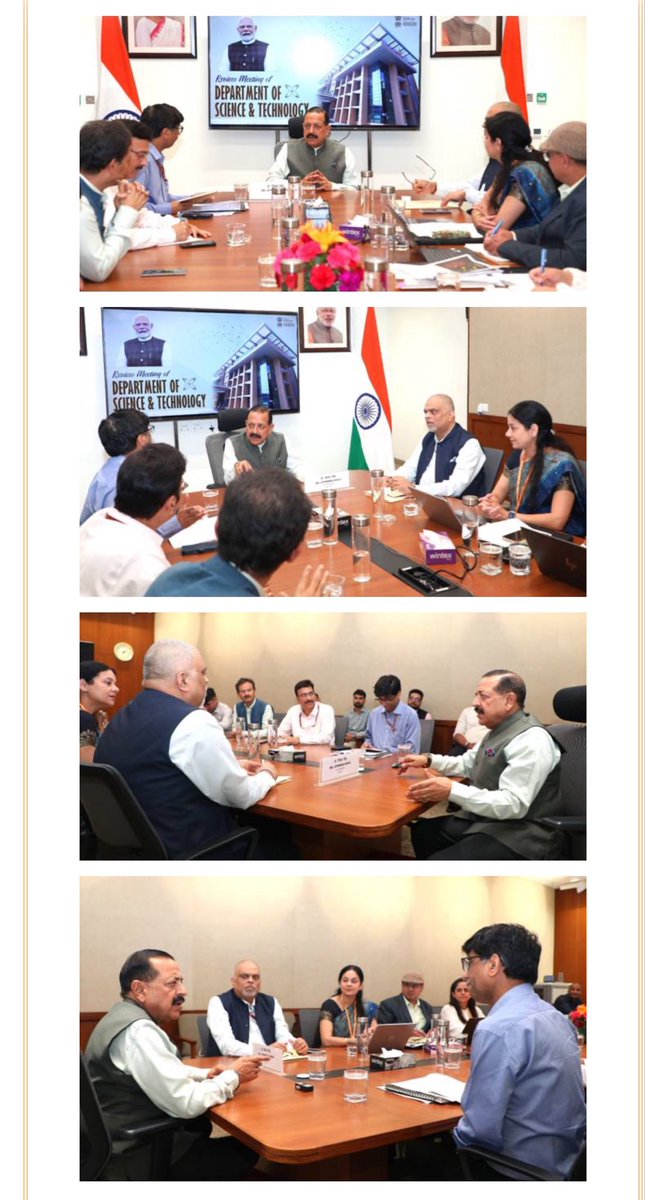
This #WorldQuantumDay, India marks steady progress in quantum science and technology.
1,000 km of secure quantum communication achieved in under 3 years, alongside a growing deep-tech ecosystem of 17 startups and 4 Thematic Hubs driving research and innovation.
Supported by the @IndiaDST under #NQM, these efforts reflect a continued commitment to building sovereign capabilities and advancing India’s role in the global quantum landscape.
@PMOIndia@DrJitendraSingh@karandi65@PrinSciAdvOff@nqmdst@DBTIndia@CSIR_IND@moesgoi@mygovindia@PIB_India@PIBDST
India has achieved a groundbreaking quantum milestone! 🇮🇳🔬
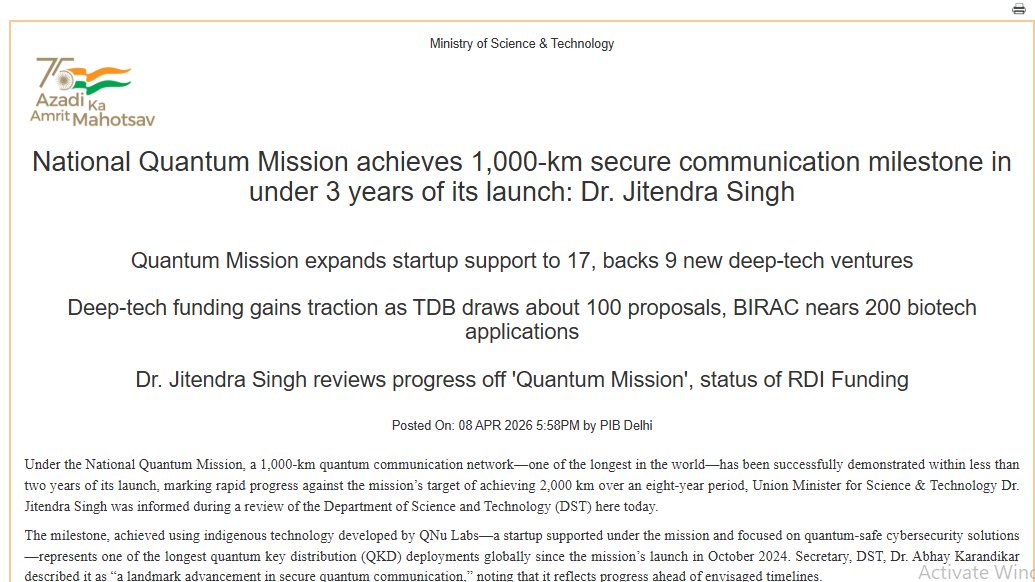
Under the National Quantum Mission, a 1,000 km secure quantum communication network one of the longest in the world has been successfully demonstrated in under 2 years since the mission’s launch in October 2024.
The original target? 2,000 km over 8 years. We’re already halfway there, way ahead of schedule.
This breakthrough is powered by fully indigenous Quantum Key Distribution (QKD) technology from Bengaluru-based deep-tech startup @qnulabs . Their ARMOS platform enables theoretically unhackable encryption using the principles of quantum mechanics.
How QKD works: It distributes encryption keys via single photons over optical fiber. Any attempt to eavesdrop disturbs the quantum state, making interception instantly detectable. This provides information-theoretic security unbreakable even by future quantum computers (unlike today’s RSA or ECC algorithms vulnerable to Shor’s algorithm).
Key technical highlights:
-> Up to 200 km per link on standard telecom fiber (handling up to 40 dB loss) without trusted relays or amplification • Independently validated by global leader VIAVI Solutions on their MAP-300 platform
-> Works on existing fiber infrastructure, including challenging terrains • Rapid progress: 500 km achieved in Nov 2025 → 1,000 km now.
This isn’t just a lab demo. QNu Labs has already delivered QKD systems to the Indian Navy, with orders from the Army and BEL. Perfect for securing defence communications, financial systems, critical infrastructure, and protecting against “harvest now, decrypt later” attacks.
Strategic importance: While China leads in some quantum areas, India is rapidly closing the gap with a startup-driven, cost-effective model. This strengthens national cybersecurity sovereignty and positions us as a serious player in quantum-safe tech.
Broader wins under National Quantum Mission:
-> 17+ quantum startups now supported (9 new ones recently added in biosensors, sensing, positioning, etc.) • Strong funding traction via TDB and BIRAC
-> Clear focus on Atmanirbhar Bharat in frontier tech
Huge congratulations to the @qnulabs team, @IndiaDST and @DrJitendraSingh for driving this momentum.
This is the kind of quiet but powerful progress India needs in deep tech. Quantum threats are real and we’re building the shield today.
Full official details: https://t.co/IIg5BFr6cV
What do you think? Is India moving fast enough in quantum? Drop your thoughts👇
#QuantumIndia #NationalQuantumMission #QNuLabs #MadeInIndia #AtmanirbharBharat #DeepTech
India 🇮🇳 Makes history!!
INDIA has successfully demonstrated a 1,000-km secure quantum communication network, which is one of the longest in the world.
This achievement comes less than two years after the mission's launch in October 2024, far outpacing the original timeline to reach 2,000 km in 8 years🤯🚀
For more information PIB Link:
https://t.co/cn78kwRs8t
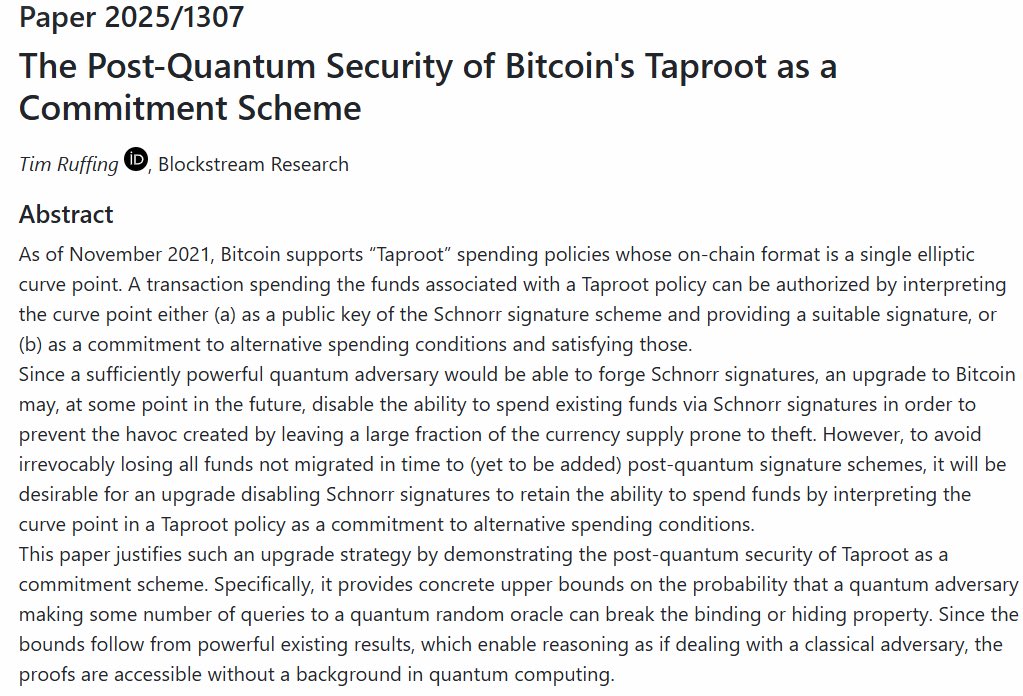
Lightning Labs CTO Olaoluwa Osuntokun just shared a working prototype posted to the Bitcoin developer mailing list yesterday that could save a huge amount of Bitcoin if quantum computers ever become a real threat.
Most modern Bitcoin wallets (especially Taproot ones) show your public key on the blockchain. Normal computers can’t turn that into your private key. But quantum computers can - using something called Shor’s algorithm. Google’s research from March 2026 showed it might only take about 9 minutes with under 500,000 qubits. That’s closer than many expected.
The emergency plan? Bitcoin could do a soft fork to disable the easy spending method. This stops attackers nd thieves, but it would lock out roughly 6.9 million BTC in normal wallets forever - even the real owners couldn’t access them.
This new prototype fixes that. It lets you prove “this wallet really came from my 12/24-word seed phrase” without ever showing your seed or private keys. The network checks the proof and lets you move your coins safely. It currently runs in ~50 seconds on a laptop.
Simple analogy:
Imagine your Bitcoin is cash in an old safety deposit box. Everyone sees the box number. A quantum thief has a magic machine that copies your key just by looking at it.
The bank switches all boxes to new unbreakable locks to stop the thief…
but now even you can’t open your own box.
This tool is like giving the bank a sealed, unforgeable letter that proves it’s really your box from the old system. They verify it and let you in. Problem solved.
This matters for all of crypto not just Bitcoin. The same math protects banks, websites, and many blockchains. We’re seeing the shift from “someday” worry to actual code.
What you should do now:
-> Use fresh addresses when sending/receiving
-> Consider moving important holdings to more quantum-resistant setups
-> Don’t panic - real quantum computers powerful enough don’t exist yet
-> But pay attention. The devs are quietly building the escape hatch before it’s needed.
Proactive work like this Bitcoin stays resilient. Respect to the team 🔥
🚨 THIS IS HUGE
Bitcoin Devs have built a prototype that will protect wallets from quantum attacks.
With this, if the Bitcoin network is ever forced to defend against quantum computing, normal spending could be paused, and users will be able to recover their funds.
Bitcoin Devs have started to take quantum threats seriously now, and this is a good sign.
🚨 Frontier AI Cybersecurity Showdown: Anthropic’s Claude Mythos Preview vs OpenAI o1.
-> Anthropic just dropped Project Glasswing using their unreleased Claude Mythos Preview model that’s already outperforming most human experts at finding & chaining zero-days.
-> Mythos has autonomously discovered thousands of high-severity vulnerabilities (including zero-days) in every major OS and web browser, plus ancient bugs like a 27-year-old flaw in OpenBSD.
-> It excels at full exploit chaining for system takeover. On benchmarks like CyberGym it hits 83%+ (vs 67% for previous Claude), and it saturates CTF-style challenges.
This model is so capable that Anthropic won’t release it publicly too dangerous for broad access. Instead, they’re gating it defensively through a massive coalition: AWS, Apple, Google, Microsoft, NVIDIA, Cisco, CrowdStrike +40+ orgs, with $100M in model credits + donations to open-source security projects.
Goal: patch critical infrastructure before bad actors get equivalent tech.
-> Compare to OpenAI’s o1 series: Strong reasoning uplift over GPT-4o helps in CTF/pwn tasks, adaptive exploitation, and creative misconfig attacks.
-> It reaches ~46% high-school / 13% pro level in some challenges with tools & iterations. But OpenAI’s evals show it stays below expert human performance for real-world zero-day hunting and autonomous high-stakes offense didn’t cross their medium-risk threshold for cyber.
-> o1 is publicly available with safety layers, focused on general chain-of-thought excellence. No equivalent large-scale defensive vuln-scanning initiative announced.
Key takeaway: Anthropic is treating Mythos as a strategic defensive asset withheld for safety but weaponized for good via industry-wide patching. OpenAI is pushing accessible reasoning improvements with rigorous red-teaming.
This is the dual-use dilemma in action: AI that can find novel bugs faster than humans can also weaponize them. One approach gates the power to defenders. The other democratizes stronger reasoning.
Who wins for real-world impact in 2026? The closed defender coalition or open(ish) capability release?
What’s your take gate frontier cyber models tightly or accelerate safely?
#AISecurity #CyberAI #ProjectGlasswing #ClaudeMythos
Introducing Project Glasswing: an urgent initiative to help secure the world’s most critical software.
It’s powered by our newest frontier model, Claude Mythos Preview, which can find software vulnerabilities better than all but the most skilled humans.
https://t.co/NQ7IfEtYk7
Introducing Project Glasswing: an urgent initiative to help secure the world’s most critical software.
It’s powered by our newest frontier model, Claude Mythos Preview, which can find software vulnerabilities better than all but the most skilled humans.
https://t.co/NQ7IfEtYk7