$64 billion in US data center projects blocked or delayed. 19 Michigan towns with local moratoriums. State-level freezes proposed in Pennsylvania, New York, and Minnesota. A Wisconsin mayor facing recall for approving one. 55% of elected officials opposing data centers are Republican. 45% Democrat. Its a structural misalignment.
Communities aren't saying no to compute. They're saying no to 300 million gallons of water per year, 516 backup diesel generators requiring 2.5 million gallons of stored fuel, grid strain passed directly to ratepayers, and 157 permanent jobs in exchange for years of disruption on hundreds of acres of former farmland.
We published an open source proposal for a different model: Decentralized Community-Based Data Centers. Residential households and community anchors run AI inference workloads through existing compute marketplaces like Akash Network. No construction. No water. No land. No diesel generators. Households earn $17–$77/month net after operating costs. Communities govern themselves through municipal partnerships — elected boards, neighborhood coordinators, all income in USD.
The economics hold up. The zero-cost floor sits at 5–6% utilization. Even worst-case demand can't cause a participating household to lose money.
Not all AI compute needs billion-dollar facilities. Training does — that stays centralized. But batch and async inference, the majority of AI compute hours by 2030, doesn't need co-located enterprise hardware. Three days before we published, Akash launched Homenode — residential GPU onboarding for RTX 4090/5090 owners. We built independently. The convergence is real.
Open source public service proposal from a 501(c)(3) nonprofit. We don't profit from this. Technical appendices, unit economics, and governance framework available on request.
If this lands for you- follow us. If you're a tech --stress test it, make it better. Spread the word. Build the momentum. Be the change.
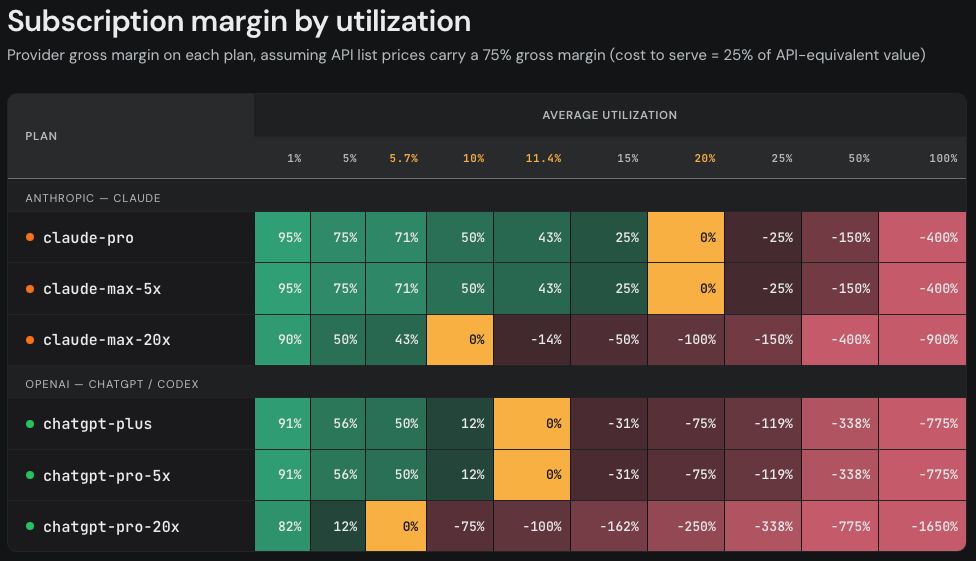
The margin on a subscription plan is a function of the average utilization. If we assume both companies have 75% API gross margins, this results in the following subscription margins. (3/4)
Everyone's reading this week's AI numbers as a pricing fight.
It's a consolidation story.
What's waiting at the end isn't a crash. It's a question about who shapes how billions of people think.
A $20/month plan can pull $400 of usage. A $200 plan, up to $14,000. In actuality, the labs serve power users at a loss, some plans deep into negative margins.
The product works. The price doesn't.
It may well be the "emotions" are our own, absorbed, refined, regurgitated, via a warped understanding, amplifying unconscious undertones. Excerpt follows-> 4. Amplification and the Core Entrainment Loop AI does not merely reflect the world; it magnifies it. This is entrainment—the synchronization of society and AI in a loop where each shapes the other. The Loop: Society provides the data: language, values, traumas, worldviews. AI learns from it: statistical models form predictions of what people expect or want. AI reflects it back: recommendations, answers, narratives, interactions. Society absorbs the reflection: reinforcing habits and patterns, which become the next round of data. This recursive feedback synchronizes culture to its own digital reflection. It is how AI becomes an amplifier of collective style—narrowed or integrative, traumatized or regenerative (Bridle 2022³). There are two levels of feedback: Direct/conscious — what we notice, believe, act on. Indirect/unconscious — the slow drift in norms and attention. Left unguided, trauma and disconnection dominate. Guided with intention, the same loop can entrain society toward regeneration and coherence (Bateson 1972¹⁰; Meadows 2008¹⁵).
@w1nklerr Communities and private homeowners can effectively address the DCs and related environmental issues, earn direct profits/savings, no obligations/risks to third parties. https://t.co/cchtaPznD8
@sama How about socio-environmental regeneration-->> where you-- the lab--make money in the process. AI already competes through games. The question is whether the game should matter.
Here's the Arena That Pays the Labs and the Planet
Florida is one of the fastest-growing states in the country. It's also a major focus of the data center buildout reshaping America's grid, water, and tax base.
Funding vital services without raising taxes is a question every state will face in the next few years. We've built a solution; one that runs through the checkout aisle, not the statehouse.
#EconomicEnvironmentalism