@LukeGromen I thought they were on the same side of the balance sheet:
- China lends to USA secured by tax revenues and redeemed.
- China lends to BRI secured by commodities
⚡️The most likely path is far stranger than “the dollar gets replaced.”
Reserve-currency power is already beginning to fracture by function.
The dollar can remain the dominant unit for trade invoicing, global credit, collateral, banking, taxes, and settlement while losing monopoly status as the place the world stores long-duration wealth.
That separation matters enormously.
For decades, the dollar system bundled several privileges together. Countries earned dollars through trade, recycled them into Treasuries, used Treasuries as reserves and collateral, borrowed in dollars, and settled through American-controlled financial infrastructure. The same network handled saving, financing, payment, and geopolitical power.
Those functions are starting to peel apart.
Gold is increasingly absorbing reserve demand from states that want an asset without another country’s liability attached to it.
Bitcoin is emerging as a globally portable scarcity asset outside discretionary sovereign supply.
Stablecoins can spread dollar settlement further than the banking system ever could.
Tokenized Treasuries can make American sovereign collateral even more globally accessible.
China can build alternative trade and payment channels without ever making the renminbi remotely as trusted as the dollar.
That produces a future where dollar dominance can weaken and expand simultaneously.
The dollar loses part of its monopoly over savings.
Dollar rails spread deeper into global commerce.
Treasuries remain foundational collateral.
Gold and Bitcoin absorb distrust of sovereign duration.
Regional currencies gain settlement share around specific trade blocs.
No single successor has to defeat the dollar.
That is the part people consistently miss.
Empires rarely lose monetary dominance because another currency wakes up one morning and takes the crown. They lose it because the network stops being unavoidable.
That is the threshold.
A sanctioned country needs another route.
A central bank wants reserves outside foreign jurisdiction.
A corporation wants settlement outside correspondent banks.
An individual wants savings outside monetary dilution.
A trading bloc wants invoicing that cannot be interrupted by Washington.
Each workaround removes one small piece of compulsory dependence.
Once enough alternatives exist, the United States can still possess the strongest monetary network on earth while losing the ability to treat participation in that network as inevitable.
And that is where the fiscal problem becomes dangerous.
Reserve-currency status has allowed America to issue liabilities on a scale other countries cannot. The world needs dollars and safe collateral, so foreign savings continually flow toward American assets.
That gives Washington extraordinary room to run deficits, intervene in crises, finance military power, and preserve domestic consumption above what pure trade arithmetic would otherwise permit.
If marginal foreign demand for long-duration Treasuries weakens while American issuance keeps accelerating, the adjustment eventually comes through some combination of higher yields, greater domestic financial repression, more official liquidity support, inflation, and a larger role for the Fed in protecting Treasury-market functioning.
That is the true reserve-currency endgame to watch.
The financial system evolves via a series of sequential betrayals between society’s stakeholders - this is why a “money” that is the obligation of a specific stakeholder will eventually fail
Japan is cooked
August 7 – Bloomberg (Nao Sano): “Japan’s four largest life insurers reported that their combined unrealized losses on domestic bonds increased 7% in the three months through June, showing the risks to the industry from soaring interest rates. Paper losses on bonds held by the insurers including Nippon Life Insurance Co. swelled to ¥15.13 trillion ($96bn), according to the four firms’ earnings reports... All four, comprising Daiichi Life Group Inc., Sumitomo Life Insurance Co. and Meiji Yasuda Life Insurance Co. in addition to Nippon Life, saw increases in unrealized losses.”
Edward Fishman ranks the most important chokepoints in global commerce, including advanced semiconductors, the U.S. dollar, China’s rare-earth minerals, and the Strait of Hormuz. Read the full interview here: https://t.co/ClhsbRQShR
To the victor, the spoils.
The transition from CaloriesAsOPEX — hunting and gathering — to CaloriesAsCAPEX — agriculture — converted subsistence from access to a natural flow into control of productive assets. Specialisation of labour and capital followed. Property rights hardened. Surplus became accumulable. Society became more stratified, hierarchical and, eventually, feudal.
Electrotech may represent an analogous transition in energy:
Carbontech: capital + recurrent fuel → energy Electrotech: capital → near-zero-marginal-cost energy
The economic locus of scarcity therefore shifts from fuel consumption to ownership of productive capacity: generation, land, grids, storage, software, finance and access rights.
Problem: What social order emerges when an essential input becomes cheap at the margin, but the assets producing and distributing it remain scarce, ownable and unequally distributed?
More sharply:
If agriculture made calories abundant by making land valuable, will Electrotech make energy abundant by making energy-producing capital more valuable — and what new hierarchy of property, rents, labour and power follows?
@grok - what is the size of UST holdings by private sector financial institutions - Japanese pension, asset management and insurance companies.
Can you compare to MOF-BOJ holdings
Make no mistake. The US Treasury teaming up with the Bank of Japan is not to merely "help the yen or other Asian currencies." It is to protect US Treasuries. Why? Because if the BoJ is left to stabilize and support the yen themselves, they will have little choice but to sell US Treasuries to do so, thereby competing with the Treasury itself for demand. This alone could send the 10-year yield over 5% and cause a large shift upwards on borrowing cost to the US Treasury, and thereby, the US government.
The global green transition won’t be driven by self-interest alone
https://t.co/idUQVrGM6S
This is like assuming your carbon footprint will help. It’s good to reduce, but the better plan may be to increase your prepper status for the imminent adaptation that will be required.
@B_Eichengreen Not good news for Japanese Asset Management
If selling Treasuries is a problem, then selling Treasuries is a problem!
1971: USD != XAU
2026:UST != USD
FIMA only works for Sovereigns/ Monetary Authorities
Not good news for Japanese Asset Management
If selling Treasuries is a problem, then selling Treasuries is a problem!
1971: USD != XAU
2026:UST != USD
FIMA only works for Sovereigns/ Monetary Authorities
This is interesting.
My view is that the absence of payment data made it harder to track Chinese commodity transactions.
There is insufficient information on energy stockpiles - etc. Extend this to other commodities and the ability to use commodity prices as geoeconomic weapons against China - and income bystanders - diminishes.
The next step will be commodity price indices - as China/ Asia will slowly define the global market away from London, New York and Chicago.
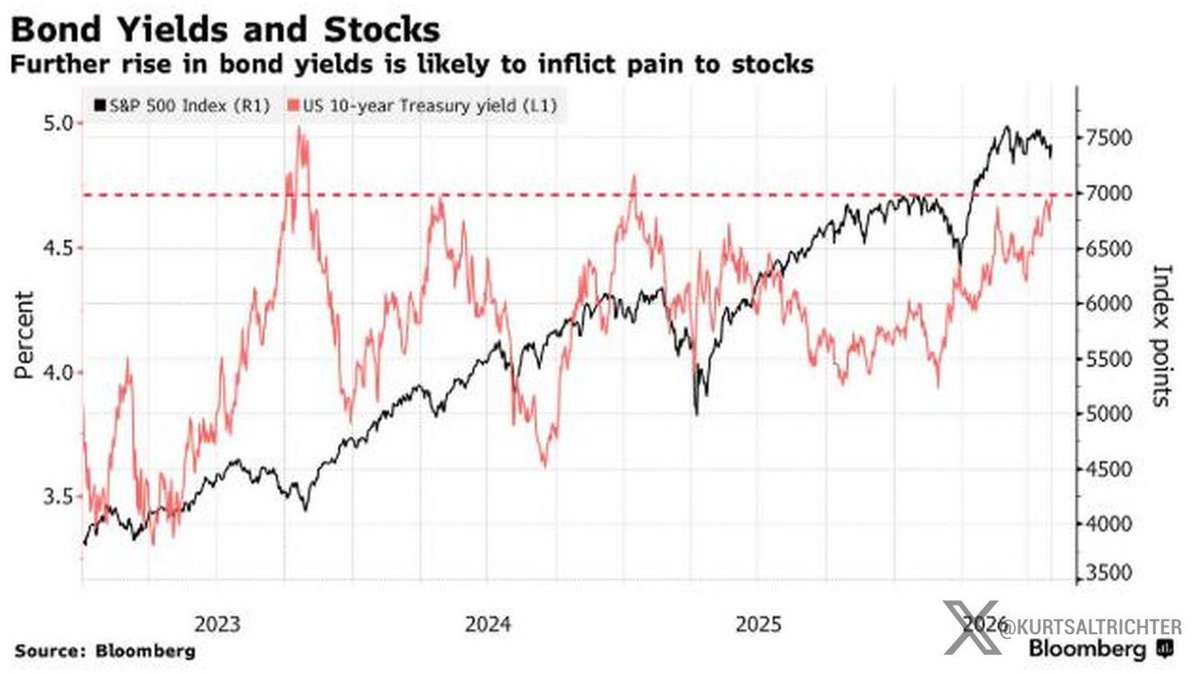
The 10-year Treasury is back at 4.7%, and it keeps capping stocks.
Every time the 10-year pushes toward 4.7%, the S&P 500 stalls, because a higher risk-free rate lowers what every future dollar of earnings is worth today.
Rising yields hit the longest-duration assets hardest, and that is Big Tech, where the valuation rests on cash flows years out. The higher rates go, the more the discount rate does the damage the multiple used to hide. The bond market is setting the ceiling here.
🇺🇸🇮🇷 Washington says a Hormuz deal could land any hour now as only two of the five destroyers defending the Mediterranean actually work
The deal window is open, and Matthew Hoh, Marine veteran of Iraq and Afghanistan turned one of Washington's sharpest dissenters, makes the case for walking through it in the bluntest terms you'll hear:
"When you lose a war, you get out of the war."
That's the prize, and he means it as encouragement, not insult.
His breakdown of the arsenal math turns the whole depletion story on its head, and he asks the question nobody else has: if America is really this exposed, why is nobody attacking?
Then the confession only a two-war veteran could make, about the one cheap weapon that would have made the occupations he served in impossible, and why Iran is the first enemy in generations that spent decades preparing.
He also demolishes the fees-are-unthinkable talking point with a map of every strait on earth where payments already happen, before his warning about what a deal might really buy: time to reload.
The exit is right there.
The question is whether anyone in Washington can recognize a door.
@MatthewPHoh@WeTheBrandon