again, big picture, donald trump won an election about affordability and then he
- passed tariffs (which raise consumer prices)
- expanded the deficit w a ginormous corporate tax cut (raises interest rates)
- waged a stupid war (raises gas prices)
- and now refuses to sign a bipartisan bill to reduce housing costs bc he's protesting senate republicans for failing to pass voting restrictions
... while making $2 billion from crypto rug pulls that transferred income from his supporters to his bank account
americans hate the president for very good reasons
One of the most positive byproducts of Hyperliquid’s success is that the market is now forcing projects to prioritize value capture and team alignment with token holders.
The public is simply just tired of founders not caring about them and making backroom deals at their expense.
There’s already enough risk investing in crypto given it’s an early stage technology.
Compounding it with ambiguous economic rights and information asymmetry just makes it that much harder for the average person to successfully navigate the asset class.
I understand that not all this was done out of malice, as many teams simply didn’t appreciate the demands of running a public project and are learning investor relations on the fly.
But man is this a much needed cultural change.
Hyperliquid.
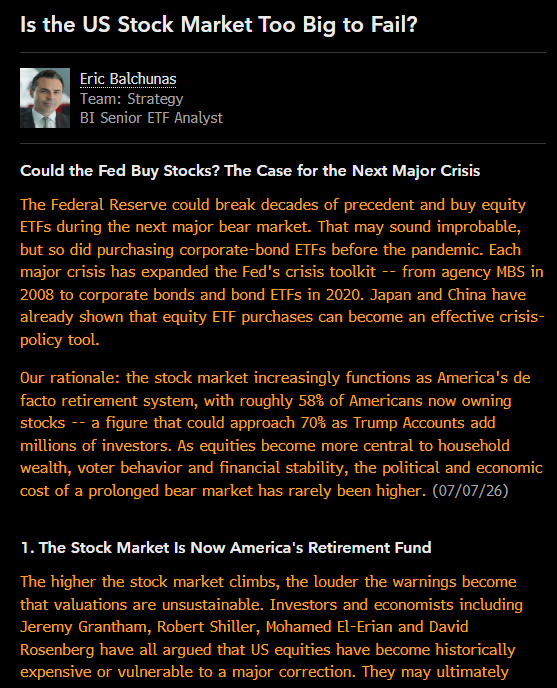
I published a note today that I've been thinking about for months.. About how the US stock market has arguably become too big and too imp to fail.. It's basically America's retirement fund now and poss even the savior of social security which is expected to run out of money in less than 10yrs
-Curr 55% of ppl own stocks, by far most in world. And w/ Trump Accounts bringing in 28 million add'l americans into stock ownership the vast majority of ppl (incl Top 1% (who own HALF of stock mkt), middle class and lower income) will have financial interest in the health of stock mkt and they're all voters = the political pressure to keep stocks out of a prolonged bear market is going to be very powerful.
-As such I think there's good chance the Fed will buy equity ETFs in the next major downturn to support market and it will be common practice going fwd. China and Japan already do this. They may even target certain sectors or Capex cos with the purchases.
-This is a massive variable that I feel like is a blind spot among the experts out there and why the bears get run over time and time again altho I think investors are onto it as evidenced by the persistent flows into ETFs during pullbacks as well as a survey of 1000 ppl showing 3/4 of them are confident the Fed will bail out markets in next crisis.
-This is just one byproduct of the 'Nothing Stops This Train' monetary supply explosion and debt extravaganza sweeping the world but esp in US which at this point feels irreversable.. Thoughts? lol
This is unusual.
Before Trump paused tariffs and ignited a historic 10% market rally, his accounts purchased 327 stocks worth up to $12.8 million.
The disclosures came more than a year late.
The fine was just $200.
Andrew Huberman’s no-BS fat loss protocol that actually works for real people:
Meat, fish, eggs, fruit, and vegetables. That’s it.
No bread, pasta, rice, tortillas, or processed junk. Water, coffee, or tea only.
People drop 4.5 kg (10 lbs) in the first week, stay full thanks to protein, and keep the results because it’s sustainable.
Add walking, then some resistance training, energy, sleep, mood, and libido all skyrocket.
Simple real food. No complicated rules.
What’s one simple eating change that’s helped you lose fat or feel way better?
Trump says he thinks Warsh is at the more dovish side of the FOMC, a day after Hassett made similar comments and one week after Bessent said he hoped the Fed would have an “open mind” on inflation and predicted it would ease this year.
A new era of forward guidance….
America Runs on Natural Gas: Fuel Set to Surpass Oil as US Top Energy Source by 2030
By the end of the decade, natural gas will likely surpass oil for the first time after the gap all but disappeared in 2025.
In 2025, natural gas comprised 36% of US energy consumption, just shy of the 37% made up by petroleum, according to a recent Energy Information Administration report.
(Bloomberg)
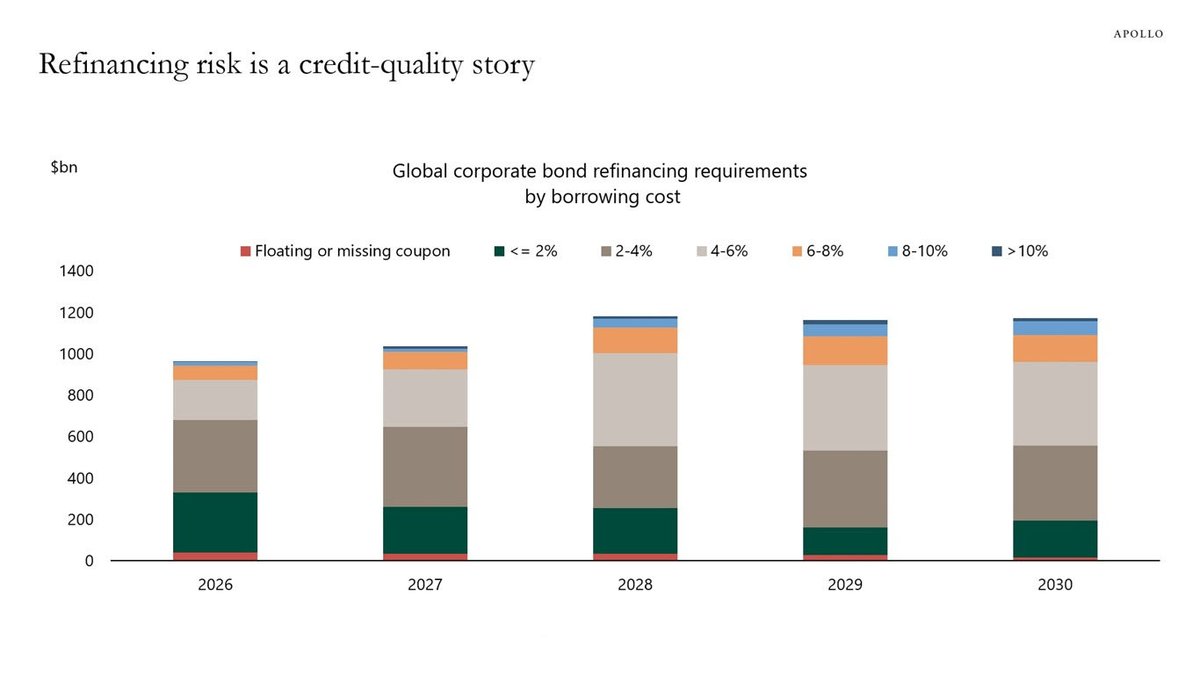
One very simple reason the Fed and Treasury can’t afford to raise interest rates and why the inflationistas are likely to be proven wrong.
From Torsten Slok:
“A wave of corporate bonds issued during the low-rate era of 2020 and 2021 is now coming due, forcing companies to refinance cheap debt at today's higher rates, with high-yield borrowers feeling the squeeze first given their shorter 5-to-8-year maturities, while investment-grade issuers sit in a stronger position today, having locked in low rates with 10-year-plus tenors that push their refinancing needs comfortably further out.”
Pair this with the refinancing needs of over $1 trillion at the Treasury and I highly doubt will see a hawkish Fed’s
Credit spreads rising should keep expectations for any rate rising at bay.
@infraa_
I am officially nominating Donald J. Trump (@realDonaldTrump) for the Nobel Peace Prize.
No President in History has ended the same war so many times.
Our Dear Leader has ended the war with Iran at least 38 times by CNN’s count.
No President has ever done this before.
And he is nowhere near finished ending it.
It’s a record worthy of the Nobel committee’s recognition. Thank you for your attention to this matter!
BREAKING: Look at this.
On July 23, 2025, Trump purchased up to $5 million of Broadcom, $AVGO, Meta, $META, Amazon, $AMZN, Apple, $AAPL, Microsoft, $MSFT, & Nvidia, $NVDA.
Later that day, the Trump admin unveiled its AI Action Plan, a policy that benefited those companies.
This capital will be used to uphold the First and Fourth Amendments to the Constitution as they relate to mankind’s interaction with AI.
To those hearing about us for the first time, consider switching to an AI platform that doesn’t demand control over you; that doesn't demand the unearned privilege of spying on your activity and siphoning it to the inquisitive. Consider that you alone should be sovereign over your mind, whether natively biological or augmented by machine.
BREAKING: Look at this.
The day before Trump paused tariffs, triggering a historic 10% market rally, his accounts purchased 327 stocks worth up to $12.8 million.
The trades were disclosed more than a year late, resulting in a $200 penalty.
Unusual.
Donald Trump declared making more than 22,000 stock transactions in 2025, according to the FT analysis. His immediate predecessor, Joe Biden, made 13 transactions over four years. In his first term, Trump made 517. https://t.co/mWDvtvAllj
On our Camino trek, tonight we stopped in Pontevedra, Spain.
a few mins into walking around we both noted this city felt weirdly great and alive (yet not chaotic) in a way other cities just don’t
Busy plazas, kids running around, people sitting outside, restaurants spilling into the streets. It felt like the city was built for humans.
It wasn’t immediately clear why it was this way so I asked chat what was going on and got a great answer (paraphrased)
In 1999, a new mayor made a very controversial bet: the city center should be for people, not parked cars.
He moved fast. Pontevedra removed street parking, eliminated most through-traffic, and kept only the useful car access: residents, deliveries, taxis, emergencies.
At first, people hated it.
Store owners were absolutely furious. The obvious objection was: if customers can’t park at the curb, they won’t come.
But then people actually lived with the change and really liked it
The city got calmer, safer, more walkable, less polluted, and more alive. Foot traffic replaced car traffic and businesses got busier than ever.
The mayor keeps getting reelected, still there 27 years later (he’s Spain’s longest serving mayor among large cities)
Of all the cities we’ve visited on this trip through Europe, Pontevedra (which I had not heard of before) is the liveliest, a hidden gem!
I don’t think every city should ban cars, but it seems obvious that cities get a lot better when the best public space is used for people instead of car storage.
Ackman views $MSFT as having an "impossible to disrupt" position in enterprise software. The base Microsoft 365 package has 450M users at a very low cost per seat, roughly $200 per customer. It would be nearly impossible for an enterprise to replace these various components with 3P vendors, even at twice the price.
Microsoft Copilot gives enterprise employees a secure way to access AI tools without putting the company at risk of extreme cloud computing bills or exposing proprietary data.
Last night’s speech by Treasury Secretary Scott Bessent signals the decisive shift in US economic doctrine: from efficiency to sovereignty.
Invoking Alexander Hamilton, Bessent framed industrial capacity not as a legacy asset, but as the foundation of national power in a contested world. The comparison is not casual. If carried through, it would make Bessent the most consequential Treasury secretary since Hamilton himself.
The message is clear. Globalisation optimised for cost has left the US exposed, to supply disruptions, geopolitical coercion and technological leakage. Dependence is no longer a benign feature of trade; it is a strategic vulnerability.
This is not autarky, but reprioritisation. Semiconductors, energy systems, advanced manufacturing and compute infrastructure are being recast as sovereign capabilities. Supply chains are judged less by efficiency than by their ability to withstand shocks and resist pressure from adversaries.
The economics are less comfortable. Resilience implies higher costs, sustained fiscal support and the risk of stickier inflation. But Washington appears willing to pay.
For markets, the shift is structural. Capital will follow policy into strategic sectors, while exposure to adversarial supply chains will command a growing discount. Hamilton’s logic has returned. This time, markets may have less choice but to follow.
I have read approximately 3,000 10-Ks in my life. I have read my wife’s emotional state correctly maybe 11 times. This is troubling because the skills should transfer. Both require you to look past the headline. Both require you to read the footnotes. Both require you to notice what was said last quarter that is not being said this quarter.
I can spot a goodwill impairment from 40 pages away. I cannot spot that my wife has been quietly furious since Tuesday. In a 10-K I notice when management changes the word “challenging” to “dynamic” and I correctly interpret this as a warning. In my marriage my wife changed the word “fine” to “fine.” and I did not notice the period. The period was the entire disclosure.
I missed it. I read a footnote last week in a packaging company’s annual report that disclosed a related-party transaction worth $400,000 and I caught it in 90 seconds. My wife told me three times this month that she was tired and I interpreted this as “tired” when in fact it was a Level 3 disclosure requiring immediate management response. I have a system for 10-Ks. I read the MD&A first, then the risk factors, then the cash flow statement, then the notes. I have no system for my wife. She is a company that does not file. She reports continuously and without warning and the format changes every quarter. Her risk factors are not enumerated.
Her MD&A is delivered through sighs of varying length and I have not yet developed the ear. Last week she said “do whatever you want” and I did whatever I wanted and it turns out the correct interpretation of “do whatever you want” was “do not do that specific thing” and I have no idea how I was supposed to know that, and yet, looking back, the signals were all there. The signals are always there. I have been trained to find signals. I find them in companies I will never meet. I miss them in the person I have lived with for nine years. My wife has started saying things like “you would notice this if I were a stock” and she is correct. She is correct. If she had a ticker I would have already built a 6,000-word model on her. I would know her seasonality.
I would know her capex cycle. I would know which quarters historically run hot. Instead I treat her like a private company and I am surprised every time the auditors arrive. I am going to bed now. She said good night in a tone. I do not know what the tone meant. I will find out in the morning. Or I will not. The 10-K of my marriage is filed in real time and I am, as always, three quarters behind.