I don't post dollar amounts because they don't matter.
What matters is return %. Speaking of that...
YTD: 3840.39%.
I'm probably the only one in the world. Who called out multiple names that 10x'd in a short timeframe.
Do you remember these thesis anon?
1. $AXTI
2. $SIVE
3. $AAOI
4. $LITE
5. $IQE
6. $AEHR
7. $CRCL
8. $EWY
9. Unimicron
10. Nitto Boseki
11. $OSS
12. $GDRZF
13. $RPI
14. $SOI
15. $ALRIB
16. $SNDK
17. $SIMO
18. $VPG
19. $TSEM
20. $ARM
21. $MRVL
22. $INTC
23. $LPK
24. $NBIS
25. $MU
They're all up 100-1000%+, because...
1. I post a thesis.
2. People can see how the stock performs months later.
3. They turn out right (thesis validation) because they're up hundreds of percent + hold their returns.
I really dislike the traditional X influencer who shows large dollar amounts or fancy watches/cars/private jets.
Then use that to get more by selling expensive subscriptions rather than through market returns.
So trying to set a new trend off pure information discovery/synthesis from free thesis posts and the results that follow in terms of return percentages.
TLDR: Market returns in terms of percentages matter the most to validate a thesis.
Not the dollar amount made.
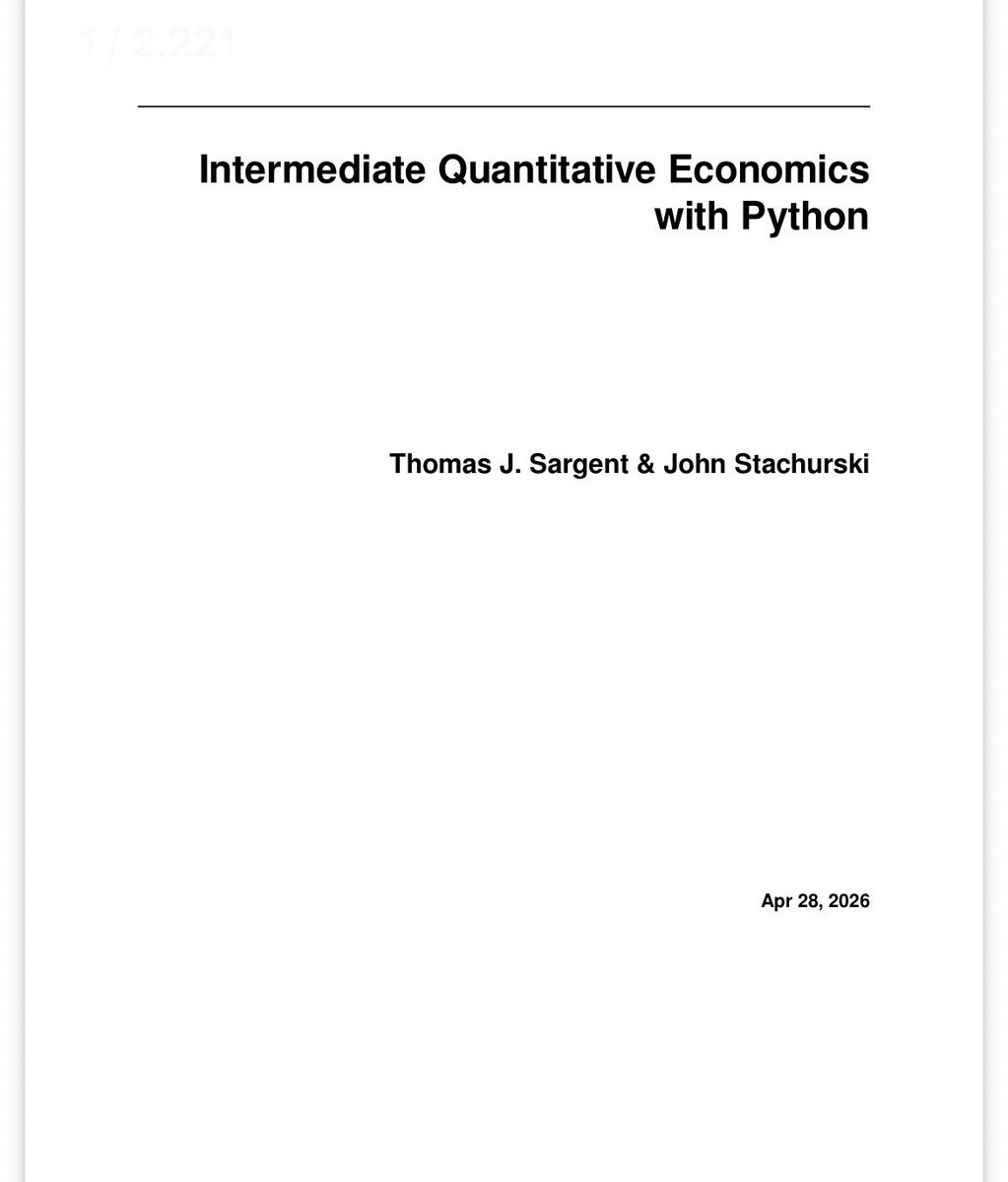
İktisat ile veri biliminin kesişim noktası.
Sargent & Stachurski'den 2221 sayfalık ve ücretsiz bir hazine:
"Intermediate Quantitative Economics with Python"
Hem öğrenmek hem de öğretmek için harika bir rehber.
🔗 https://t.co/ykmIOPHy9i
I accidentally discovered how to compress a semester of learning into 48 hours.
A grad student at MIT showed me his NotebookLM setup. I thought he was just organized. Then I watched him pass a qualifying exam on a subject he'd never studied before.
Here's exactly what he did:
First: he didn't upload a textbook.
He uploaded 6 textbooks, 15 research papers, and every lecture transcript he could find on the subject.
Then he asked NotebookLM one question:
"What are the 5 core mental models that every expert in this field shares?"
Not "summarize this." Not "explain this topic."
Mental models. The stuff that takes professors years to develop.
But the next part is what broke my brain.
He followed up with:
"Now show me the 3 places where experts in this field fundamentally disagree, and what each side's strongest argument is."
In 20 minutes he had a map of the entire intellectual landscape of the field:
the debates, the consensus, the open questions.
Most students spend a full semester just figuring out what those debates even are.
Then he did something I've never seen before.
He asked:
"Generate 10 questions that would expose whether someone deeply understands this subject versus someone who just memorized facts."
He spent the next 6 hours answering those questions using the source material. Every wrong answer triggered a follow-up:
"Explain why this is wrong and what I'm missing."
By hour 48, he could hold a conversation with his thesis advisor without getting destroyed.
The tool didn't change. The questions did.
Most people treat NotebookLM like a fancy highlighter.
These students are using it like a private tutor who has read everything ever written on the subject.
The difference between a semester and 48 hours isn't the amount of content.
It's knowing which questions to ask.
1/ X's algorithm was changed in mid-July 2024 to systematically boost Republican-leaning accounts and Elon Musk's own account following his endorsement of Donald Trump, according to a newly released computational study of engagement from the Queensland University of Technology.⬇️
How should we tax capital gains due to rising asset prices? On realization? On accrual? Or should we perhaps tax wealth?
The existing public finance literature has a big hole making it unsuitable for thinking about these issues: it doesn't model asset prices!
🧵 on a new paper:
Just hired a 21yo for their first job. What basic professional advice do they need? Here's what I tell all my new staff, but perhaps you can add. I'll start small.
1/ Use an online calendar. Have a foolproof system of reminders, so you never forget a deadline or obligation.
New IMF analysis shows that geopolitical preferences increasingly drive the geographic footprint of foreign direct investment. Fragmentation of FDI could lead to output losses of about 2% of global GDP—roughly equivalent to the annual output of France. https://t.co/4TEh1XromR
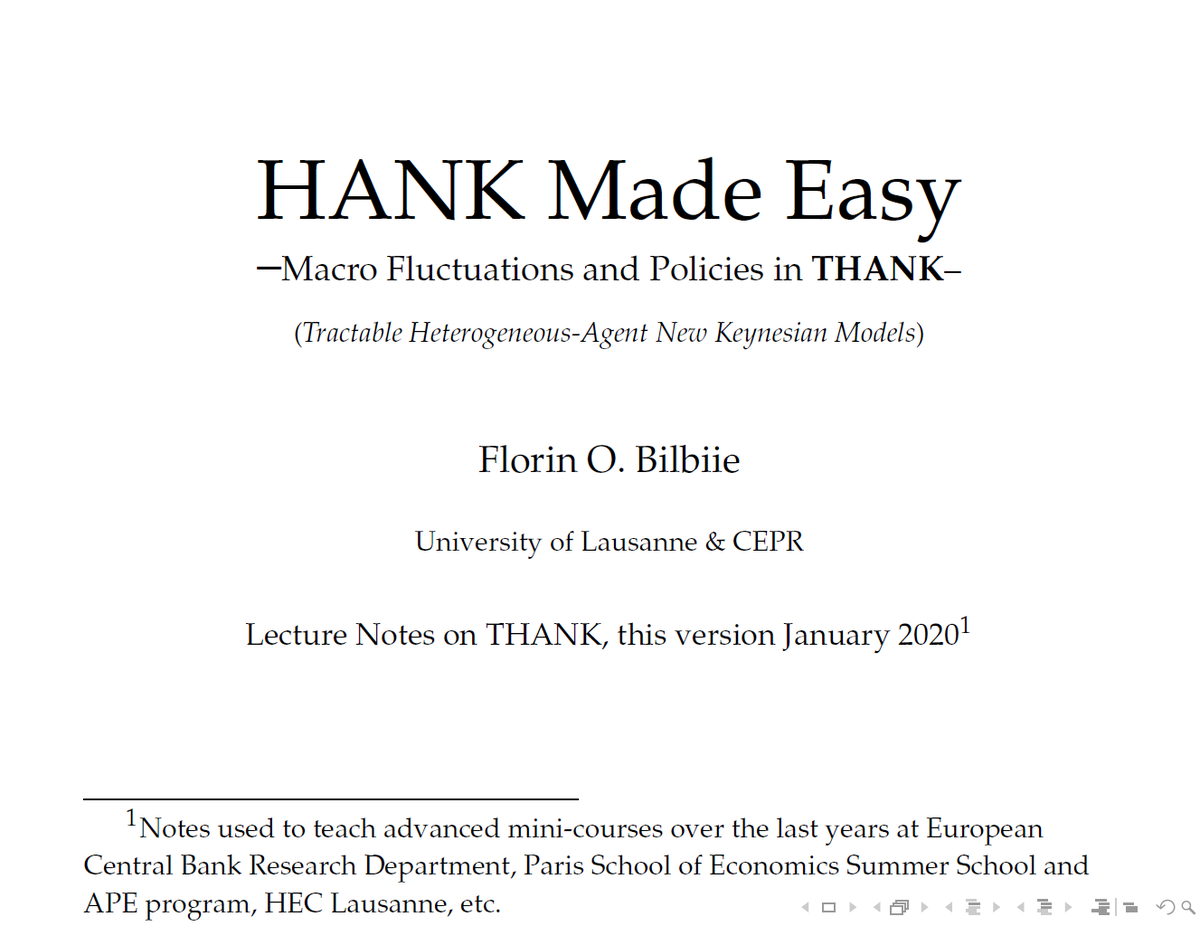
1/n "HANK Made Easy" Lecture notes/slides on Macro Policies in THANK (Tractable HANK). Having had to cancel several courses, I am sharing publicly the slides I use to teach TANK and (T)HANK
https://t.co/pBQuNQf3an
The debate on 🇷🇺 oil & gas ban to #StopFundTheWar & #StandWithUkraine is important. 🇺🇦🌻
I put together a list of arguments against the ban, debunking them 1-by-1 (a "myth buster")
Hope it's constructive & useful 4 all involved.
PDF here:
https://t.co/L26ZGfX9IK
16 myths: