There is so much productive economic activity that is currently blocked by bureaucracy and red tape. One of the most promising uses of AI is to unlock that activity by streamlining how the government functions. That's why I'm super excited to see this work by my colleagues @OCLarter and @davthack, who partnered with the UK govt to help it build more housing faster.
Housing shortages are a huge problem all over the world. In the UK, planning officers have to consolidate masses of data and paper work just to process a single application. The AI tool they've developed will consolidate all that, helping the UK meet its 2029 goal of building 1.5 million homes.
My hope is that we'll see a lot more of this. Business applications being processed instantly, permits being approved in minutes rather than months. There is such a huge unlock of potential in getting the government to work for its citizens.
Here is the article:
https://t.co/x8dqsFBiqa
Some news: As of June 30, I'll be on leave from Stanford at Anthropic. I'm joining the Anthropic Institute, where I'll continue my research on AI and our economic future and give seminars and talks as always. 1/3
We have created a micro-site for Messy Jobs, at https://t.co/6kQuA00d8Y, were you can find Part I of the book in open access, and an experimental feature, that we will be enriching with data, helping you determine how "Messy" your job is.
Enjoy!
https://t.co/hpcabDIKrk
Can microeconomists help build better AI models?
New guide with @pavelkireyev_io: we map how microeconomic theory connects to the post-training of LLMs.
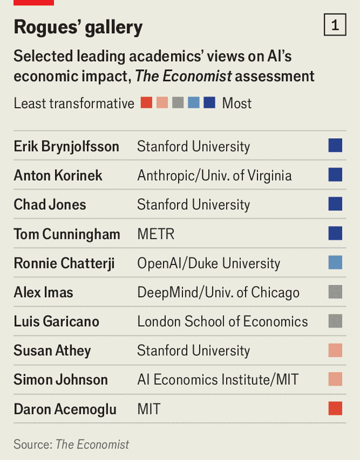
Meet the world’s top AI-pilled economists
"This year the NBER is likely to host more conferences on health care than on AI. But some academic economists have seized the AI opportunity."
@TheEconomist
🤖Excited to share a new working paper.🤖
The phrase "AI-Native firms" it everywhere, but are they any different? Is it just hype?
In our new paper we show AI ventures are organized differently, but not for the reasons you think.
In the latest episode of Justified Posteriors, @mioana makes the argument for a digital tax. We also discuss insurance against AI risks and DOJ antitrust enforcement. Check it out!
If AGI is achievable & labs can be banned from using a model internally ONLY if they release the model publicly, the Big Three labs may decide it is better to capture all the value from AGI themselves by expansion & acquisition. Sharing AI access with other firms triggers risk.
In part. But I think we need options. Interdependency, like the post argues, is useful and good to have. Having some capability, behind the frontier, also gives us options. My view (with Jesús Saa-Requejo) is here, I will develop it further later in the week. https://t.co/dwX2FRwsuk
Future of the firm: “the real opportunity is not in picking the best model but instead in building a learning loop on top of models where human capital and token capital compound”. But “There is no societal permission for an AI future that hollows out entire industries.”
Medicine discovers the bitter lesson: frontier LLMs (here GPT 5.2, Opus 4.6, Gemini 3.1) outperform specialized "clinical AI" (e.g. OpenEvidence) in a blind test.
Even funnier that hospital IT are more likely to approve the *specialized* versions despite them being worse.
How do we go from AGI to Superintelligence? New report discusses four potential pathways: scaling, AI paradigm shifts, recursive improvement, and ASI emerging from large-scale multi- agent collectives. Importantly, it also looks at possible frictions and bottlenecks along these pathways. Instant classic! https://t.co/uBF3m2YoyH
There's lots of fear about AI and price discrimination. "They're using data in all sorts of complicated ways we can't even comprehend!"
Fair. So instead of assuming a specific form, ask, what can happen across all possible types of data?
Are consumers doomed? I'll argue no.
Extremely cogent and well-written scenario, starting from the present, warning about Europe’s dangerous trajectory. I was in Paris for the AI Summit after DeepSeek r1, and I can attest that the level of delusion about what that model meant was exactly as this scenario describes.
"What will happen to Europe if it keeps ignoring AI?"
Three American labs each (!!) operate more AI compute than all of Europe combined. Today we're launching Europe 2031: a story of what might happen if that doesn't change.
Today, the Stanford @DigEconLab launches the AI Economic Indicators, a new platform for tracking how AI is reshaping work, productivity, adoption, and the economy.
1/6
Delighted to tell you that Messy Jobs is coming out on June 21st. The kindle preorder link is available!
Here are advance reviews/blurbs for you to ponder by @raffasadun@davidautor@patrickc@alexolegimas@bengtmit and Evan Guo.
"Messy Jobs is a brilliant application of price theory. AI changes what is scarce in the economy and therefore what is valuable. When intelligence becomes cheap, judgment, coordination, trust, and responsibility become more valuable. The authors use this simple, powerful logic to illuminate how AI will reshape work and organizations." Bengt Holmström, Paul A. Samuelson Professor of Economics at MIT and recipient of the 2016 Nobel Memorial Prize in Economic Sciences
"In Messy Jobs, Garicano, Li, and Wu bring the discipline of organizational economics to a question too often left to speculation: How will AI actually reshape work? They move past the usual debates about what AI can or cannot do and ask the harder questions. What shapes the incentives to adopt it? How does adoption reshape the incentives to learn? What new configuration of skills will emerge as AI advances? A rigorous, original, and engaging account of how AI will reshape organizations and labor markets, and what it will take to thrive in them." - Raffaella Sadun, Charles Edward Wilson Professor of Business Administration, Harvard Business School
"This is the first book in the AI era that recognizes that most of what organizations struggle with does not involve computational problems. People in messy jobs must hold coalitions together, adjudicate between competing interests, and make change stick. These are political, diplomatic, and interpersonal challenges. As a result, these types of messy jobs will persist well into our AI future. Garicano, Li, and Wu, are neither techno-utopian nor techno-dystopian. They take seriously what machines can do, what humans will do, and how jobs will be rebundled. The economics analysis is lucid and penetrating, and the book pinpoints where human agency will remain paramount. The book is hopeful and practical for anyone charting a career in the coming decade." - David Autor, Daniel (1972) and Gail Rubinfeld Professor, Google Technology and Society Visiting Fellow, Margaret MacVicar Faculty Fellow, MIT Department of Economics
"This is simply a must-read book if you are interested in the future of work in the age of AI. For decades, Luis Garicano has been a leading voice in how organizations morph and change with new technology and innovation. Together with Jin Li and Yanhui Wu, they have written the definitive text on how AI will affect the labor market. The book is an impressive feat of combining academic rigor with clear explanations and concrete examples. I would recommend this book to anyone interested in learning about what comes next. "- Alex Imas, director of AGI Economics, Google DeepMind, and the Roger L. and Rachel M. Goetz Professor of Behavioral Science, Economics, and Applied AI, and Vasilou Faculty Scholar at the University of Chicago Booth School of Business
"There is a lot of woolly thinking on the topic of AI and jobs. This excellent book contains by far the most thoughtful and economically literate account that has yet been written." - Patrick Collison, CEO, Stripe
"AI is not going to lead to mass unemployment, and this is the best book to explain why not. It also illuminates how labor markets are likely to evolve. It is short, to the point, eminently readable, and of extreme relevance. ""- Tyler Cowen, professor of economics at George Mason University
"This book isn't just some economist's armchair theorizing; it's a practical guide. I hope you get as much out of it as I did. "-- Evan Guo, CEO of Zhaopin Group, the largest career development platform in China
https://t.co/L7UM3bHHYO