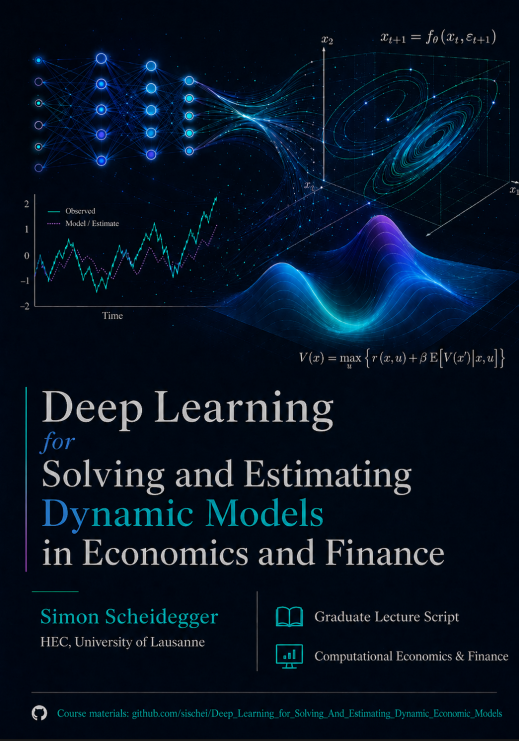
Thrilled to share a project I've been refining: a complete, open-source repository on "Deep Learning for Solving and Estimating Dynamic Models in Economics and Finance."
I've cleaned up the materials from my PhD classes and summer schools into one coherent resource. 🧵 1/6
@cscsch is hiring two Information Security Engineers
Join CSCS and help protect critical infrastructure, services, and research environments.
Explore this opportunity: https://t.co/Hg9V7vMEEj
Reaktorentwicker will in die Schweiz:
Immerhin gibt es noch Leute, die in der Schweiz einen Beitrag für den künftigen Wohlstand in anderen Ländern leisten wollen.
Das Projekt selbst ist durchaus eine Herausforderung.
https://t.co/gFDcuYvYQK
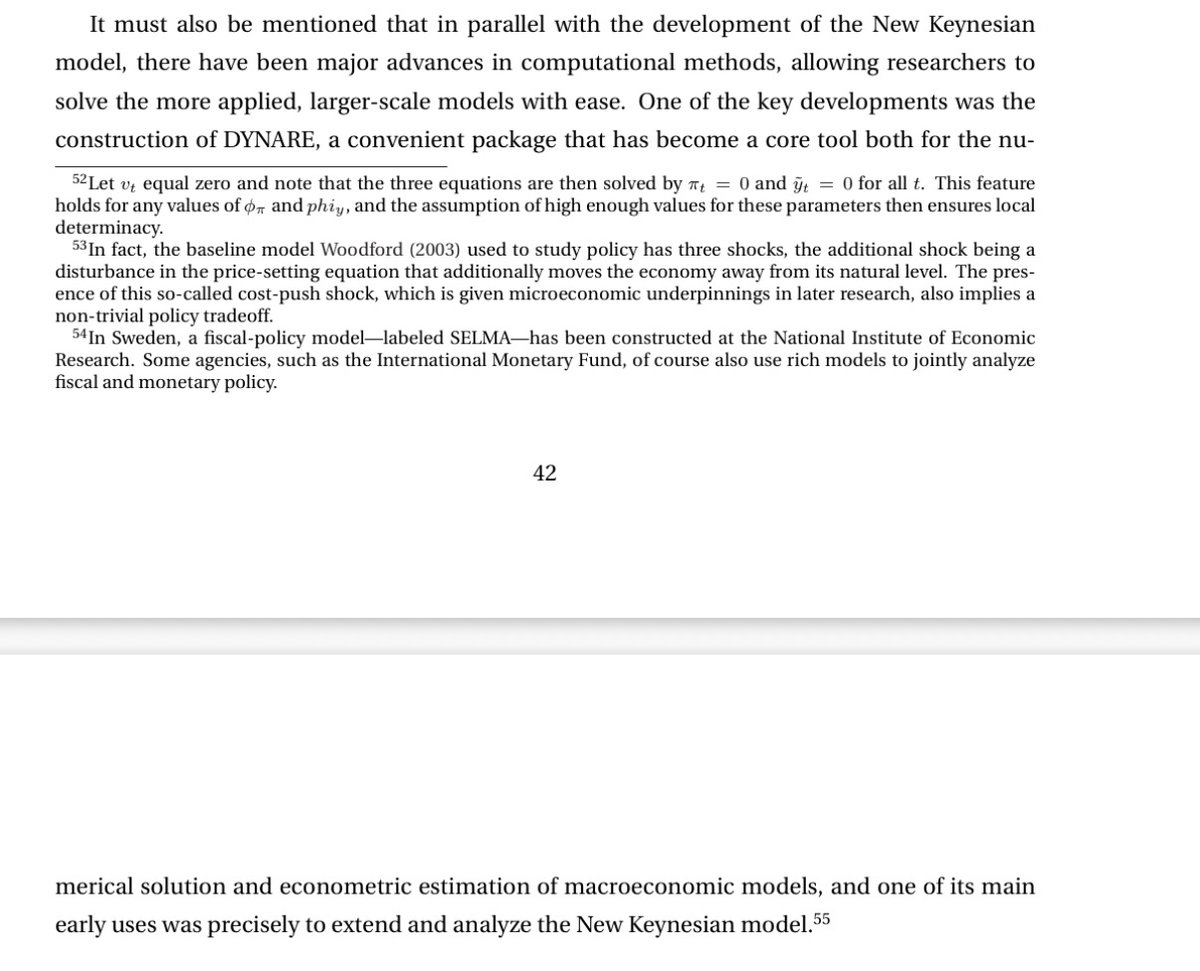
🤩 Dynare is mentioned in the scientific background to the 2026 Economics Nobel Prize (p. 42)!
Congrats to Robert E. Hall & Michael Woodford. A proud moment for open-source macroeconomics and for @MichelJuillard ! 🏆
#dsge#nobel2026#newKeynesian#dynare
Der Expertenkrach um die AKW-Kosten geht in die nächste Runde: Nach einer Gruppe von ETH-Wissenschaftern übt nun auch ein ehemaliger Spitzenbeamter des Bundes Fundamentalkritik an den Berechnungen der Akademien der Wissenschaften – diese widersprechen... https://t.co/ilYIAHE1ny
Egal, was ein neues AKW kostet:
Die Energiewende ist praktisch unbezahlbar.
Der Atomausstieg bricht jeder modernen Volkswirtschaft das Genick.
Man muss sich entscheiden: Bin ich ein Narr & Staatsfeind und schade mir und allen anderen, oder eben nicht?
https://t.co/SR4BaOGox4
Delighted to see this published with @PhilippJRenner!
Moving beyond 2 or 3 types has been a persistent roadblock for ages. By bypassing APS set-valued iterations entirely, we open up rich type distributions for applied work.
💻 Code: https://t.co/BKCCuTnWDq
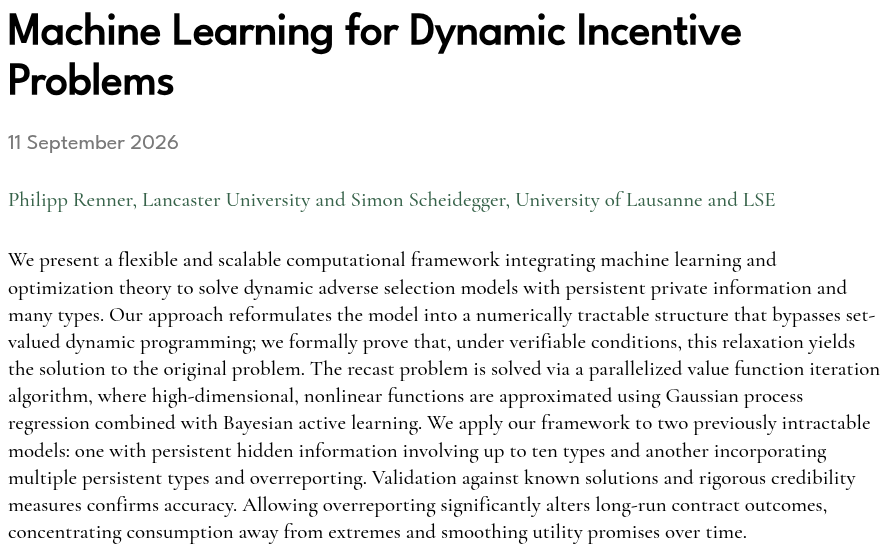
"Machine Learning for Dynamic Incentive Problems": @comp_simon & @PhilippJRenner introduce a framework combining penalties, Gaussian processes and Bayesian active learning to bypass set-valued dynamic programming. Handles at least 10 persistent types."
https://t.co/YxhjSnmvAS
We introduce a penalty relaxation that bypasses computing feasible sets a priori, solving it via value function iteration with Gaussian Process regression and Bayesian Active Learning. The generic framework scales up to at least 10 persistent types.
We introduce a penalty relaxation that bypasses computing feasible sets a priori, solving it via value function iteration with Gaussian Process regression and Bayesian Active Learning. The generic framework scales up to at least 10 persistent types.
Dynamic adverse selection with persistent private info typically requires set-valued dynamic programming over high-dimensional, unknown, and irregular state spaces (curse of dimensionality).
Dynamic adverse selection with persistent private info typically requires set-valued dynamic programming over high-dimensional, unknown, and irregular state spaces (curse of dimensionality).
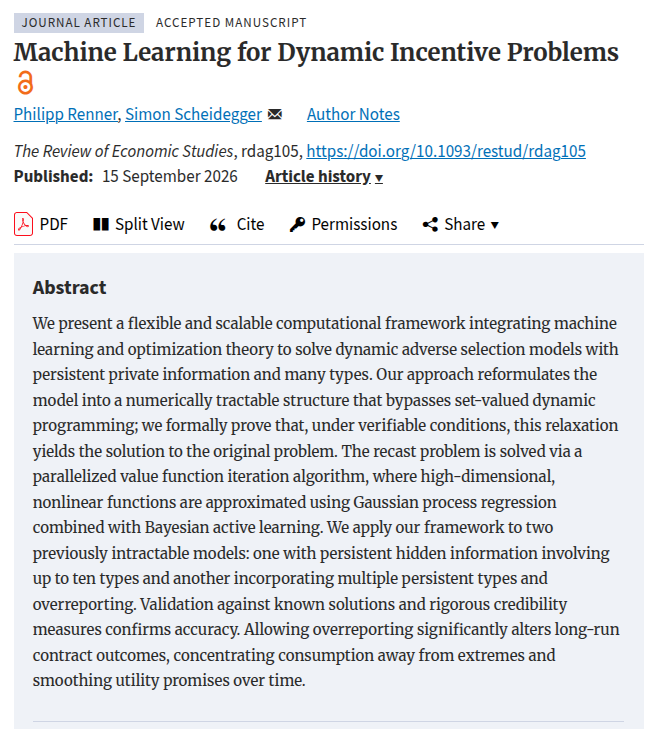
Thrilled to share that "Machine Learning for Dynamic Incentive Problems" (with @PhilippJRenner ) is in Review of Economic Studies (@RestudJournal)! This was truly a career-decisive project for me: my Job Market Paper back when ML and deep learning were not yet a thing 🧵👇
Thrilled to share that "Machine Learning for Dynamic Incentive Problems" (with @PhilippJRenner ) is in Review of Economic Studies (@RestudJournal)! This was truly a career-decisive project for me: my Job Market Paper back when ML and deep learning were not yet a thing 🧵👇
🎓Reminder: PhD Guest Course at #DSEA@UniPadova
📅23-24 September 2026
'Deep Learning for Solving Dynamic Models' with @comp_simon from @heclausanne.
Topics include ML, DEQNs & macroeconomic applications.
Register now https://t.co/kUVuwtjGoz #EconX#EconTwitter
Thrilled that "Deep Learning for Solving and Estimating Dynamic Models in Economics and Finance," found a home at @QuantEcon. Access the e-book/code here: https://t.co/CAvYWnUW1H . Huge thanks to Matt McKay, @john_stachurski , Tom Sargent, QuantEcon team for making this happen!
@RickEcon@QuantEcon Thank you for your kind words and your sustained support. I miss the good old OSE Lab days (https://t.co/l2zamqfxAd) that you were championing as an evangelist for computational economics!