Smartphones are not the explanation for the recent decline in fertility. Instead, they are an accelerator of deeper forces already at work.
Let’s start with the facts. Fertility is falling almost everywhere: in rich, middle-income, and poor countries; in secular and religious countries; and in countries with high and low levels of gender equality.
The decline accelerated around 2014. So, no country-specific explanation will work unless you are willing to believe that 200 distinct country-specific explanations arrived at roughly the same time.
Smartphones look like the obvious candidate: the first iPhone was released in 2007, and global adoption has been astonishingly fast.
Economists understand the first major decline in fertility in advanced economies, from 6 or 7 children per woman throughout most of human history to about 1.8, that occurred between the early 1800s and roughly 1970, well before smartphones. The main drivers were a sharp fall in child mortality (effective fertility was rarely above 3 and often close to 2) and the shift from a low-skill, rural agrarian economy to a high-skill, urban industrial one. We have quantitative models that fit these facts well.
Country-specific factors mattered too, of course. Proximity to low-fertility neighbors accelerated Hungary’s decline, while fragmented landowning structures accelerated France’s. But these were second-order mechanisms.
This is also why most economists long considered Paul Ehrlich’s doom scenarios implausible. We forecast that fertility in middle- and low-income economies would follow the same path as in the rich, probably faster, because reductions in child mortality reached India or Africa at lower income levels (medical technology is nearly universal, and most gains come from handwashing and cheap antibiotics, not Mayo Clinic-level care). Much of what we see in Africa or parts of Latin America today is still that old story.
But in the 1980s, a new pattern appeared. Japan and Italy fell below 1.8, the level we had thought was the new floor. By 1990, Japan was at 1.54 and Italy at 1.36.
This second fertility decline began in Japan and Italy earlier than elsewhere, driven by country-specific factors, but the underlying dynamics were widespread: secularization, an education arms race, expensive housing, the dissolution of old social networks, and the shift to a service economy in which women’s bargaining power within the household is higher. The U.S. lagged because secularization came later, suburban housing remained relatively cheap, and African American fertility was still high. U.S. demographic patterns are exceptional and skew how academics (most of whom are in the U.S.) and the New York Times see the world.
My best guess is that, without smartphones, Italy’s 2025 fertility rate would be about 1.24 rather than 1.14. I doubt anyone will document an effect larger than 0.1-0.2. Italy was at 1.19 in 1995, not far from today’s 1.14. The TFR is cyclical due to tempo effects, so I do not read too much into the rise between 1995 and 2007 or the decline from 1.27 in 2019 to 1.14 today. The direct effect of smartphones is not zero, but it is not, by itself, that large.
Where social media, in general, and smartphones, in particular, matter is in the diffusion of social norms. What would have taken 25 years now happens in 10. Social media are not the cause of fertility decline; modernity is. But they are a very fast accelerator.
That is why social media are a major part of the story behind Guatemala (yes, Guatemala) going from 3.8 children per woman in 2005 to 1.9 in 2025. Without them, Guatemala would also have reached 1.9, just 20 years later.
Modernity, in its current form, is incompatible with replacement-level fertility. By modernity, I do not mean capitalism: fertility fell earlier and faster in socialist economies than in market economies. Socialist Hungary fell below replacement in 1960, and socialist Czechoslovakia in 1966 (both experienced small, short-lived baby booms in the mid-1970s). By modernity, I mean a society organized around rational, large-scale systems and formalized knowledge.
Countries will not converge to the same fertility rate. East Asia is likely stuck near 1, possibly below, given its unbalanced gender norms and toxic education systems. Latin America faces the same gender problem plus weak growth prospects, so I expect something around 1.2. Northern Europe has more egalitarian family structures and might hold near 1.5. The very religious societies are probably the only ones that will sustain 1.8.
All of this could change with AI or changes in population composition. We will see. But on the current evidence, deep sub-replacement fertility is the “new new normal.” Unless we reorganize our societies, better learn to handle it as best we can.
Our energy work at @AbundanceInst keeps growing. The Gigawatt Summit, transmission, nuclear, geothermal, batteries, all of it. State and federal policy. Pro-innovation, anti-paralysis, unrelenting, unapologetically optimistic.
Looking for someone to continue building this out alongside me. A mix of policy fluency, technical chops, coalition instincts, real ownership over the work. Utah-friendly but open to anywhere.
If that’s you (or you know who it is) DM me. Always glad to talk to good people in this space even if the timing isn’t right.
Just delivered at home.
More importantly, in a world with powerful LLMs, the relative importance of understanding economics (as opposed to being able to complete a proof) just went up considerably. An LLM can solve a fixed-point problem faster than most of us. What it cannot do is look at a policy proposal and see the second-order effect, the incidence shift, or the margin that adjusts. That is price theory. No amount of computation will give it to you.
Becker knew this fifty years ago: the power of economics was never in the math. The math was always the servant. The power was in thinking clearly about trade-offs, incentives, relative prices, and equilibrium. LLMs just made the servant very cheap. That makes the master more valuable, not less.
P.D. One still needs to know the math. I am only claiming its relative price changed!
A point that is sometimes overlooked is that PDEs in physics and economics have a subtle but important difference.
When a physicist solves the Schrödinger equation (see my slide below), the potential is given. The coefficients of the equation are part of the problem statement. You pick your grid, refine your mesh, and the equation never changes on you. Better numerics give a better approximation to a fixed target.
In economics, this is not the case. Look at the Hamilton-Jacobi-Bellman equation for the neoclassical growth model (also slide below). The drift of capital depends on a derivative of the value function, the very object you are trying to solve for. The “coefficients” of the PDE are endogenous to the optimal choices of the agents. This is what @UncertainLars and Sargent referred to as the cross-equation restrictions implied by optimizing behavior.
This is what @MahdiKahou and I call the “equilibrium loop”: improving your approximation changes the policy, which changes the dynamics, which changes where in the state space the economy spends its time, which changes where your approximation needs to be accurate. You are not chasing a fixed target with a better net. Moving the net moves the target.
This has serious consequences for computation. You cannot just borrow neural network architectures from deep learning in the natural sciences. The loss function comes from equilibrium conditions, not from labeled data. The evaluation points are not given. Instead, they are regenerated each epoch from the current approximation. Ignoring it is why you often get solutions that look good on a training set but fall apart in simulation.
I have talked many times on X about overparameterization and the double descent phenomenon. I just finished the first draft of a new paper with @MahdiKahou, “The Blessings of Overparameterization: Applications in Solving Economic Models,” that formalizes part of my thinking.
The punchline is simple. In the context of solving operator equations, such as the ones that appear in economic models (Bellman equations, Euler equations, and so on), overparameterizing the approximating solution, whether it is a neural network or a polynomial, is a blessing. It improves both accuracy and, more importantly, algorithmic stability.
This finding challenges the conventional view, which holds that overparameterizing a solution to an operator equation risks overfitting and poor performance on evaluation points not used in computing the solution (e.g., outside the collocation or grid points).
The practical implication is straightforward: when in doubt, use a wider network. Overparameterization is not a source of risk to be managed but a feature to be exploited.
I will be presenting the paper tomorrow at the Department of Applied Mathematics and Statistics at Johns Hopkins (in case you are around, feel free to join). Since this will be the paper’s first outing, I decided to post the slides here:
https://t.co/ELJQLbLwOq
and see if anyone has suggestions about the best way to make the argument (or if there are doubts the slides do not address). I will post the whole draft in a few days, after I get some feedback.
Also, just for fun, I decided to play with the color palette in Beamer. Curious to hear reactions to the soft grey-bluish theme I am testing.
Very interesting development in open source. @a16z is leading the Series A funding for @gitbutler, a new platform that modernizes the current Git and GitHub workflow allowing for more parallel and agentic AI participation. https://t.co/Mb26obeJ8P
Something I've been thinking about - I am bullish on people (empowered by AI) increasing the visibility, legibility and accountability of their governments.
Historically, it is the governments that act to make society legible (e.g. "Seeing like a state" is the common reference), but with AI, society can dramatically improve its ability to do this in reverse. Government accountability has not been constrained by access (the various branches of government publish an enormous amount of data), it has been constrained by intelligence - the ability to process a lot of raw data, combine it with domain expertise and derive insights. As an example, the 4000-page omnibus bill is "transparent" in principle and in a legal sense, but certainly not in a practical sense for most people. There's a lot more like it: laws, spending bills, federal budgets, freedom of information act responses, lobbying disclosures... Only a few highly trained professionals (investigative journalists) could historically process this information. This bottleneck might dissolve - not only are the professionals further empowered, but a lot more people can participate.
Some examples to be precise: Detailed accounting of spending and budgets, diff tracking of legislation, individual voting trends w.r.t. stated positions or speeches, lobbying and influence (e.g. graph of lobbyist -> firm -> client -> legislator -> committee -> vote -> regulation), procurement and contracting, regulatory capture warning lights, judicial and legal patterns, campaign finance... Local governments might be even more interesting because the governed population is smaller so there is less national coverage: city council meetings, decisions around zoning, policing, schools, utilities...
Certainly, the same tools can easily cut the other way and it's worth being very mindful of that, but I lean optimistic overall that added participation, transparency and accountability will improve democratic, free societies.
(the quoted tweet is half-ish related, but inspired me to post some recent thoughts)
Something I've been thinking about - I am bullish on people (empowered by AI) increasing the visibility, legibility and accountability of their governments.
Historically, it is the governments that act to make society legible (e.g. "Seeing like a state" is the common reference), but with AI, society can dramatically improve its ability to do this in reverse. Government accountability has not been constrained by access (the various branches of government publish an enormous amount of data), it has been constrained by intelligence - the ability to process a lot of raw data, combine it with domain expertise and derive insights. As an example, the 4000-page omnibus bill is "transparent" in principle and in a legal sense, but certainly not in a practical sense for most people. There's a lot more like it: laws, spending bills, federal budgets, freedom of information act responses, lobbying disclosures... Only a few highly trained professionals (investigative journalists) could historically process this information. This bottleneck might dissolve - not only are the professionals further empowered, but a lot more people can participate.
Some examples to be precise: Detailed accounting of spending and budgets, diff tracking of legislation, individual voting trends w.r.t. stated positions or speeches, lobbying and influence (e.g. graph of lobbyist -> firm -> client -> legislator -> committee -> vote -> regulation), procurement and contracting, regulatory capture warning lights, judicial and legal patterns, campaign finance... Local governments might be even more interesting because the governed population is smaller so there is less national coverage: city council meetings, decisions around zoning, policing, schools, utilities...
Certainly, the same tools can easily cut the other way and it's worth being very mindful of that, but I lean optimistic overall that added participation, transparency and accountability will improve democratic, free societies.
(the quoted tweet is half-ish related, but inspired me to post some recent thoughts)
@MaxGhenis and @ThePolicyEngine team have integrated frontier agentic AI into the most expansive open source microsimulation model of US fiscal policy. AI allows easier use and access as well as automates much of the model creation and maintenance.
https://t.co/QCnXtVEMsz
@john_stachurski@SocCompEcon Congrats, John. Much deserved. David Kendrick was a professor of Jason DeBacker’s and mine at the University of Texas at Austin (2003-2008).
We added a new and final chapter to Dynamic Programming Vol II (DP2) on approximation and reinforcement learning: https://t.co/PPDk98DFgV. DP1 and DP2 will always remain freely available online -- give me liberty or give me death 🤟💀
Tom and I have finally finished a draft of Dynamic Programming Vol 2! Exhausting but satisfying. New approach to DP theory, advanced material, many applications... https://t.co/PPDk98DFgV
RIP @chucknorris . I loved his fight with Bruce Lee in Way of the Dragon. I drew genuine happiness from using him as an exaggerated example of indestructibility. A true legend. Plus, I loved @ConanOBrien's long running bit with the Walker Texas Ranger lever.
https://t.co/3ScDg1WktN
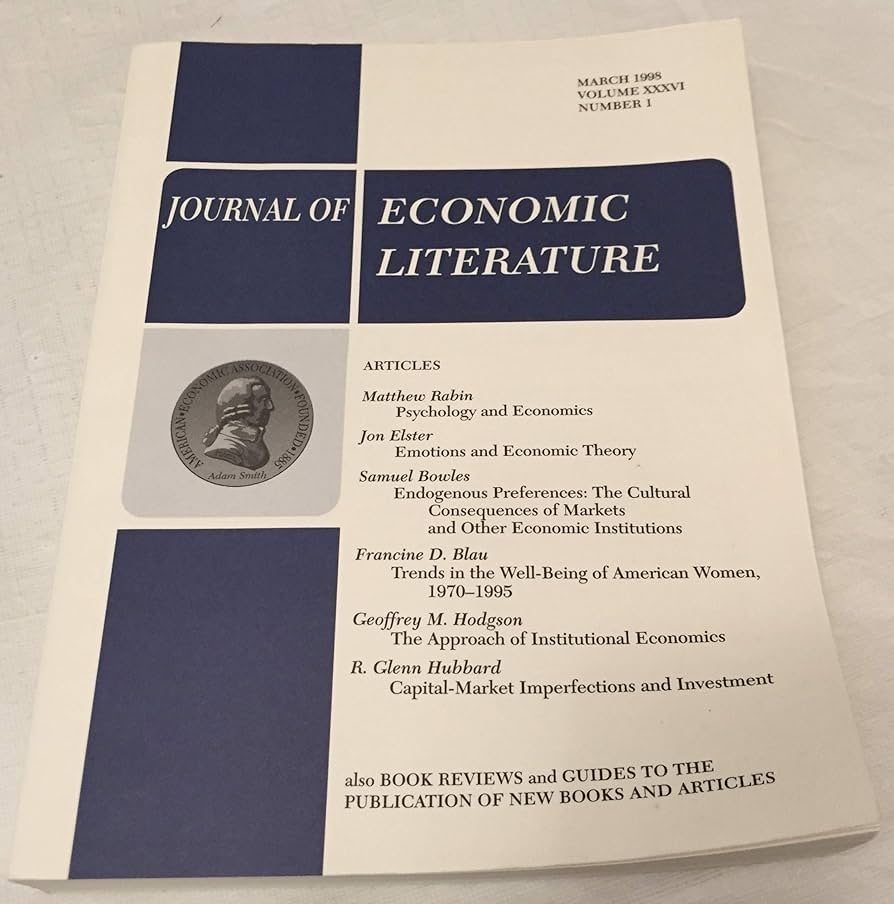
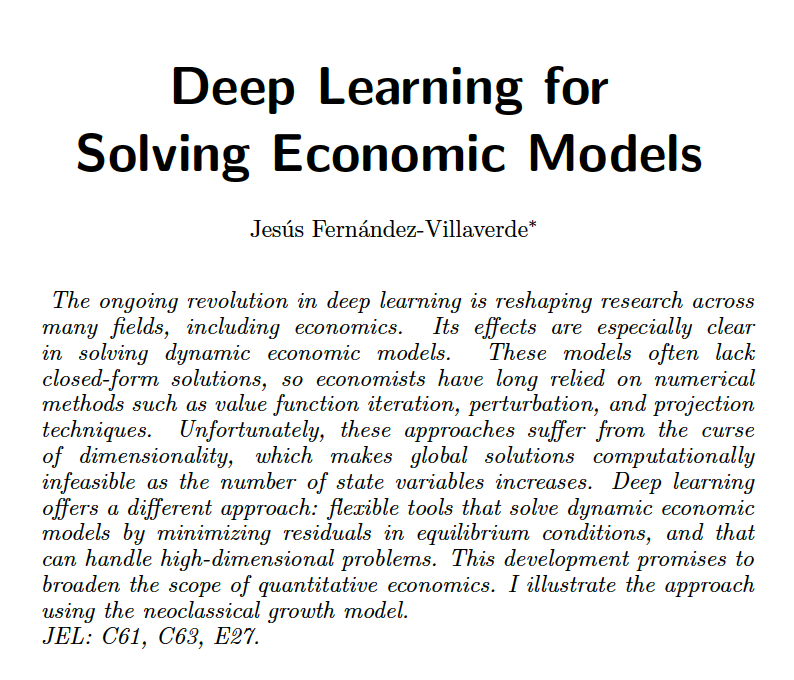
By now, I have published a fair number of papers, and one more acceptance would have close to zero marginal impact on anything that matters professionally. But getting my survey on “Deep Learning for Solving Models” accepted into the Journal of Economic Literature made me genuinely happy, for reasons that have nothing to do with my CV.
I had the misfortune of studying my undergraduate degree in economics at a quite awful institution. Two professors, David Taguas and Alfredo Arahuetes, were outstanding, and I owe them a great deal. The rest were well below any reasonable professional level, and some violated the basic standards of ethical conduct. They had no business teaching economics at any level, let alone at a university that charged tuition and claimed to prepare students for professional life.
I had to work out most of my education on my own. The surveys published in the Journal of Economic Literature were how I did it. I spent hours in the library’s reading room going through one survey after another on topics I had never been properly taught. Some helped more than others, but collectively they gave me a solid enough foundation that, when I arrived at Minnesota for my PhD, I discovered, to my considerable surprise, that I was ahead of nearly all the other first-year students, including some who held master’s degrees, despite the fact that I had finished my undergraduate degree just six weeks before. I owe the Journal of Economic Literature a debt I will never be able to repay. Publishing a survey there is the closest I can come to trying.
So, the thought that some student somewhere, working on her own in a library or on a laptop, might find my survey useful gives me tremendous satisfaction.
But there is a broader point worth making. Even in the world of AI, the profession has an important mission in making educational material widely available. Textbooks, surveys, teaching slides, these are public goods in the economist’s sense: high social value, insufficient private incentive to produce. This is also why I post all my slides and teaching material online:
https://t.co/jcFH9WK9Qu
We do not reward these activities nearly enough, and their supply is well below what any reasonable social planner would choose. I do not have a good proposal for changing this, and I would welcome suggestions.
What I do find heartbreaking is that many of the great economists of the past couple of generations never wrote textbooks on their areas of expertise. I do not mean this as criticism. All of them maximize, and perhaps they all suffer from the same bias I suffer from: the belief that one can always do it next year. But I often think about the hours of pure intellectual pleasure I would have had reading “Time Series Econometrics: An Advanced Textbook” by Chris Sims or “Methods in Structural Estimation” by Pat Bajari. Those books do not exist. They should.
I am very happy that my survey paper, "Deep Learning for Solving Economic Models," is forthcoming in the Journal of Economic Literature (pending final replication checks, which should be quick).
The paper benefited greatly from the editor, David Romer, five referees, and many friends who read earlier versions. I believe the result is a solid introduction to the field, though in 48 pages, there is only so much one can do. So, I created a companion webpage:
https://t.co/zZpOLFXpDk
where you can find the paper, the code, and some slide decks with my teaching material. My plan is to expand the slides over time, adding new material and updating them as new results appear. I will probably do a thorough revision once the spring semester is over.
Those who follow my feed know that I think deep learning is the most fundamental change to computational economics in the last 40 years. I am by now convinced it is more important than the development of Markov chain Monte Carlo methods in the early 1990s or the introduction of projection and perturbation methods in the 1980s. To find a comparable shift, one would probably need to go back to Richard Bellman's invention of value function iteration in 1957.
More pointedly, we need to redesign the Ph.D. in economics. Not at the margin. From the ground up. Economists can either fully embrace the deep learning revolution or become irrelevant, as has already happened, I would dare say, to some fields in academia that refused to accept reality.
Finally, let me apologize to everyone working in this area whom I could not cite. Space was a binding constraint.
And yes, this post was written with the considerable help of AI. There is nothing I am prouder of than the fact that AI is now an integral part of every step I take in my professional life.
@rickbeato We should invite @rickbeato to our @abundanceinst Creative Frontiers event in Deer Valley, Utah this summer that focuses on music and AI with artists, producers, tech companies, and policy influencers.
Great video by @rickbeato on his predictions on how AI will affect the music industry. He compares brick and mortar music studios to today's data centers and discusses the value of open source AI models.
https://t.co/MgHEU8k5Vh
I think @rickbeato's prediction about data centers going away and AI companies failing is too strong. But I think he is right that the rate of growth will slow and that the health of the open source and open access AI ecosystem is an essential nongovernmental guardrail.