Happy to see my paper with @EdPerry285 is published online. Here, we find that greater premium subsidies attract farms with low-risk into crop insurance:
https://t.co/EkM5SLhCzm
Our paper (w/ @EdPerry285 and @TackJesse), which uses crop insurance data to assess the impacts of temperature on overall/cause-specific crop yield losses, is finally out @NatureComms. @kstateagecon
Congrats to Dr. @EdPerry285 on winning the @AAEA_Economics 2020 Quality of Research Discovery Award for his paper, “Valuing Product Innovation: Genetically Engineered Varieties in U.S. Corn and Soybeans.”
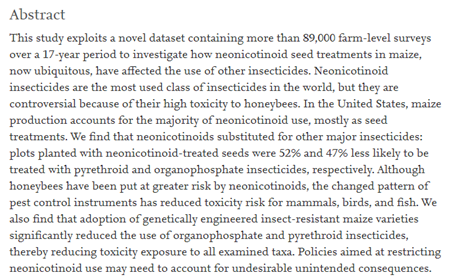
Recent work w/GianCarlo Moschini on #neonicotinoid use in U.S. maize. Using ~89K surveys from '98-'14, we assess the impact of neonic adoption on trad. #insecticide use. We find a ban, as in EU, would not be a risk-free answer to falling #bee pop. Thread https://t.co/ShxAxJ8vi4
@mattsclancy@davidfickling@nphendricks Enjoyed the thread. Another related paper this year studied yield trend differences between the U.S. & EU as a result of GM: https://t.co/8PtM3YP7qK
Contra NYT, they found corn & soy yields have diverged between U.S. & EU since GM ban.
Ciliberto, Moschini and @EdPerry (2019) take a completely different approach. Rather than looking at measures of yield, they look at farmer choices. CMP assume farmers are rational, and buy the seeds that maximize profit. https://t.co/PL7UV0Yhfd
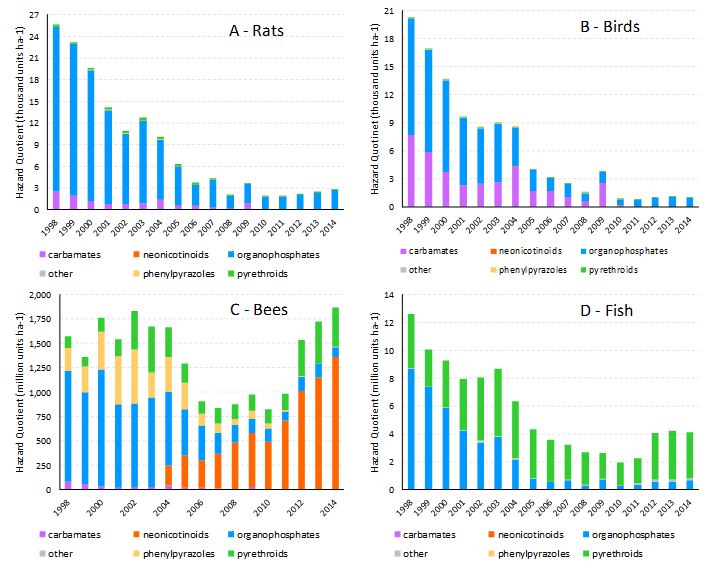
2) Despite ubiquity of neonics, hazard quotient measures of insecticide use fell for mammals, fish, & birds. This was due to lower LD50 ratings & app. rates for neonics compared to organo & pyr. Bee levels were comparable to 1990s in '14, though risk now primarily from neonics.
Recent work w/GianCarlo Moschini on #neonicotinoid use in U.S. maize. Using ~89K surveys from '98-'14, we assess the impact of neonic adoption on trad. #insecticide use. We find a ban, as in EU, would not be a risk-free answer to falling #bee pop. Thread https://t.co/ShxAxJ8vi4
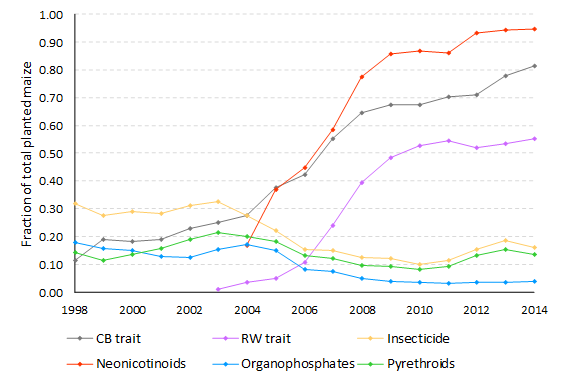
1) Neonic seed treatments intro'd in maize in '04. Rapidly adopted, along with GE insect resistant traits (CB & RW). We estimate that neonics reduced #pyrethroid & #organophosphate use by 52% & 47%, resp. GE maize also reduced insecticide use, but by less than neonics.
@mattsclancy @dclingi Classex (https://t.co/9GnvAaORBO) is a pretty amazing platform for online experiments. I use it for my class of 150+. It can be used on a smartphone or computer. Everything is already set up. It's based on Bergstrom's Experiments text. You have to register though (for free).
1. Some observations based final US average estimate of the corn yield for 2018. First, 176.4 bpa represents the 5th straight year of above trend yields. Is this just good weather or a signal that rate of growth in trend yields has ticked up?
@KansasBowhunter@SpacePlowboy No. More=better control. Clustering @ 32 oz is what's of interest-why not choose 30 oz? Plus, @ 32 w/5 lb implied acre rate is 1.25 lb/ac. Why is this rate almost never observed w/other concs? Storage savings that high? Same for 3 lb and 3.7 lb. Keep in mind this is 10 yrs ago.
Great synopsis by @mattsclancy on my recent paper w/G. Moschini & D. Hennessy in JEBO. After glyphosate went off patent in 2000, products w/higher concentration levels entered. We study how farmers used these products & find evidence of historical inertia
https://t.co/SDMmx3wfQu
Very cool paper from @EdPerry285, David Hennessy, and GianCarlo Moschini forthcoming in JEBO. Are firms (specifically farms) as rational as we like to assume? Maybe not! Thread: https://t.co/EOrU3geqrB