AI is about to make 80% of corporate thought leadership worth almost nothing, and companies should either focus on the remaining 20% or decide not to pursue this form at all.
Language models are better placed to replicate the corporate voice tone than any other kind of writing. Lots of these papers deliberately didn’t contain anything controversial or new, because most firms are allergic to the idea of putting off any potential customers - reports are heavily caveated, use the passive voice a lot and designed to appeal to as many people as possible. As the cost of producing things like this has fallen to near zero, there will be a glut of it in the market and people will switch off and read none of it.
I think there are a few avenues worth exploring:
Ideas. The subjects most corporate thought leadership positions as new aren’t actually new, they’re worn out. But new ideas are always interesting - if they wouldn’t cause some people to disagree and be annoyed they probably aren’t new enough.
Genuine insights. Lots of companies are well placed to share insights from actual proprietary knowledge they have. The bar is high - if it includes the word “synergy” it probably isn’t a new insight.
Skin in the game. When companies are visibly making bets on x, not y, and explaining their rationale. I think the research that analysts at the big banks publish will still be interesting to people because at some level they are making predictions, and stand to make or lose money based on those.
Personality. The chief executives of many (not all) big businesses are charismatic and interesting people, but very few of them are trying to be actual thought leaders like eg Jamie Dimon. Many see this as risky, but we are interested what these people think and if they can capitalise on it they can be philosopher kings.
For many businesses, 1-4 won’t be feasible for internal political reasons, in which case it’ll be better to not do it at all than to do a bad version of it.
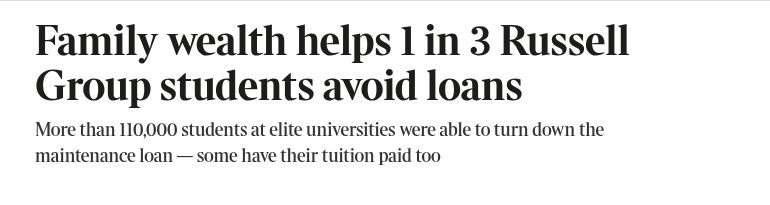
Family wealth buys time at university. Nearly one in three Russell Group students avoided maintenance loans with family support, while poorer students can take the maximum loan and still need paid work to get by.
@suttontrust research found that essential costs exceeded the maximum loan for 57% of students living away from home outside London - meaning that they have to work to make ends meet.
This has a knock on effect on their academic work. In separate Sutton Trust polling, 49% of undergraduates said they had missed timetabled teaching to do paid work.
Poorer students were also twice as likely to have missed a deadline or requested an extension because of paid work: 16% compared with 8%.
Fair access doesn't stop at admission. At a minimum we need maintenance loans to increase so students can live on them - and ideally some form of grant brought back for the least well off students.
@thetimes.
Government and business need a bigger shared ambition than getting through the next Budget.
Unlocking Britain's hidden talent could be that ambition. It would give firms the people they need to grow, and give more young people a fair chance to get on.
As I argue in @Independent this week, Britain's growth and opportunity problems are two sides of the same failure. We are not doing enough to find, develop and use the talent we have.
I spent two decades helping major businesses grow and become more competitive. Now, leading the Sutton Trust, I see young people with enormous ability and ambition held back by a lack of educational opportunity, the right connections or that crucial first job. Both experiences have convinced me that widening opportunity should sit at the heart of Britain's growth strategy.
There is a "grand bargain" to be made here.
Government gives business greater confidence to invest: stable policy, faster planning, reliable infrastructure and action on the practical barriers to growth.
In return, business commits to more investment, better jobs, more training and wider routes into careers and progression. Where firms receive substantial public support, those commitments should be measurable and enforceable.
This could help rebuild business confidence. Clear commitments from government would give firms a stronger basis for growth, and a shared ambition to unlock talent would give business leaders and government something positive to get behind – with both sides holding a direct stake in making it succeed.
The best employers already understand that finding potential others miss is a competitive advantage. The opportunity is to make that approach far more widespread.
I'd like to see government and business leaders come together to work through the bargain: what each needs, what each can deliver, and how we turn that into stronger growth and wider opportunity.
@suttontrust
Last week we set out to find out how Andy Burnham's Triple Lock decision might impact electoral calculations.
Like it as a policy or not (I do), it looks like there are a bunch of important Red Wall/coastal seats where it could drive voters to Reform.
https://t.co/Cr3cGH1eLM
One tiny illustration of how mental the world and its news agenda is right now.
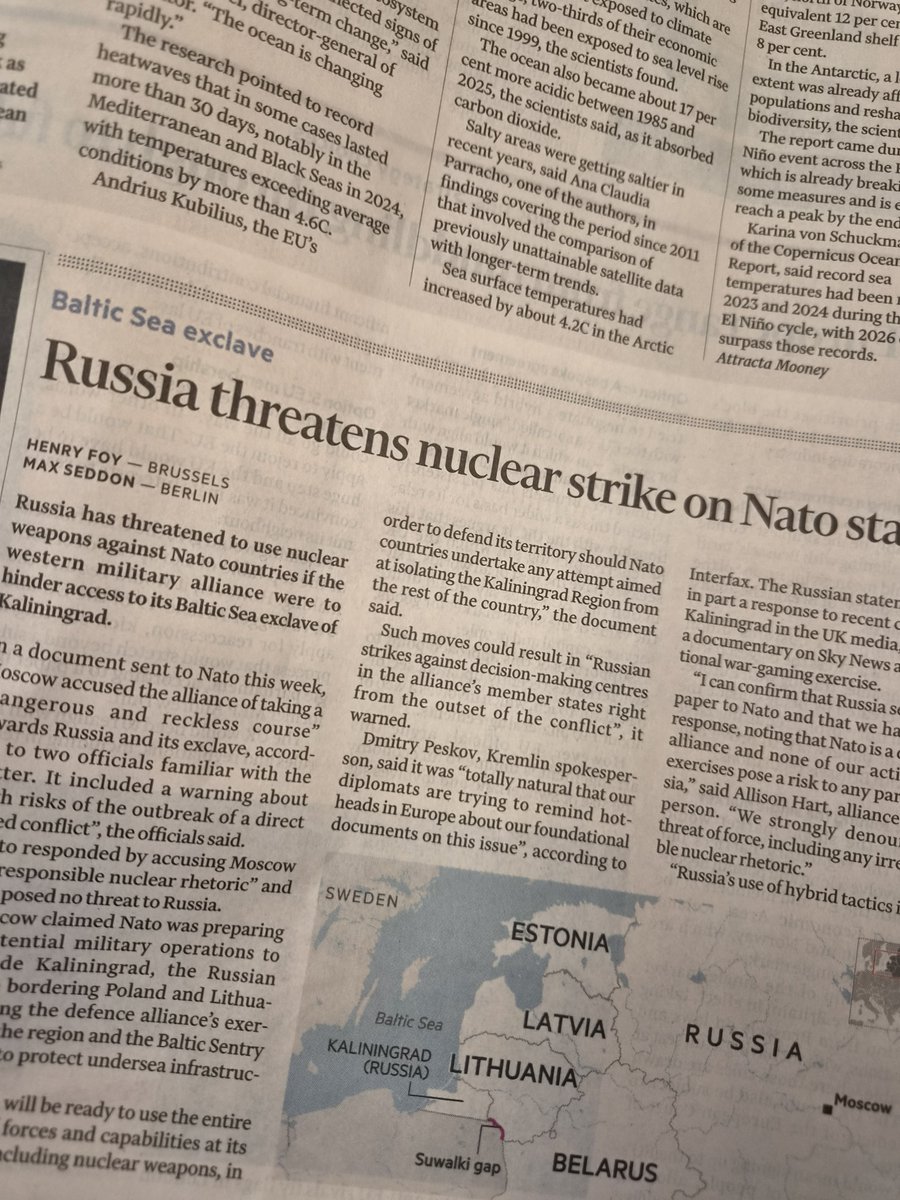
"Russia threatens nuclear strike on Nato" is a page 4 downpage in today's FT.
Pretty sure it would have been the splash in most of the last four or five decades.
Incredibly pleased that this government will bring back the popular Union Learning Fund.
Was vindictive and shortsighted of the last government to abolish it, given how little in-work training this country does, and how crucial upskilling is for the changing economy
One former great of the @tes newsroom passes @theipaper political baton to another former great of the TES newsroom.
Delighted Richard Vaughan is joining this old TES lag at Public First.
Delighted to have been appointed Chief Political Correspondent @theipaper, stepping into the huge shoes of my colleague Richard Vaughan who’s leaving the Lobby after a brilliant 10 year shift.
Strong new evidence from @TheIFS last week that children benefit when smartphone use is delayed. It compared schools where 20%+ of families pledged to delay smartphones until 14 with matched schools with below 5% delaying. Mental-health needs fell 8.2% and psychiatric DLA claims 6% in the schools where phones were delayed.
@suttontrust
Not said enough in recent weeks that Bridget Phillipson was the cabinet minister who did the most to secure the abolition of the two-child benefit cap (cited by Starmer as his proudest moment).
@bphillipsonMP Having worked closely with her over this period, I found @bphillipsonMP to be hugely committed, focussed and brave.
In the face of many who said it was impossible, she forced through reforms that this country and its young people desperately needed 5/6