Today, we are launching our research blog!
We’ll use it for technical notes from our work building tools for enzyme and biomolecular design.
Our first post is about The Unreasonable Redundancy of Nature's Protein Folds.
TLDR: Please don't fold more sequences (1/n)
🚨 Meet 01C's 3D agent 'Amara'
Describe a world. Bring your own assets or let Amara generate them. You steer the vision; Amara builds the scene and thousands of articulated objects, fully editable, getting sharper every time you iterate.
More details below 👇
Amara can go beyond a static scene and build the logic for dynamic environments, the leap from a scene you watch to a world that runs, which is what real games and simulations need.
@anthonygitter@DdelAlamo@ebetica Overconfidence seems to be a trait of most of the AlphaFold3 inspired folding models. Protenix is where we have had most success for now. Still nothing is quiet reaching the real deal.
Today we're announcing ESMFold2, an open scientific engine to power prediction, design, and discovery across protein biology.
The new model delivers state of the art performance on protein interactions, especially antibodies, a critical modality for therapeutics.
We have designed and validated miniprotein binders and single chain antibodies across five therapeutic targets that are important in cancer and immunology. We are seeing very high success rates, and affinities at levels consistent with therapeutic activity.
We’re also releasing an atlas of 6.8 billion proteins, and 1.1 billion predicted structures.
ESMFold2 is built on a state of the art language model that has been trained on billions of protein sequences.
A world model of protein biology emerges through language modeling.
We’ve used the techniques of mechanistic interpretability developed to understand large language models to understand the concepts ESM uses to represent proteins.
The model’s representation space has a compositional organization of features across scales, levels of complexity, and abstraction, that reflects and mirrors the understanding of protein biology developed through a century of empirical science.
This understanding emerges without prior knowledge, just from language modeling of protein sequences.
Language models are becoming a powerful substrate to understand and program biology.
The design of protein interactions is one of the most fundamental problems in biophysics, and has critical implications for the discovery of new medicines. A simple gradient based search with the model was able to discover high-affinity protein binders.
I'm excited by the potential this has to accelerate basic science and the understanding of proteins. And especially for the new avenues it opens up for therapeutic design and medicine.
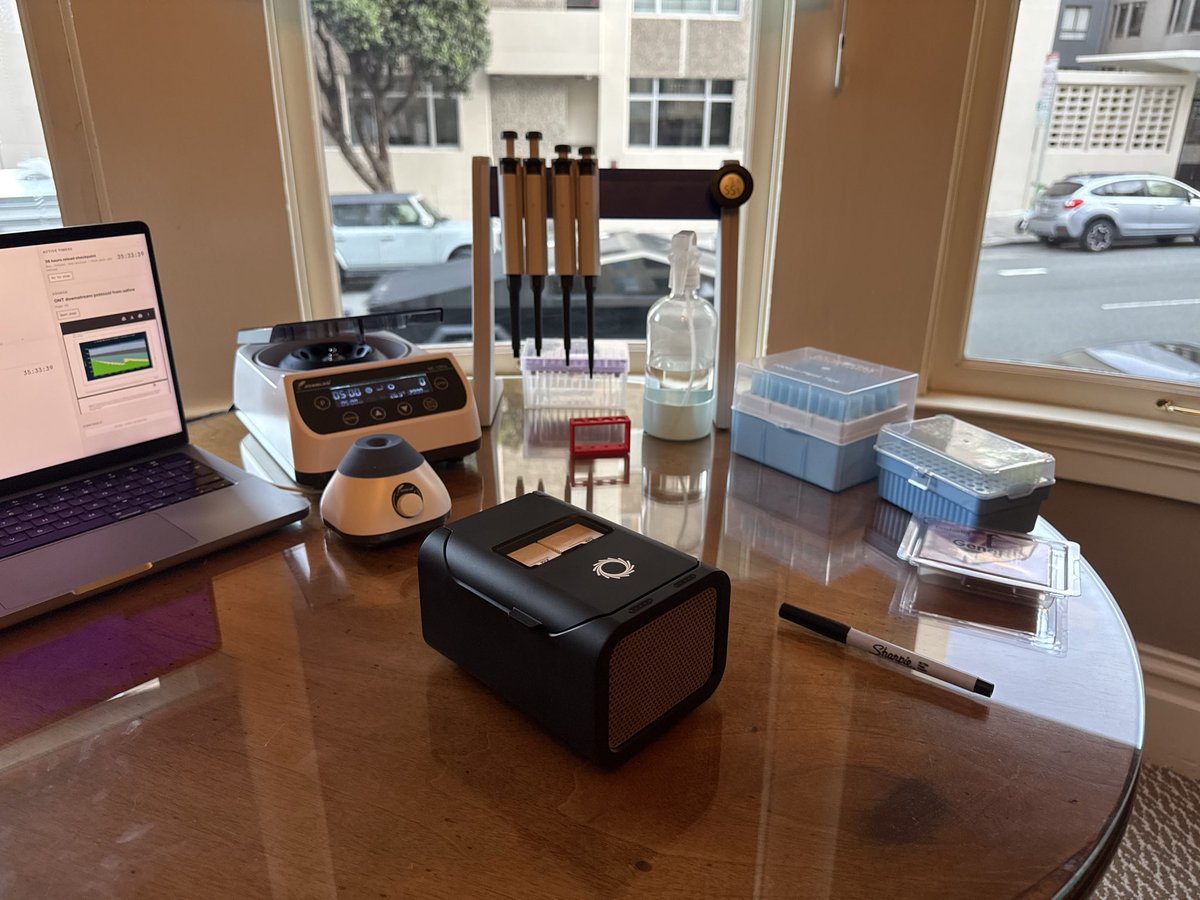
I just sequenced a human genome to 30× coverage entirely at home.
As far as I know, this is the first time this has been done.
I didn’t step foot in a lab once. Every step - from saliva collection, to running the sequencer - took place in a single room with a dining table + kitchenette.
Six weeks ago, I had never done wet lab biology before.
I used an Oxford Nanopore P2 Solo - the only commercially available sequencing device portable enough to do 30x human genome sequencing at home.
Biggest takeaway - I could build something that combined software, hardware, and molecular biology far faster than I thought was possible.
I can name >100 specific instances where AI helped me solve a technical problem that would previously have blocked me because I lacked access to a domain expert.
For example: how do I save my sequencing run when my DNA extraction yield is 4x lower than I need it to be, and I have this limited set of reagents to hand?
To make this work, I had to navigate multiple disciplines:
- writing software to monitor sequencing runs and orchestrate remote GPU infra for basecalling
- learning + executing 5 hour long molecular biology protocols
- building a hardware device to quantify DNA concentration
Apologies for the hyperbole, but I feel super lucky to be living in 2026.
A few weeks ago I decided to sequence a human genome to 30x at home.
Then I actually did it. And I did it really quickly.
Liftoff of Starship V3, from the dunes right outside the pad.
This is the most insane shockwave action I have ever seen on video. Absolutely mad.
📽️ Me for @WeAreSpaceScout
FinalDose is building the first programmable drug platform - a single smart drug molecule that finds diseased cells by their DNA and destroys them. They're starting with all cancers.
Congrats on the launch, @Jeffliu6068Liu, @sklin_lite, and @liyaohuang2!
https://t.co/uKJgl7lpmR
@logangraham How are you thinking about biological research? It’s getting pretty scary how much of our enzyme design workflow agents can ace in the last few months.