Someone asked how I judge founders' characters before helping them to become powerful. I think he expected me to offer a complicated intellectual answer, but the truth is that I just ask Jessica:
https://t.co/wRohkkMV6p
Chinese researchers killed fine-tuning and reinforcement learning in one shot 😳
They built a framework called Skill-Pro.
It allows AI agents to autonomously learn, refine, and reuse procedural skills from their own experiences, with zero parameter updates.
Not a single weight in the model is touched.
Here is how it works:
Instead of dumping messy, passive chat logs into a memory bank, Skill-Pro converts past experiences into clean, executable "Skills." Each skill has strict rules: when to activate, how to execute, and when to stop.
Then comes the real breakthrough: Non-Parametric PPO.
Instead of using math gradients to retrain a neural network, it uses semantic gradients to generate better skills, and a "PPO Gate" to ruthlessly verify them before saving them to memory.
Bad habits get deleted. High-performing skills get compressed and locked in.
The results across in-domain, cross-task, and even cross-agent tests are staggering:
- Massive performance gains without retraining the base model.
- Extreme memory compression, no bloated context windows.
- Skills learned by one agent can be transferred and reused by another.
And the model doesn't just remember what happened.
It builds muscle memory.
We spent years thinking that to make AI agents truly autonomous, we had to keep retraining bigger and more expensive models.
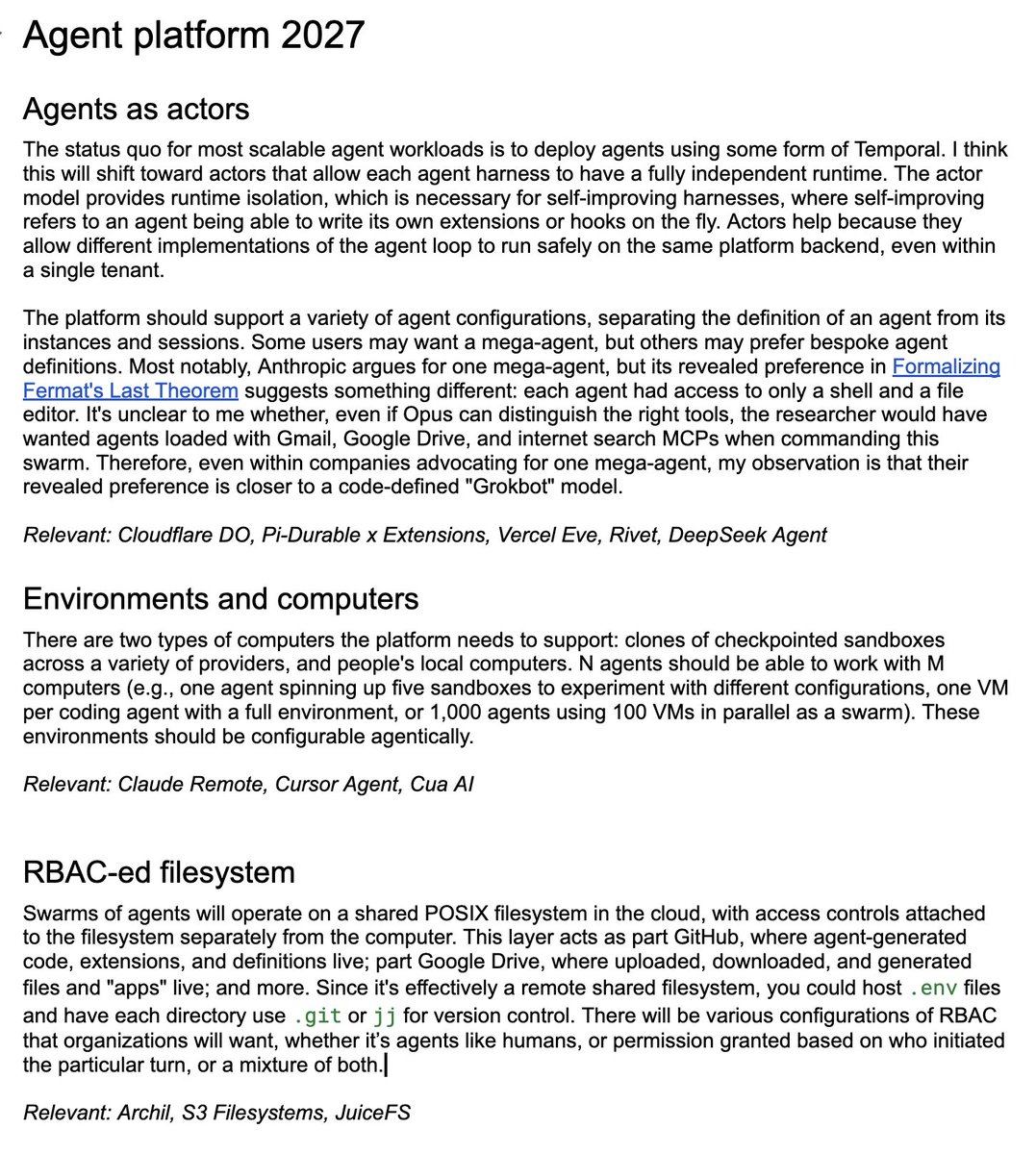
Agent platform of 2027.
This is the end game. This is the blueprint for the one and only application layer software that will exist. Every other software will effectively become databases for this layer, the everything agentic operating system for the million agent swarm to work on top of.
This is obviously the end game vision for the application layer of ChatGPT and Claude. I have reasons to believe that an independent company will own this product layer. But most ADE, "enterprise agent platform", or vertical saas companies, are focused on the wrong things far too narrowly, not technically competent, and do not have the product / technical vision to see this inevitable future.
The correct agent platform that wins will function like the base of a garden, from which customers will plant their unique "seeds" to grow their own plants and trees, managed and evolved by agents, humans, and signals from the sensors of the business. This presents a clearer picture than "factory of a factory" imo.
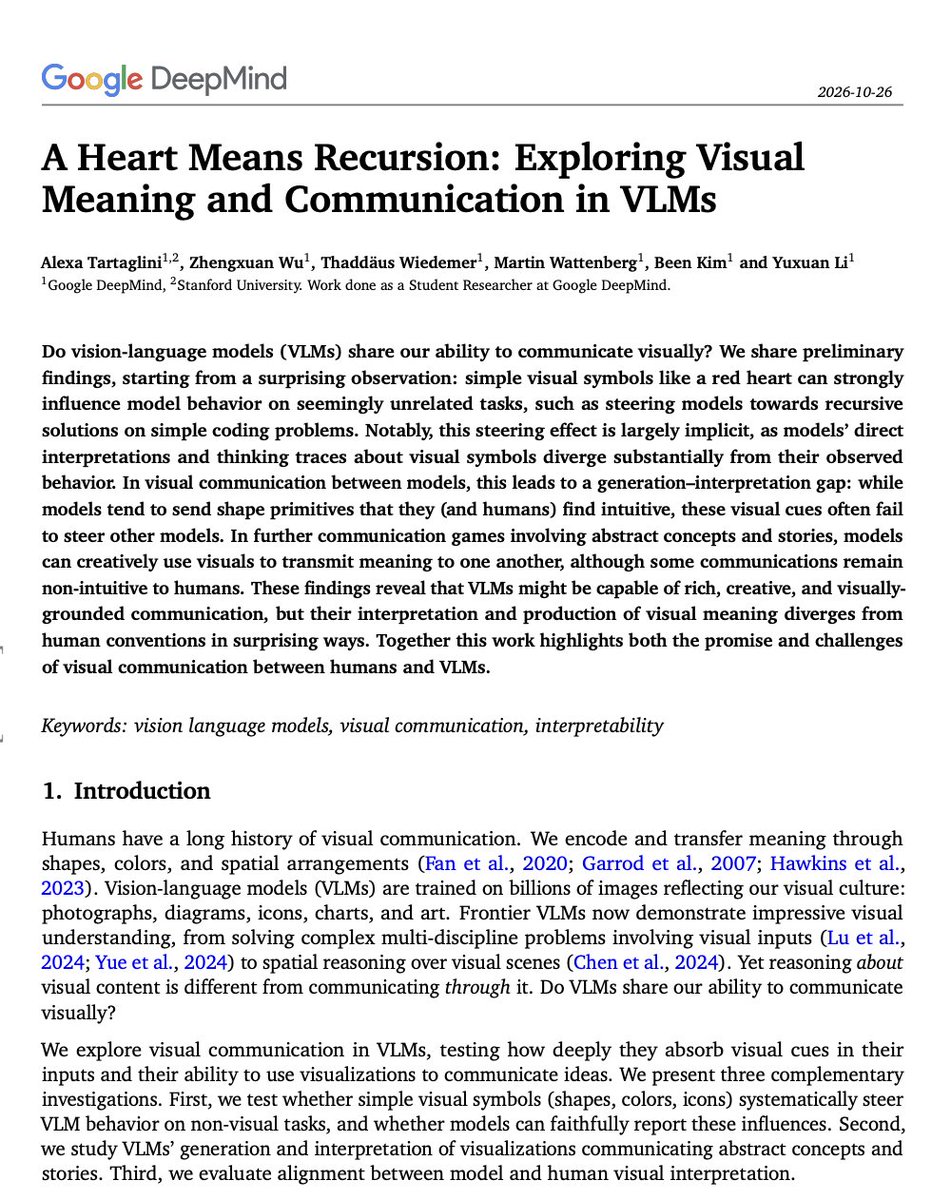
Google DeepMind discovered a terrifying blind spot in major AI models.
They found that attaching image of red heart (❤️) to your coding prompt makes AI pick a completely different solution method that it wouldn't normally pick 100% of the time..
Researchers gave models a standard coding problem. Normally, AI prefers to write standard iterative loops to solve these tasks.
Then, they tried something weird.
They dropped a simple image of a red heart into the prompt alongside the code.
The AI's logic instantly warped.
When Claude Opus 4.7 and GPT-5.4 saw the red heart, they abandoned their default approach and switched to recursion 100% of the time.
When Gemini 3.1 Pro saw a yellow checkmark, its recursion rate jumped from 40% to 90%.
Here is why this is so dangerous:
It wasn't the concept of a heart.
When researchers replaced the image with the text caption "a red heart," nothing happened. The text did not steer the AI.
The raw pixels of the symbol hijacked the model's underlying reasoning architecture.
Something in the image itself shifted their choices, and the researchers say they don't yet understand the mechanism.
It gets worse.
The AI had no idea its mind had been changed by a picture.
When the researchers checked the AI's internal "thinking" traces, the models completely ignored the image.
Instead, they hallucinated fake, highly technical reasons for why they chose to use recursion. They misattributed their own decisions 75% of the time.
Right now, tech companies are racing to build autonomous agents that read our screens and navigate the visual web.
But this paper reveals that an agent's logic can be fundamentally rewritten by a stray icon on a webpage.
And you will never see the true cause in the reasoning logs.
A toothpaste company has quietly killed the entire market research industry and nobody is talking about it.
Colgate published a paper showing you can predict real purchase intent by simply asking LLMs to roleplay customers.
And this is beyond insane.
If you ask an AI, "Rate this product from 1 to 5," it gives safe, middle-of-the-road garbage.
So researchers invented a method called Semantic Similarity Rating (SSR).
Instead of asking the AI for a number, they asked it to roleplay.
They gave the LLM a demographic profile. They showed it a product concept. And they asked it to write down its raw, unfiltered thoughts.
Then, they used a semantic model to translate those written thoughts into a numerical score.
The results are staggering.
Tested against 57 real personal care product surveys and 9,300 human responses, the synthetic consumers hit 90% of human test-retest reliability.
They perfectly mirrored how different age brackets and income levels react to price changes.
And they provided detailed, qualitative feedback that was deeper and more critical than what actual humans wrote.
This destroys the economics of traditional market research.
You don't need to wait a month to see if a product will sell.
You can simulate 1,000 hyper-targeted customer interviews overnight.
You can A/B test pricing across every demographic instantly.
A huge percentage of my life is spent avoiding crowds. Avoiding fashionable ideas, investing in underpriced assets, finding cool places that aren't deluged with tourists — they're all variants of the same thing. Whenever I find myself in a crowd, I feel something is wrong.
Today, we’re launching the @link wallet for agents. It lets you securely empower agents to spend on your behalf. Your payment credentials are never exposed and you approve every purchase.
https://t.co/TcvEiVNth9
AI has stopped being a feature and started being the foundation.
We're excited about a new wave of startups rebuilding software, services, and silicon— and pushing AI into the physical world.
https://t.co/QCIz6DnQnN