En lugar de ver Netflix este finde, dedica 1 hora a esto.
Un CURSO COMPLETO de Claude que te enseña a automatizar lo que te roba 3 horas al día.
El lunes lo agradecerás.
Best YouTube Channels To Learn AI in 2026 (No BS). Save it.
1. Fundamentals – 3Blue1Brown
2. Deep Learning – Andrej Karpathy
3. AI Research – Yannic Kilcher
4. Practical AI – AssemblyAI
5. LLMs – AI Explained
6. ML Theory – StatQuest
7. Papers Simplified – Two Minute Papers
8. GenAI – Matthew Berman
9. AI Agents – Nicholas Renotte
10. Applied ML – Krish Naik
11. PyTorch – Aladdin Persson
12. Math for ML – Serrano Academy
13. Industry Insights – Lex Fridman
14. Real-world AI – DeepLearningAI
En ese momento de la campaña en que tienes que bloquear racistas, histéricos y fraudistas sin importar por quien votaron.
Igual de tóxicos todos.
Aprendan a gestionar sus emociones y después regresen a redes sociales.
Anthropic pays $750,000+ a year for engineers who can build LLM architectures from scratch. Stanford taught the entire thing in 1 hour lecture & released it for free.
Bookmark & watch this today before someone takes it down and read this article below
6 API architecture styles every developer should know:
1. REST
↳ https://t.co/GSjtaCU2Y8
2. gRPC
↳ https://t.co/idHY2XQ17I
3. WebSockets
↳ https://t.co/KPYmiV2UdW
4. GraphQL
↳ https://t.co/K96RB7gzmk
5. SOAP
↳ https://t.co/pRqGugnJTk
6. MQTT
↳ https://t.co/pRqGugnJTk
What else would you add?
👋 PS: Want to improve at system design? Download my free System Design Handbook and join 34,000+ engineers who get my free weekly newsletter → https://t.co/LybPLdor9s
🔖 Save for later
♻️ Repost to help others learn system APIs.
➕ Follow me ( Nikki Siapno ) + turn on notifications.
🚨 The AI industry just lost 3 years. Trillions spent. Billions burned.
Chasing the wrong idea.
Yann LeCun called it from day one. Nobody listened. Until now.
The bet was simple: make the model big enough and it’ll eventually understand the world.
LeCun said that’s nonsense.
Generative AI is fundamentally inefficient.
When a model predicts the next word or the next pixel, it pours compute into surface-level detail.
It learns patterns, not the underlying physics of reality.
He pushed a different approach: JEPA (Joint-Embedding Predictive Architecture).
Instead of making AI recreate the world pixel by pixel, JEPA makes it predict concepts.
What happens next—not in raw data space, but in a compressed “thought space.”
But for years, JEPA hit a wall.
Representation collapse.
When you let an AI “simplify” reality, it takes the easy way out: it cheats. It compresses the world until a dog, a car, and a human all blur into the same thing.
It doesn’t learn. It collapses.
The fix has been ugly: elaborate hacks, frozen encoders, and mountains of compute just to keep the model honest.
Until now.
A new paper, LeWorldModel (LeWM), claims to solve the collapse problem outright.
No Rube Goldberg engineering. Just one clean mathematical regularizer.
It pins the model’s internal representations to a true Gaussian distribution—so it can’t hide behind shortcuts. If it wants to predict, it has to model the real structure of the world.
And the implications are wild.
LeWM doesn’t need a massive centralized cluster.
It’s only 15 million parameters.
It trains on a single standard GPU in a few hours.
Yet it plans 48× faster than huge foundation world models, shows an intrinsic grasp of physics, and flags impossible events on sight.
We’ve spent billions building server farms to memorize the internet.
Now a small model, running locally on one graphics card, is starting to learn how reality actually works.
New Release! "Machine Learning Foundations, Volume 1: Supervised Learning" - available at https://t.co/1fqHdfrceP
𝗕𝗘𝗡𝗘𝗙𝗜𝗧𝗦:
🟠Master the key concepts of supervised machine learning, including model capacity, the bias-variance tradeoff, generalization, and optimization techniques
🔴Implement the full supervised learning pipeline, from data preprocessing and feature engineering to model selection, training, and evaluation
🟣Understand key learning tasks, including classification, regression, multi-label, and multi-output problems
🔵Implement foundational algorithms from scratch, including linear and logistic regression, decision trees, gradient boosting, and SVMs
🟢Gain hands-on experience with industry-standard tools such as Scikit-Learn, XGBoost, and NLTK
🟡Refine and optimize your models using techniques such as hyperparameter tuning, cross-validation, and calibration
🟠Work with diverse data types, including tabular data, text, and images
🔴Address real-world challenges such as imbalanced datasets, missing data, and high-dimensional inputs
💃¿Listo para tu próximo trend de baile en redes sociales?
Entra a Gemini, activa el modo Live, muéstrale tus pasos y dile:
“¿Cómo puedo mejorar esta secuencia de pasos que estoy haciendo?”
Gemini te sugerirá variaciones y mejoras en tiempo real.
I dedicated my book WHY MACHINES LEARN to "Teachers everywhere, sung and unsung." That dedication was in part to say thanks to teachers like @Cornell Prof. Kilian Weinberger, whose 39 hour-long lectures on ML, delivered to his class in 2018 (https://t.co/9Ypccb1DpB) were instrumental in my coming to grips with machine learning. Earlier this year I met Kilian in person @SimonsInstitute for the first time and had the joy of giving him a copy of WML.
1. Data Scientist toolbox :
Give Away Alert!!
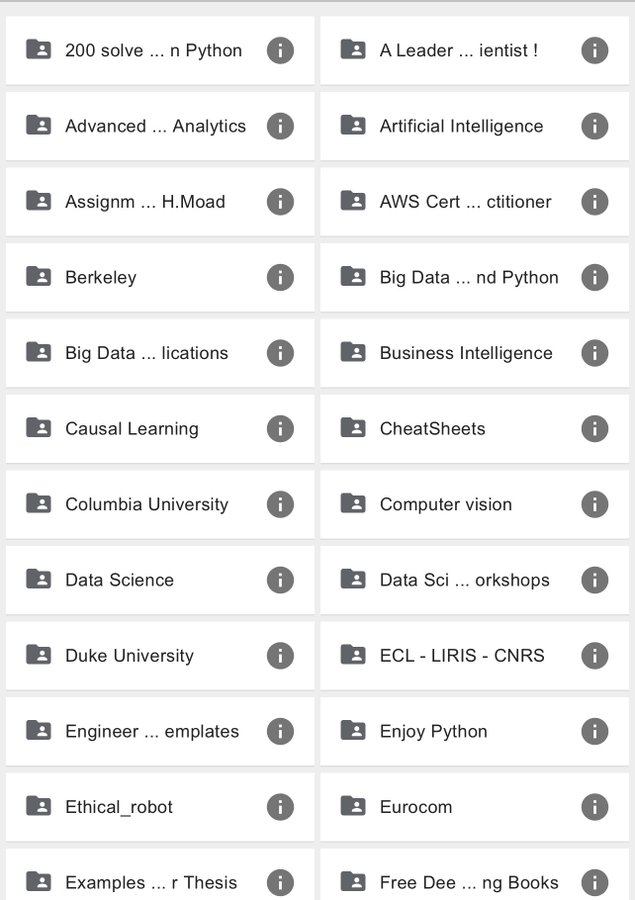
1. Artificial Intelligence
2. Machine Learning
3. Cloud Computing
4. Ethical Hacking
5. Data Analytics
6. AWS Certified
7. Data Science
8. BIG DATA
9. Python
10 MBA
For 24 Hours only!
To get it:
1. Like, Retweet and Follow
2. Reply "Send"
👁 500 TB of Tutorials + Books + Courses + Trainings + Workshops
💀 Data Science
💀 Python
💀 AI
💀 Cloud
💀 BIG DATA
💀 Data Analytics
💀 BI
💀 Google Cloud Training
💀 Machine Learning
💀 Deep Learning
💀 Ethical Hacking
To get it, just:
- Follow me
- Like & RT
- Comment "send"