@EuroBriefing Politicians must release the central bank from its straitjacket. Debt-based money is unsustainable in an over-indebted society. Time for safe money outside the banking system. https://t.co/F6k4GalAmB pdf: https://t.co/VHE0DIpI0c
The Genocide for Gas Program is in progress.
And it's a killer - literally.
Gaza has been split EXACTLY at the point defining the territorial waters of North Gaza and South Gaza, under which terms the North has access to ALL offshore gas and oil fields.
The missing context for what's happening in Gaza is that Israel has been working night and day to ethnically cleanse the Palestinian people from their homeland since even before Israel become a state – when it was known as the Zionist movement.
Israel didn't just cleanse Palestinians in 1948, when it was founded as a Western colonial project, and again under cover of a regional war in 1967.
It also worked to ethnically cleanse Palestinians every day between those dates and afterwards. The aim was to move them off their historic lands, and either expel them beyond Israel’s new, expanded borders or concentrate them into small ghettoes inside those borders – as a holding measure until they could be expelled outside the borders.
The 'settler' project, as we call it, is a misnomer. It's really Israel's ethnic cleansing programme. Israel even has a special word for it in Hebrew: 'Judaisation', or making the land Jewish. It is official government policy.
Gaza was the largest of the Palestinian reservations created by Israel's ethnic cleansing programme, and the most overcrowded. To stop the inhabitants spilling out, Israel built a fence-barrier in the early 1990s to pen them in. Then when policing became too hard from within the prison, Israel pulled back in 2005 to the outer perimeter barrier.
New technology allowed Israel to besiege Gaza remotely by land, sea and air in 2007, limiting the entry of food and vital items like medicine and cement for construction. Automated gun towers shot anyone who came near the fence. The navy patrolled the sea, stopping boats straying more than a kilometre or two off shore. And drones watched 24 hours a day from the sky.
The people of Gaza were sealed in and largely forgotten, except when they lobbed a few rockets over the fence – to international indignation. If they fired too many rockets, Israel bombed them mercilessly and occasionally launched a ground invasion. The rocket threat was increasingly neutralised by a rocket interception system, paid for by the US, called Iron Dome.
Palestinians tried to be more inventive in finding ways to break out of their prison. They built tunnels. But Israel found ways to identify those that ran close to the fence and destroyed them.
Palestinians tried to get attention by protesting en masse at the fence. Israeli snipers were ordered to shoot them in the legs, leading to thousands of amputees. The 'deterrence' seemed to work.
Israel could once again sit back and let the Palestinians rot in Gaza. 'Quiet' had been restored.
Until, that is, last weekend when Hamas broke out briefly and ran amok, killing civilians and soldiers alike.
So Israel now needs a new policy.
It looks like the ethnic cleansing programme is being applied to Gaza anew. The half of the population in the enclave's north is being herded south, where there are not the resources to cope with them. And even if there were, Israel has cut off food, water and power to everyone in Gaza.
The enclave is quickly becoming a pressure cooker. The pressure is meant to build on Egypt to allow the Palestinians entry into Sinai on 'humanitarian' grounds.
Whatever the media are telling you, the 'conflict' – that is, Israel's cleansing programme – started long before Hamas appeared on the scene. In fact, Hamas emerged very late, as the predictable response to Israel's violent colonisation project.
And no turning point was reached a week ago. This has all been playing out in slow motion for more than 100 years.
Ignore the fake news. Israel isn't defending itself. It's enforcing its right to continue ethnically cleansing Palestinians.
Nog even uit dat rondetafelgesprek ‘weerbare democratie’ @FD_Nieuws, waarin hoogleraar @TomWGvdMeer de vinger op de zere plek legt. Duidelijk werd overigens uit die hele bijeenkomst dat deze academici niet van plan zijn om zich voor het karretje van de verbodsroepers te spannen. Chapeau.
Ik ben vooral gecharmeerd van het standpunt dat #CBDC geen wettig betaalmiddel mag zijn. De ECB kan naar eigen inzicht liabilities creëren. Als ze maar niet in staat is deze aan ons op te dringen. De status 'wettig betaalmiddel' zou haar daar wel toe in staat stellen.
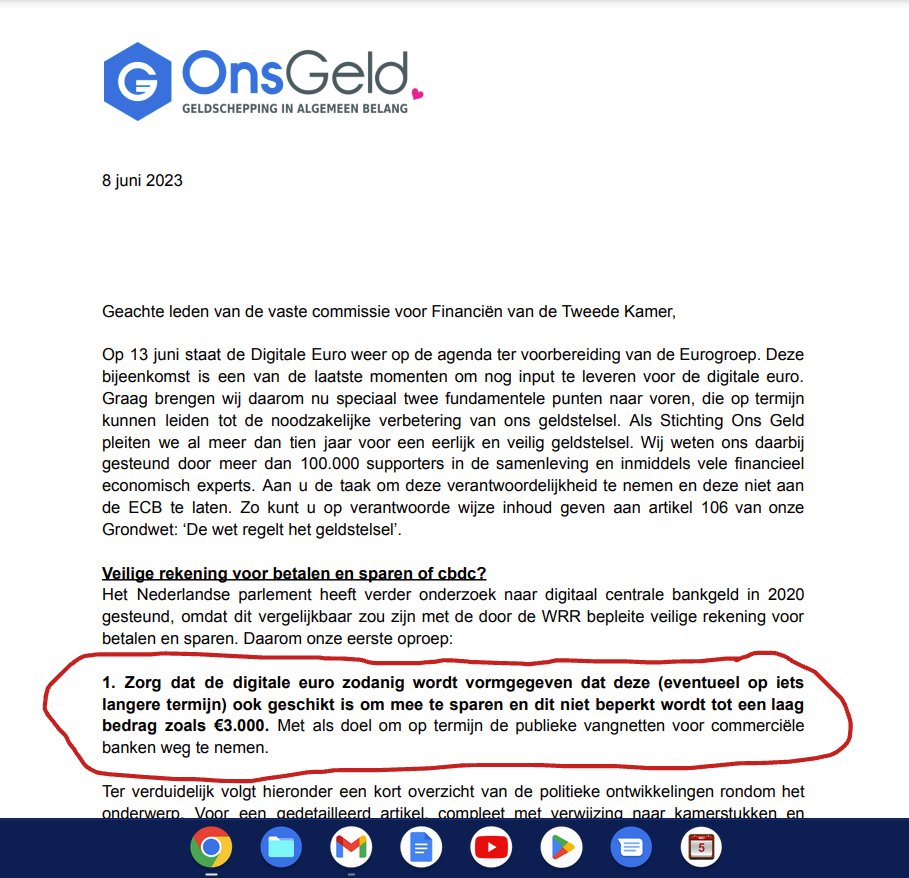
Zolang de digitale euro geen spaarmiddel mag worden en niet als doel heeft om op termijn de publieke vangnetten voor commerciële banken weg te nemen zullen de banken hun huidige machtspositie behouden. Stichting Ons Geld zal dit blijven benadrukken 👇👇👇
https://t.co/xs6H0f2lbb
Het parlement heeft nog 30 dagen (!) de tijd en MOET dus voor het zomerreces actie gaan ondernemen (en daarvoor zijn 30 Tweede Kamerleden of 15 senatoren nodig) anders wordt de gewijzigde Gezondheidsregeling (die bindend is!) van de WHO onvermijdelijk op 31 mei 2024 van kracht!
The ECB deliberately chooses to give away €130 bln to commercial banks in 2023! The conclusion @MartijnJvdL and I drew in October 2022 based on our investigations, (which was later also adressed by @pdegrauwe) has finally trickled down to the public arena! https://t.co/AION0HNQvw
Ons Geld en Edgar Wortmann zijn al sinds 2012/2013 bezig met monetaire hervorming in Nederland. Hun oplossingen zijn radicaal maar onderbouwd en interessant, zeker in een tijd waarin banken door digitalisering kwetsbaarder zijn geworden.
Leuk om met Edgar hierover te praten.
@reindevries76 Nog wonderlijker was het weer opstijgen en aansluiten op het moederschip in orbit. De video weergave ervan was echter weinig overtuigend.
@MahirAlkaya Dat is mooi Mahir. Langs die weg zou de Kamer het initiatief weer naar zich kunnen toetrekken, mbt de digitale euro. https://t.co/9C2aYbc5FH
Pepe is correct, in the relationship between the Biden crime family and the Ukraine-Israeli-Cypriot oligarch Igor Kolomoisky. It was K. who created Zelensky (literally), and it was K. who gave Hunter Biden his no-show job at Burisma Gas,
@VerduijnNiels@lexhoogduin Invoering van de digitale euro hoort gepaard te gaan met afschaffing van de status 'wettig betaalmiddel', zoals in NL voor invoering van de euro ook gebruikelijk was. Wat 'gangbaar geld' is wordt in het verkeer bepaald. TK 7729 6 p. 114. https://t.co/efOY4RleTA
@VerduijnNiels@lexhoogduin Inflatie hoort bij een commercieel geëxploiteerd geldstelsel, zoals het bankgeldstelsel. In een maatschappelijk beheerd geldstelsel kan inflatie achterwege blijven.
@lexhoogduin@VerduijnNiels Monetair managent vergt actief beleid. Dat moet zijn gericht op absolute prijsstabiliteit, dus geen inflatie- noch deflatiedoelstelling. Overheid mag private liquide stores of value niet steunen, maar ook niet verbieden. Ze wordt gedisciplineerd door de markt.
@VerduijnNiels@trias_politica @madelonvos_ @lexhoogduin@ArnoWellens @SFL_nl @BezemerDirk@MahirAlkaya @teunisbrosens @mrtbollen@paulbuitink Niet uitfaseren van banktegoeden maar demonetariseren. Pariteit met de euro wordt dan niet meer door de centrale bank bewaakt, en door de belastingbetaler gegarandeerd. Geld aantrekken van het publiek moeten banken dan doen als ieder ander: onder prospectusplicht.
Volgens @paulbuitink verscheen gister de ´moeder aller CBDC podcasts´ met @bslagter en @ArnoWellens. Hebben de heren geleverd? Ik vind van wel! Maar dat neemt niet weg dat ik een aantal opmerkingen heb: 🧵 1/n
@Digitale_Euro 7 jaar geleden wees ik de commissie financiën op het belang van digitaal contant geld: een schuldvrije munt die NIET wordt uitgegeven door de centrale bank. https://t.co/2TUkyctJ3d :::
https://t.co/ovdNMS4Jqo ::: #DigitaleEuro.
@VerduijnNiels@lexhoogduin@sassenvanelsloo@BartNijman@mrtbollen@MartijnJvdL Volle potentie van CBDC = centralisering van geld en krediet = totalitair. Vandaar dat we digital cash (DC) moeten hebben zonder centrale bank (CB). Dan is de volle potentie scheiding van publiek (geld) en privaat (krediet en stores of value).