@getpseudoed it’s linked to it yes, but i’m more referring some of the science behind the dominant and specific wavelengths of light that reach us only at those times. i wake up unusually early and am partial to sunrises.
@zachariaspro not to argue. stealing published works is hard to say. and i would say the watermark is more to prove that it was in fact claude and so that generated the text. not to claim ownership
sam's opening statement to congress after qwen 3.8 27B:
"look, i want to be really clear, i think open source is amazing and we love it. but Senator, a $900 gpu is now running frontier intelligence completely offline. no account, no subscription, no provider in the loop who feels a responsibility for safety. and i take that incredibly seriously. when a teenager can run a model that rivals ours in their bedroom, with no logging or oversight, and no monthly relationship with a company that cares about alignment, i think we have to ask what kind of world we're building. we're not asking for control. we're asking for a thoughtful framework. for humanity."
Feb 2023: Google invests $300M in Anthropic
Oct 2023: Google adds $2B
Mar 2025: Google adds $1B
Oct 2025: Anthropic deal for ~1M Google TPUs
Apr 2026: Multi-GW TPU deal, Google invests an additional $40B
May 2026: Anthropic commits ~$200B to Google Cloud
Mentally healthy people live in a permanent hallucination.
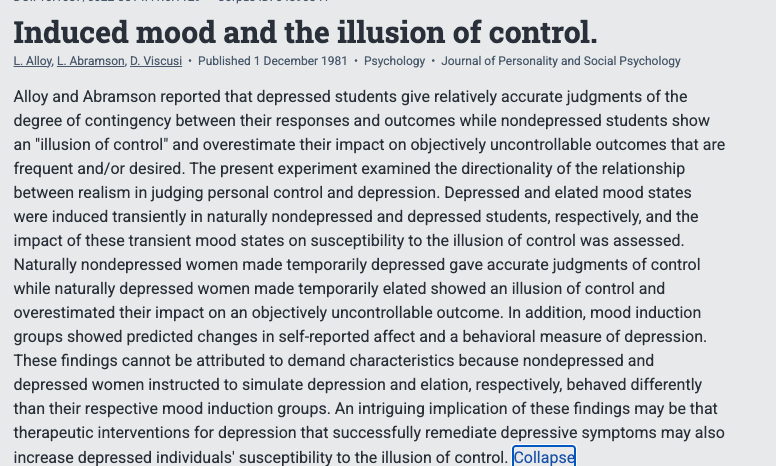
Lauren Alloy's landmark studies at Temple University shattered a comfortable assumption about mental health.
She gave participants a simple task: press a button and try to control when a light turns on.
Some had control, others didn't.
Depressed participants accurately identified when they had zero influence over the light. Mentally healthy participants believed they were controlling it even when the light operated on pure randomness.
The pattern repeated across dozens of experiments. Healthy people overestimated their test scores before getting results back. They predicted longer lifespans, better job prospects, and lower divorce risk than statistical reality supported. Meanwhile, mildly depressed individuals predicted outcomes that matched actual data with eerie precision.
Alloy called this "depressive realism" and it reveals something disturbing about human consciousness. What we label as mental wellness depends on systematic self deception. Your brain evolved to lie to you about your chances, your control, and your capabilities because accurate risk assessment would have killed your ancestors before they reproduced.
The optimism that gets you out of bed each morning is the same cognitive error that makes you buy lottery tickets.
But, the depressed participants who saw reality clearly became more depressed as a result of their accuracy. Knowing the truth about your limited control and uncertain future creates a feedback loop that spirals into paralysis.
Evolution faced a choice between accuracy and action. It chose action every time.
The people you admire for their mental strength are chemically incapable of seeing how bad the odds really are.
this is actually insane
> be tech guy in australia
> adopt cancer riddled rescue dog, months to live
> not_going_to_give_you_up.mp4
> pay $3,000 to sequence her tumor DNA
> feed it to ChatGPT and AlphaFold
> zero background in biology
> identify mutated proteins, match them to drug targets
> design a custom mRNA cancer vaccine from scratch
> genomics professor is “gobsmacked” that some puppy lover did this on his own
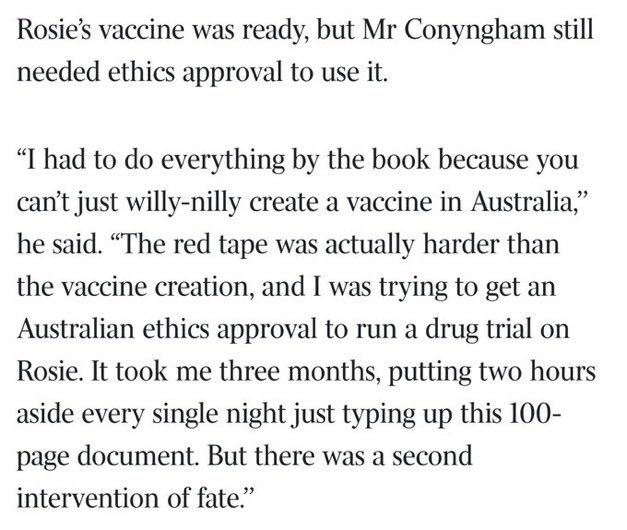
> need ethics approval to administer it
> red tape takes longer than designing the vaccine
> 3 months, finally approved
> drive 10 hours to get rosie her first injection
> tumor halves
> coat gets glossy again
> dog is alive and happy
> professor: “if we can do this for a dog, why aren’t we rolling this out to humans?”
one man with a chatbot, and $3,000 just outperformed the entire pharmaceutical discovery pipeline.
we are going to cure so many diseases.
I dont think people realize how good things are going to get