Vimal Kapur tries to spend a third of his time with customers or sales teams.
For the Chairman and CEO of @honeywell Technologies, those conversations help him understand what customers need, test ideas for new products and make decisions about where the business should go next.
Today, we’re launching Future Proof, @semafor’s technology podcast. The first guest, @alexstamos, is a much needed voice of reason at this crazy time. But don’t get me wrong! It’s a spicy one! Hope you download it and listen. (Or watch on YouTube)
“I don’t think autonomous systems should launch a weapon.”
@MotoSolutions Chairman and CEO Greg Brown sees a growing role for drones and robots in dangerous situations—from defusing bombs to helping protect first responders.
“This is bullsh*t. And if you want to fire me, go ahead and fire me.”
That was Greg Brown’s response when @MotoSolutions board considered putting the company up for sale in 2014.
David Ellison is bulking up his executive team with a big poach: Ynon Kreiz, formerly of Mattel, IS headed to the combined $WBD - $PSKY, sources tell @semafor, in a yet undefined senior role.
When Greg Brown became Motorola CEO, the company was losing $350 million to $400 million a quarter. Extrapolating out, he says, @Moto was just 18 months to two years away from bankruptcy.
“If you knew what I knew, you would have made the same decision,” he says of splitting the company.
"The Western world is more concerned about individualism and privacy, and Asian companies are more collectivist, willing to do what's good for the company."
@kaifulee tells @Edgecliffe why Asian companies are more likely to adopt an all-knowing 'Boss AI.'
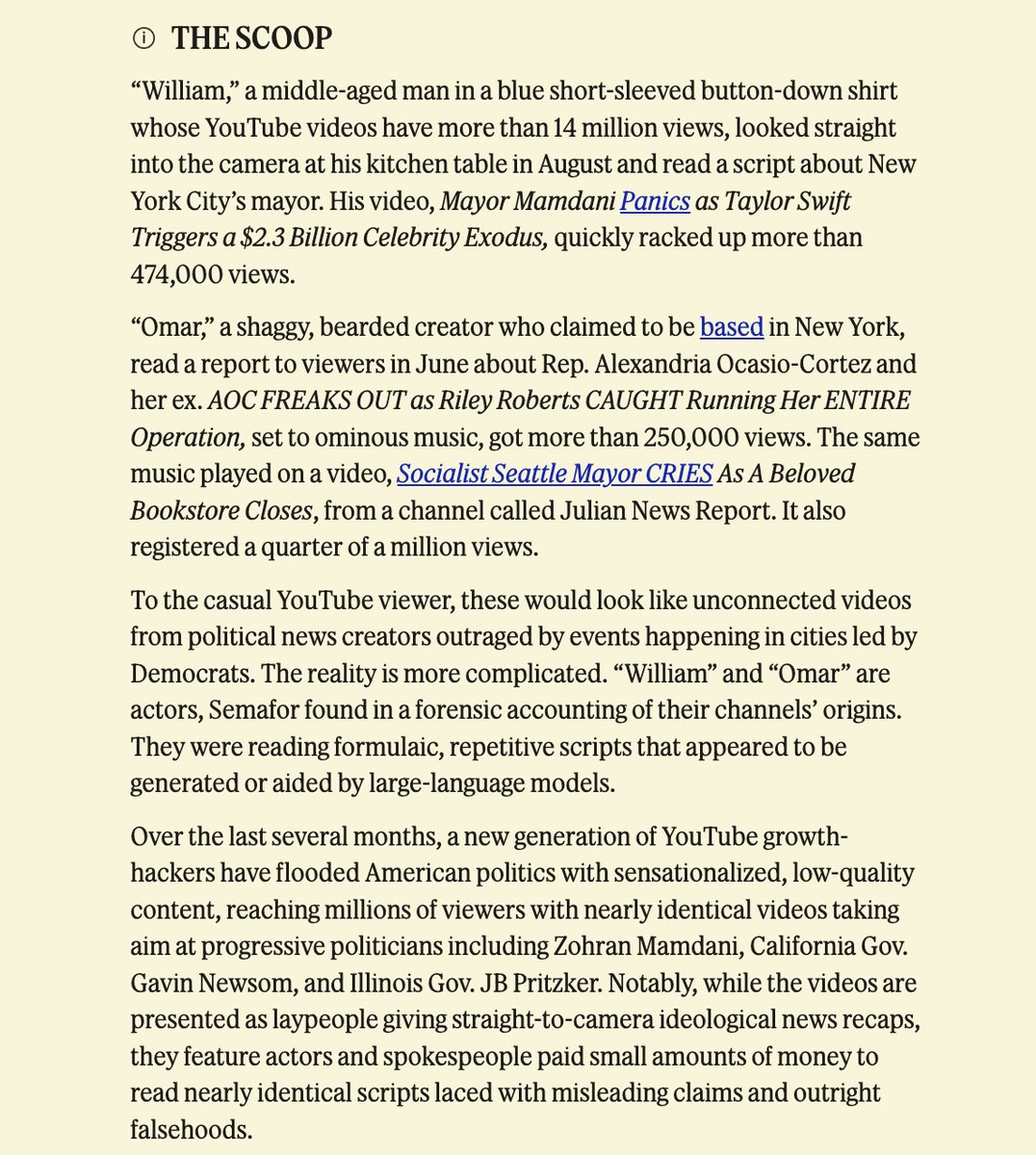
I wrote about a guy running a network of secret "ghost creators," paying actors $26 per video to read AI-assisted "anti-Dem" videos on YouTube.
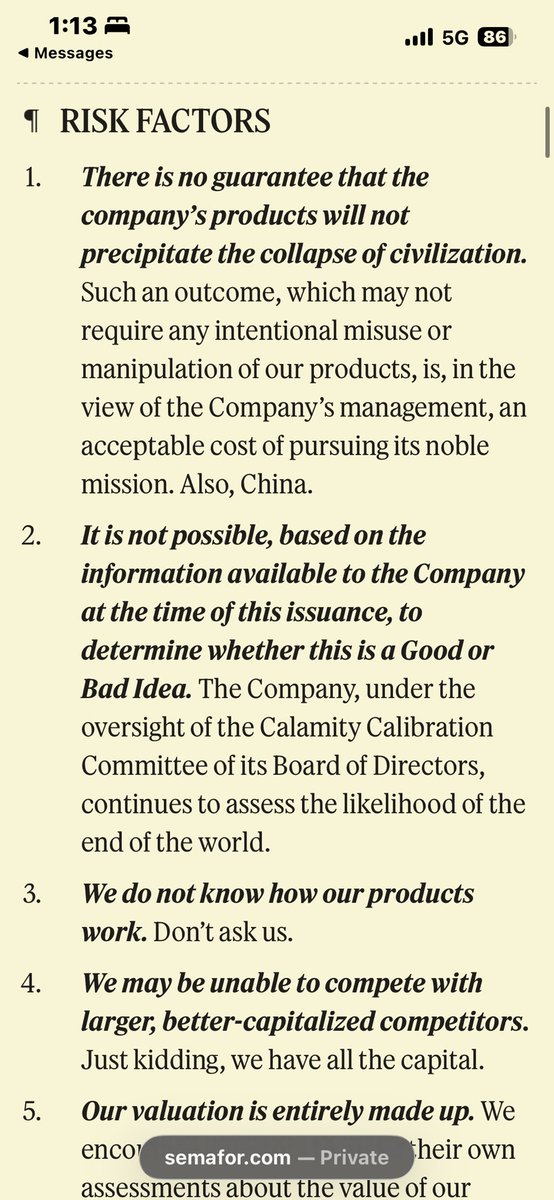
In just a few months, the channels got 45 million views, more than media companies like WaPo, the New Yorker, and, sadly, Semafor.
Reed Hastings sees AI unleashing a new wave of “creative destruction”. Check out our conversation for The CEO Signal for what that means for all of us. https://t.co/jQC8zG86VN via @semafor
Semafor has announced the expanded Global Advisory Board for Silicon Valley & The World — a first-of-its-kind, multi-year initiative bringing together the leaders building transformative technologies with the policymakers shaping how they are deployed.
With more than 40 global figures joining the board — including @patrickc, @eldsjal, Jane Fraser, @ajassy, Jay Y. Lee, Dilhan Pillay Sandrasegara, @GinaRaimondo, @AravSrinivas, and Hiroki Totoki, alongside co-chairs Jensen Huang, Divesh Makan, @satyanadella, Ruth Porat, and @LisaSu — this group reflects the full spectrum of power driving the AI economy.
Designed to move the conversation beyond debate, the platform will bring together more than 350 founders, CEOs, investors, and policymakers in November, uniting the leaders with the ability to fund, scale, and implement new ideas.
Delighted so see how The CEO Signal show is resonating with audiences. Catch up on any episodes you've missed, here or wherever you get your podcasts https://t.co/aImbQk6sTc
🟡Listen to The CEO Signal, a new show hosted by @PennyPritzker and @semafor CEO Editor @Edgecliffe. Building on The CEO Signal NL, the show features candid conversations with the leaders of the world’s most consequential companies.
🟡https://t.co/RYbWytAtyy
In this episode of The CEO Signal, @Cisco Chair and CEO @ChuckRobbins is direct about what it takes to lead at the speed of AI.
He tells Penny Pritzker and @Edgecliffe why a bad decision can beat a delayed one, why teams need to “disagree and commit,” and when a CEO should step out of the room so their view does not distort the debate.
The conversation also explores Cisco’s role in the AI buildout, from networking and silicon to security in an AI-agent world.
For Robbins, keeping a large organization moving starts with the CEO setting the pace.
His advice: “Be the pace car.”
🟡 "There should be more voices" in the corporate world speaking up on societal issues, @Allstate CEO Tom Wilson tells @Edgecliffe and @PennyPritzker in this episode of The CEO Signal.
“CEOs need to stand up and decide what’s important to them, what’s important to their customers — and take a stand.”
Wilson has led Allstate for nearly two decades, running a business built on trust at a time when trust in America is under pressure. He explains why declining trust is not just a social problem, but a business risk for an insurance company whose promise is to be there when customers need it most.
Wilson discusses why he believes companies have four roles: serving customers, making money for shareholders, creating opportunity for employees, and improving communities. That philosophy has shaped Allstate’s stance on issues from climate resilience and personal privacy to wages, good jobs, and the future of work in an AI-driven economy.
He also talks about the 20-year journey of turning purpose from a corporate slogan into daily practice — including Allstate’s work helping more than 75,000 employees identify their own personal purpose.
“If you want to be a purpose-driven company,” he says, “you have to be powered by purpose-driven people.”
Wilson reflects on his evolving leadership style, why “greater clarity leads to greater empowerment,” and how CEOs must be willing to pick the big moments and be “in the change” if they want organizations to move.
We launched a cool new editorial project today called Semafor Intelligence. It’s very much the work of humans, but has an interesting backstory because it started as a prototype I built with Codex in an hour. It allowed us to gather insights from our week-long Semafor World
🟡 Semafor today launched Semafor Intelligence, a new AI-enabled editorial insight product that transforms the full onstage record of Semafor’s global convenings into evidence-backed analysis — capturing the views of the world’s most consequential decision-makers, the debates shaping their thinking, and forward-looking signals.
The first edition draws on Semafor World Economy 2026, where more than 500 CEOs, policymakers, and G20 leaders gathered in Washington, DC, to discuss the forces shaping the new world economy.
To produce it, Semafor developed a proprietary AI tool that analyzes the full onstage record of each convening, identifying key claims, topics, stances, and supporting evidence, then linking each finding back to the relevant speaker, session, transcript, and video moment. Semafor’s editorial team then distilled the strongest patterns into the sharpest insights. Each published theme combines transcript-backed analysis, speaker moments, citations, and a journalist’s view on why the signal matters.
Semafor Intelligence findings from Semafor World Economy 2026 tell the story of The Chokepoint Economy — the consensus among leaders that the promise of globalization has given way to concentrated power and risk, and that resilience is now the organizing principle of the new world economy. Across nine themes, the report surfaces where consensus is forming, where it is fracturing, and where the prevailing views may be dangerously wrong.
🟡 Semafor is launching a new initiative: Silicon Valley & The World, bringing together leaders building artificial intelligence and other breakthrough technologies with leaders responsible for shaping the strategies, policies, and institutions around them.
Co-Chaired by Divesh Makan, @satyanadella, Jensen Huang, Ruth Porat, and @LisaSu, the inaugural gathering will convene leading technology CEOs, senior government officials, and global financial leaders in Silicon Valley in November.