PyMOL in the web browser with a couple bugs fixed, and now with a copilot --you no longer need to know commands or write scripts!
Out soon at https://t.co/b8E8sUIrzT
Can we teach an LLM to fold proteins?
Introducing RumiFold: a chat model that folds proteins in its own hidden states, then reasons about their function through natural language! 🧬 (1/4)
that fund putins weapons or chinese ships that fund russia and we have a failed government staying quiet about it and there are rumors about 2 young libyans dead in the attack this attack changed my view on ukraine
the attack happened in my city in libya a neutral country and this is terrorist behavior no different from any terrorist organization libya is not in europe and not a funder of russia this is a coward move you will never see them flex the same muscles on oil pipelines
@Lolool620619 مشكله هولاء ليس عندهم ادراك انه كل ما قام فيه ابستين هو اساسا قانوني في دول عربيه اصلا دول عربيه عباره عن جزر ابستين لكن فرق ابستين دفع ثمن جرائمه وعالم سمع صوت ضحايا لكن هنا يشرعون كل قذرات ابستين باسم دين
New paper just released! "DAQplugin: Interactive validation of Cryo-EM protein models in ChimeraX", Structure. The plugin validates a structure as it is built in real time, and suggests how to correct them.
Paper: https://t.co/8TjvyQl5iv
Plugin: https://t.co/q98zmpLWAY
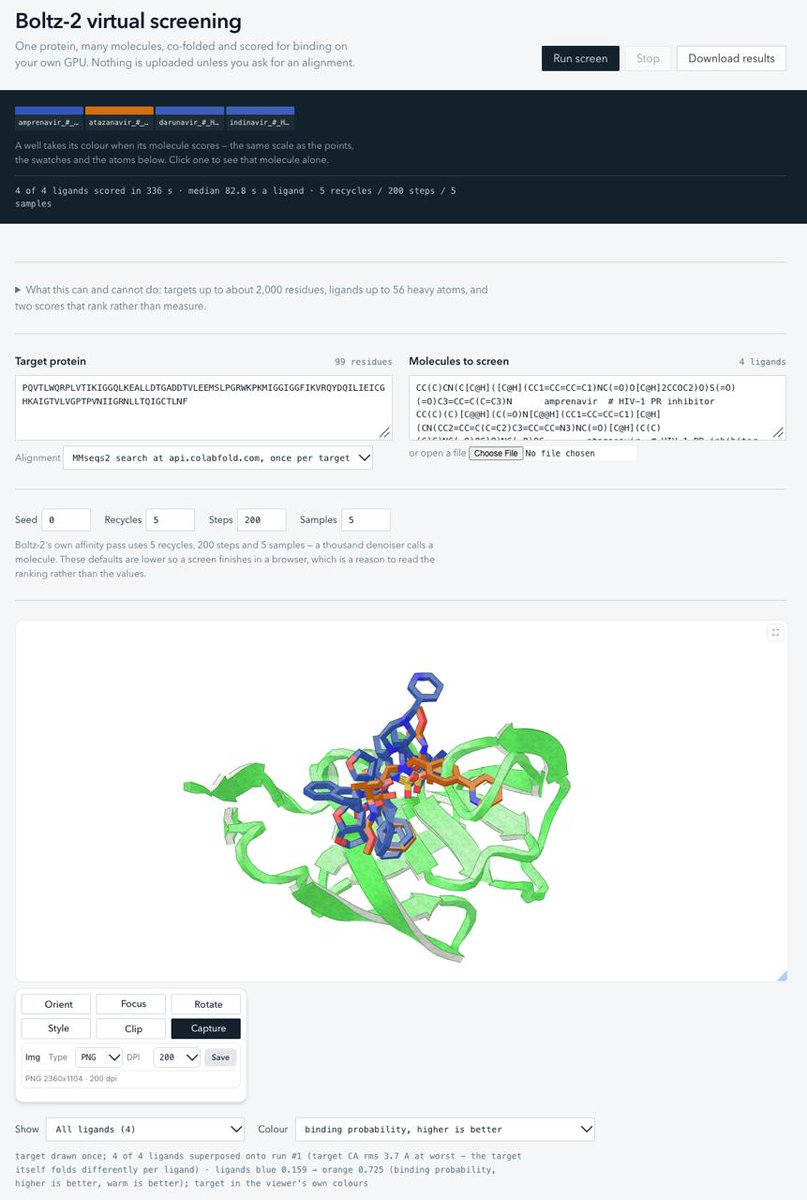
Virtual screening in your browser: paste a sequence + SMILES, and Boltz-2 co-folds and scores each ligand on your own GPU. Nothing uploaded.
100 ligands in 39 min on an M3 Pro. Bigger targets → one Colab cell.
Built on LocalFold by @sokrypton 🙏
https://t.co/p23gZCezw7
You can use Claude Fable 5.2 to make MSAs. The MSAs have clear coevolution signal. You can give those MSAs to AlphaFold for structure prediction 🤠 (1/5).
Thanks to the thousands of you that used the RFD4-Proteina online GUI and gave feedback! Thanks to the one and only @sokrypton it is now even easier to use, both on HF and on your own laptop/tablet/even phone! Make your own pesticide degrader like legend @SethWoodbury1 in our paper, including refolding! Links etc in 🧵
LLMs are powerful, so why do we still make them call tools to handle 3D molecules?
Introducing Nahual: a decoder-only model for any sequence of text and 3D molecules. #NeurIPS2026
In roughly a day's worth of work with a few dollars of GPU compute, I could computationally design miniprotein binders against IL-36 in Codex. It involved a bunch of steps, including detecting and mitigating against reward-hacking of the design function and optimizing for developability. A slew of tools was involved: RFD4-Proteina, Boltz2, ESMFold, Protein-Sol. Runpod GPUs. Sounds impressive? Read through to the end for the point I am making.
1. RFD4-Proteina generation. Method and output: Original versus V2 reward, eight matched seeds, 16 successful searches. Each search used 60 steps, beam width 2 and branching 2, with checkpoints at steps 30 and 60. Saved 128 rollouts, including intermediate checkpoints; 74 distinct coordinate structures after exact deduplication.
2. Selection and deduplication. Method and output: Two final candidates per seed per arm: 16 original + 16 V2 entries. Cross-arm sequence deduplication yields 22 molecules: 6 V2-only, 6 original-only and 10 shared.
3. Standalone folding. Method and output: ESMFold predictions for all 22 unique sequences; assessed consistency with the designed binder structures. Added cost.
4. Complex prediction. Method and output: Boltz-2 predictions for all 22 sequences with IL-36γ, three poses each: 66 complexes. Fixed settings, three recycles, 200 sampling steps, shared target MSA and empty binder MSA; no coordinate templates or affinity model.
5. Developability prioritization. Method and output: All 22 scored with Protein-Sol and NetSolP-D, plus isolated-monomer exposed hydrophobic surface. Four candidates on the first Pareto front.
6. Detailed structural review. Method and output: U04 and U10: six existing complex poses examined for pose consistency, close contacts and hydrophobic patches.
7. Figures. Method and output: PyMOL ribbon pictures, interface close-ups and editable sessions from existing model-0 coordinates; no coordinate optimization.
At the end I have a few candidates that are predicted to have good binding affinity and developability against IL-36. So have I designed a new protein binder or drug? Of course not. Of course I need to experimentally test these predictions.
But I did this exercise to make a point: we are constantly hearing about especially the frontier labs designing all kinds of proteins against different targets. This work is legitimate and valuable and a great advance relative to where we were even two years ago. But the point is that someone like me who is not an expert can now do this with a few dollars of compute in a day or two; if I had a couple of thousand dollars to blow on tokens I could have done much more. It's not as impressive as it looks - and that's a good thing.
Only large-scale experimental validation can validate the predictions that are coming out of AI-designed protein and small-molecule pipelines. This is no different from twenty years of computational chemistry and biology where we saw the best algorithms and docking and other models die on the rocks of experimental validation. AI is a great thing and a fantastic accelerant for work like this, but it's really important to put it in perspective and not get carried away. Retrosynthesis, protein design, small molecule design - all of these are now possible with AI, but none of them turn into proven science until there's large-scale validation of their predictions.
We need to stop being unduly impressed with such exercises and treating every rapid computational molecular design exercise as a big deal, and in a way that's a great thing because it really shows us how far AI has come so quickly. A few computational design pipelines don't equal a step change in scientific discovery, especially new therapeutic discovery. If we unduly raise expectations from AI-enabled biology or drug discovery and related areas, we risk facing the same disillusionment that proponents of computational techniques in these fields have faced for fifty years. The proof is in the pudding, and those who eat it know the difference between how it tastes and how it looks like in a recipe book.
AlphaGenome 2 is live! A step change in performance and new capabilities over AG1! @adamgayoso's thread covers the key results.
Manuscript: https://t.co/exVx6kxCxY
Blog: https://t.co/YkuyxDHs0D
API: https://t.co/I7zaZobbLx
A few notes under the hood & what's next:
Creation of light emitting proteins by AI.
AI designed a completely new enzyme capable of producing light through a chemical reaction. The artificial luciferase was only 13.9 kDa, remained stable above 95°C and showed catalytic efficiency comparable to natural luciferases.
https://t.co/bfR5sqco0Z
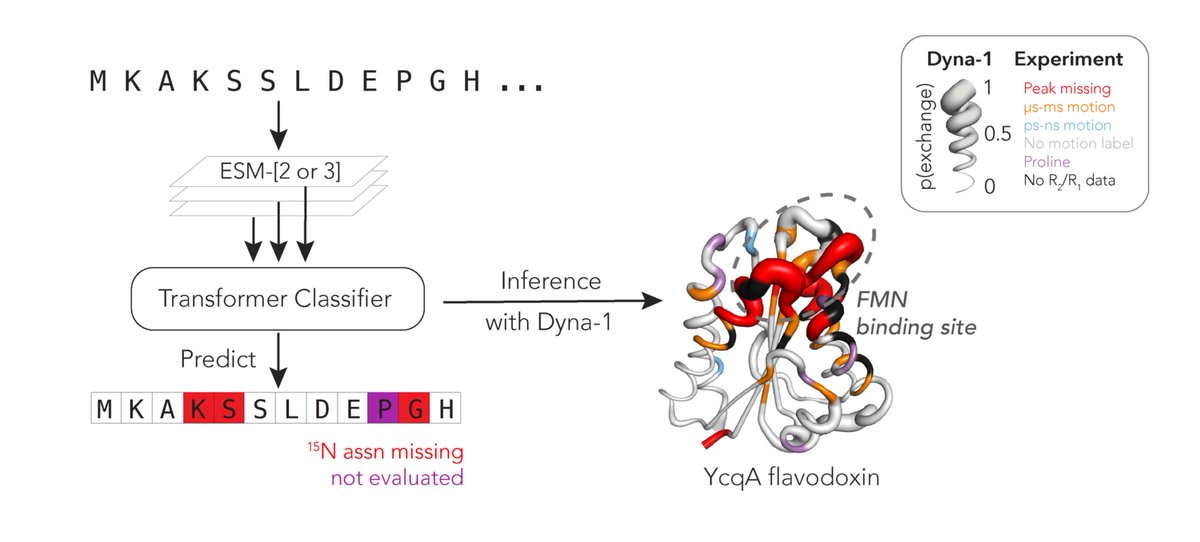
Protein function often depends on protein dynamics. To design proteins that function like natural ones, how do we predict their dynamics?
@HWaymentSteele and I are thrilled to share the first big, experimental datasets on protein dynamics and our new model: Dyna-1!
🧵
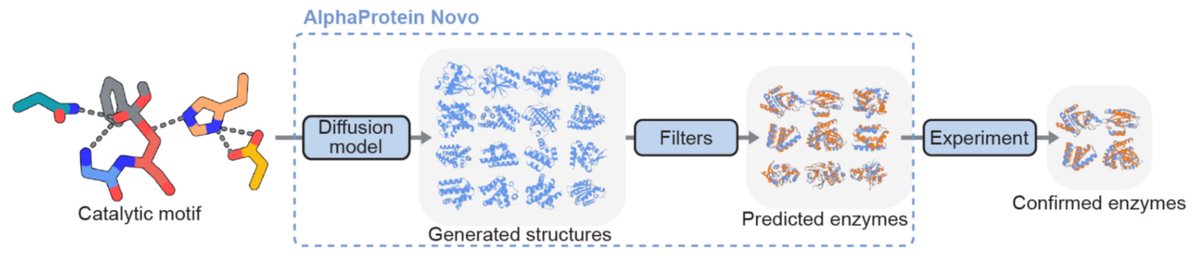
In collaboration with the @francesarnold and @pengliu_group research groups, we @GoogleDeepMind are proud to release AlphaProtein Novo, a pipeline for small-molecule enzyme design.
We developed AlphaProtein Novo on a few standard model reactions, and validated designs in our own wet lab. We then wanted to challenge this system against nascent chemistries, so we asked leading scientists in biocatalysis whether we could partner on the reactions they cared about.
Introducing AlphaProtein Novo, a pipeline for de novo enzyme design! In collaboration with @francesarnold's group, we developed AP Novo and used it to get SoTA "novel-scaffold" activity on 2 benchmark reactions and create enzymes to synthesize the pharmaceutical motif piperidine and degrade the environmental toxin DEHP.
Work led by @ZvxyWu@ZiqiLi0513 with teammates @alexechu_@kelly_ruijie@schulluc@jacobjinkelly@rosaliags@davidla@solserpens@j_reisenbauer, @pengliu_group, Josh, Thomas, Amy, Tristan, Harshnira, and others. It was a joy and privilege to work with you all!
Preprints and code:
https://t.co/Q3aaoSAFcv
https://t.co/NTtjUmk354
https://t.co/RoA7wEfzYn
Today we’re releasing the fastest? protein folding models ever!
@biohub actually trained ESMFold2 variants from the 300M and 600M parameter ESMC backbones, however, they did not release the models with confidence heads. Synthyra fixed that, now, the FastPLM versions of ESMFold2-300 and 600 can return pLDDT, pTM, and iPTM alongside structure.
These models are actually very strong. On FoldBench, moving from 300M to 600M only gains about 0.008 IDDT and 1.8 percentage points in PPI pass rates. Moving from 600M to 6B only gains another 0.028 IDDT and 6 points.
Our new confidence heads showcase high correlation to truth on held out evaluation sets. Roughly 0.8-0.9 spearman correlation across LDDT, TM, and DockQ. They can even tell which residues are intrinsically disordered from pLDDT alone with ROC AUC ~0.86.
Importantly, correlation to the 6B model is ~0.7 on pLDDT, ~0.8 for pTM, and ~0.7 for iPTM. There are many gradient-based protein design methods at this point, (Bindcraft, Mosaic, etc.) so this monotonic relationship between these tiny model’s outputs and the production ESMFold2 are super important for cheap gradient based design, where critic stages can still come from the larger model.
We have also integrated @AnthropicAI's new optimizations for protein language models, including our ESMFold2 implementations, for even more speed!
Of course, like any FastPLM model, these are super easy to use – even on consumer hardware. I predicted the barnase-barstar complex structure in 18 seconds on my modest 3070 GPU, including imports and model download.
Check out FastPLMs and try ESMFold2-300 and 600 today!
https://t.co/UyOOuPtktP
https://t.co/kl1mzpmXaJ
https://t.co/mwqkxaIXu0
Avengers assemble: 1 year BakerLab + NVIDIA GenAIR = 🔥 https://t.co/Cd2qiugCJo
Presenting RFD4-Proteina, our latest protein design model, significantly better and faster than everything we compared against, both in silico and in the lab! 1/30