#BREAKING: The @US_FDA has approved a new IV maintenance dosing for #Alzheimer therapy lecanemab (@EisaiUS) to be taken once every 4 weeks.
Our coverage on the decision:
https://t.co/KZweoPjlBx
We're excited to announce our new website!🧠 Learn how we are decoding the science of brain resilience and transforming knowledge into action for improving cognitive health at https://t.co/kKLOBQ89RY.
Researchers at the University of Kentucky’s Sanders-Brown Center on Aging are at the forefront of advancing dementia research with groundbreaking work on a condition known as LATE. “This work is a testament to the importance of precision in dementia diagnosis. With these new criteria, we are not only addressing a critical gap in identifying LATE but also empowering clinicians and researchers to provide more targeted care and advance the search for effective treatments,” said 𝐃𝐫. 𝐆𝐫𝐞𝐠 𝐉𝐢𝐜𝐡𝐚. @UKYMedicine@ResearchKY@NeuroscienceRPA@HillaryUKPR
https://t.co/Nv9mM1VOKP
Assistant Professor Carolyn Fredericks, MD, and her lab have demonstrated in detail the connection between biological sex and related differences in neurologic makeup, and the likelihood of developing #Alzheimer's disease.
https://t.co/AXS5MF2vv4
Supported by Stanford @BrainResilience our latest work uses #blood#biomarkers Aβ42/Aβ40 to predict cross-sectional and long-term cognition in early #Alzheimer’s disease and in clinically unimpaired older adults. A fantastic collaboration with @alitrelle!
https://t.co/yekJtnwx1n
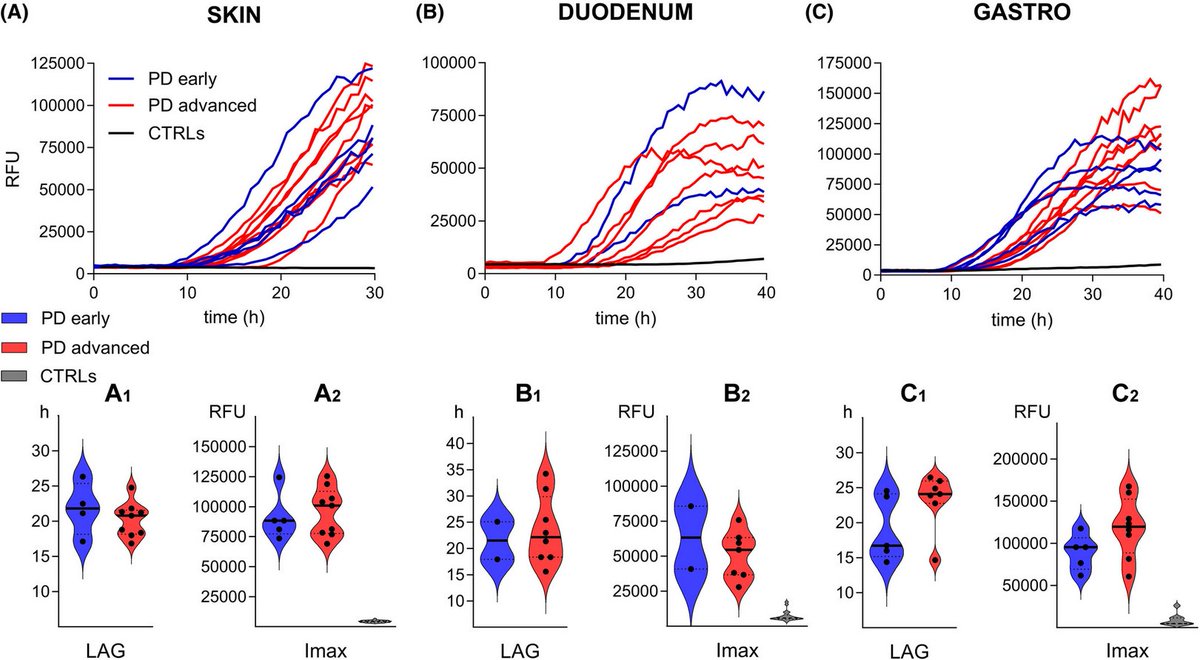
Researchers assessed RT-QuIC seeding amplification assay in gut & skin biopsies from early & advanced-stage #Parkinsons; Detection sensitivity was higher in advanced PD, may reflect diff.s in burden & distribution of α-syn within peripheral tissues
https://t.co/XT37QuUCIH
Extrasinusoidal dural macrophages are a distinct subset of immunologically active central nervous system–associated macrophages
https://t.co/8hG9wZegY2
@SciImmunology @AmnLukas
Save the date for our symposium on February 6! This event will highlight emerging research on brain resilience and aging, including a clinical presentation, select talks on prion disease, and a Stanford neuroscience poster session.
Learn more: https://t.co/WOj15OkYZJ
It's an honor to receive this recognition with so many distinguished women. A testament to hard work and to all the key people who have influenced and been an inspiration along this journey
#CARTcells for #DIPG#DMG clinical trial (1st arm) results are out today. Full Tweetorial coming, but first want to share the story of a patient whose #DIPG has disappeared for over 3 years. It is a milestone and moment of hope on a journey filled with so much grief.
“There’s a lot of loss that led to this research,” Drew’s dad said. “I hope those families know that this success is because of them.”
https://t.co/rNnHkL6pQR
High-throughput proteomics with Mendelian randomization identifies many causal immune-related proteins for #Alzheimer's disease, highlighting a role of lysosomes, and potential role for repurposed drugs
https://t.co/lrGDrJMapr @NatureGenet@ccrugom And a proteomics AD prediction model outperformed genomics
When asked to draw a scientist, school-age kids in the United States are increasingly sketching women, according to a study from 2018.
Read more on #STEMSTEAMDay: https://t.co/xtOAX8sof0
🌟 Cai Lab @Nature paper alert! In new work led by @mysteriousjoe_, we find that rest periods after learning not only stabilize new memories BUT ALSO integrate new memories with older ones from days past! (1/9)
Read it here: https://t.co/Ur8dbGfuP3
Stanford Medicine’s Center for Clinical & Translational Research & Education received an NIH award to fast-track new biomedical treatments into real-world patient care and public health improvements. https://t.co/I9CpcW3fAE
Preprint Alert!!!! Another fantastic manuscript from talented @SashkaBeric and the whole team exploring non-invasive biomarkers for Parkinson's Disease. #Parkinson#transcriptomics#machine_learning
Wanna read it? Link below👇👇👇
https://t.co/Zk6EHEyvnJ
Amazing study by @laura_actg, demonstrating that genomic-based biomarkers (cell Free plasam RNA) can be leverage to create highly accurate predictive models for #Parkinsons, and capture biological relevant disease pathways. @WashUNeurology@MichaelJFoxOrg