Everyone knows the vocabulary. Everyone has heard the speeches.
Whitehall must be more agile, more mission-focused, more digital, more accountable, more joined-up, more innovative, more outward-looking.
The words change a little with each administration, but the ritual is repetitive. A new government arrives, a new review is launched, a new unit is created, a new organogram is drawn, a new acronym is born. Then the system absorbs the initiative, waits for ministerial attention to move elsewhere, and carries on much as before.
If the sweeping Civil Service review just announced by the Cabinet Secretary becomes another diagnosis of known problems, it will join the crowded shelf of well-intentioned failure.
But it could mark the beginning of something different...
✍️@TimKnoxLondon & @Kakabadse
Read more: https://t.co/FhiYOavYWN
There will be plenty of commentary over the coming days about who was in the right. But for us, the more revealing and more useful question is why the system works like this in the first place.
In a high-performing organisation, process, sequencing, follow-through and access to information are precisely the things that are tightly managed rather than left to chance, personality or circumstance. Appropriate processes and systems prevent this.
And yet in government, we find that incidents where trust has broken down, poor decisions have been made, and there is seemingly a lack of clear accountability happen with worrying regularity. Meaning the challenge isn't simply political, it's managerial.
Over decades, reform efforts have tended to focus on structures, policies and announcements.
But the day-to-day disciplines that make complex organisations function — clear accountability, strong management, consistent processes — have received less sustained attention. Perhaps because they're just not so glamorous.
Publishing personal objectives at the top of Whitehall is rare.
It happened briefly (2012–16), then stopped.
That’s why it matters that Antonio Romeo has published hers now.
It signals leadership and accountability — but history suggests the real test isn’t publication.
It’s whether performance against those objectives is ever shown. And, whether government departments themselves have objectives too.
There’s something right in this.
Britain isn’t broken. But parts of the state aren’t working as they should.
The risk isn’t “too much pessimism” — it’s stopping at diagnosis.
Across parties, there’s growing agreement on the problem.
The harder question is why, after decades of reform, it still isn’t fixed.
@thetimes
https://t.co/hKXqA6fkoE
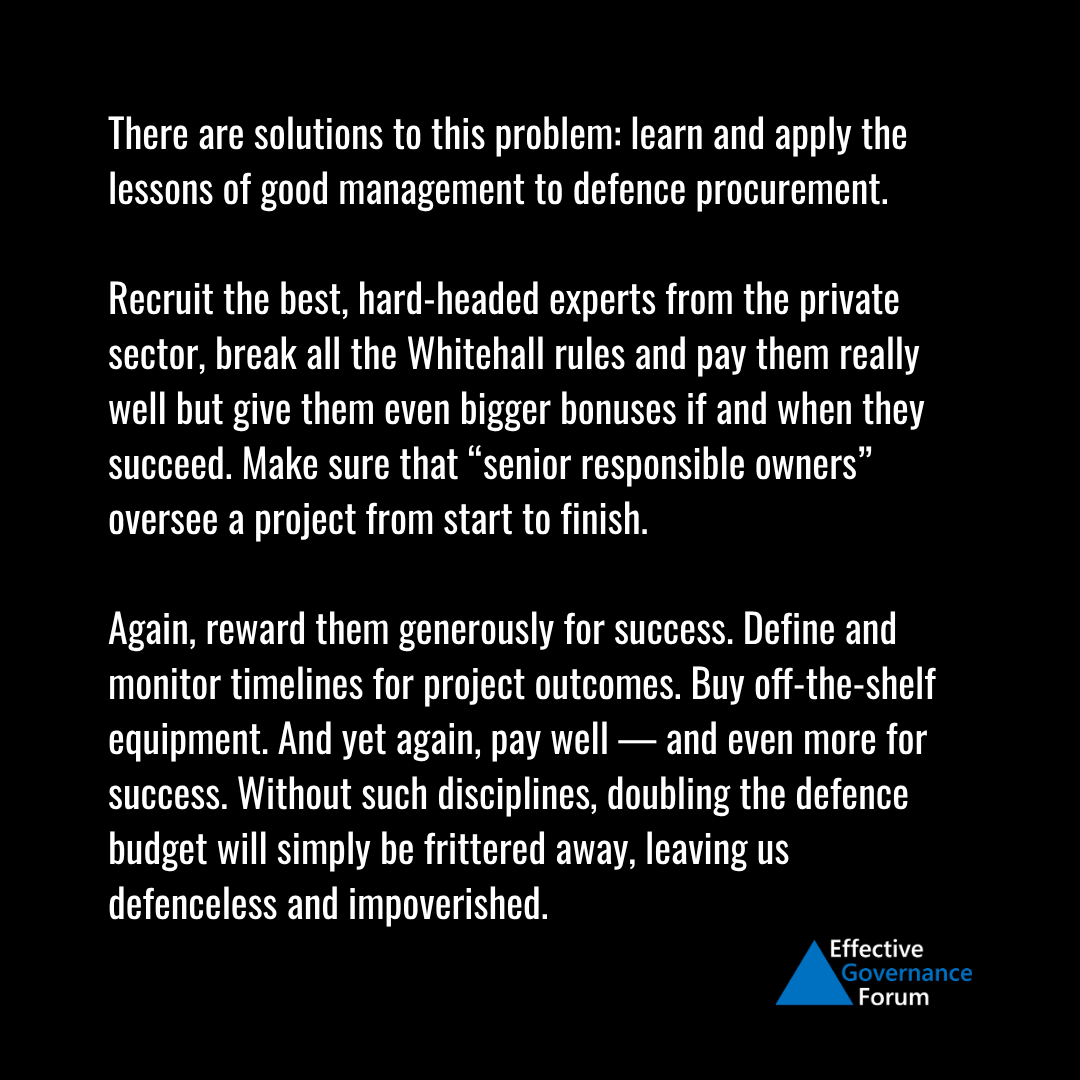
Writing yesterday, in The Times, @TimKnoxLondon responded to the news that Ministers could delay shipbuilding in £10bn MoD budget cut by making the argument for better leadership and management 👇
The prize is large.
The productivity gap is already costing around £80bn a year — rising to £170bn by 2030 if unaddressed.
Improving how government works determines whether the state can deliver what it promises.
Governments are elected on highly visible promises.
Whether those promises can be delivered depends on something much less visible: the capability of the state itself.
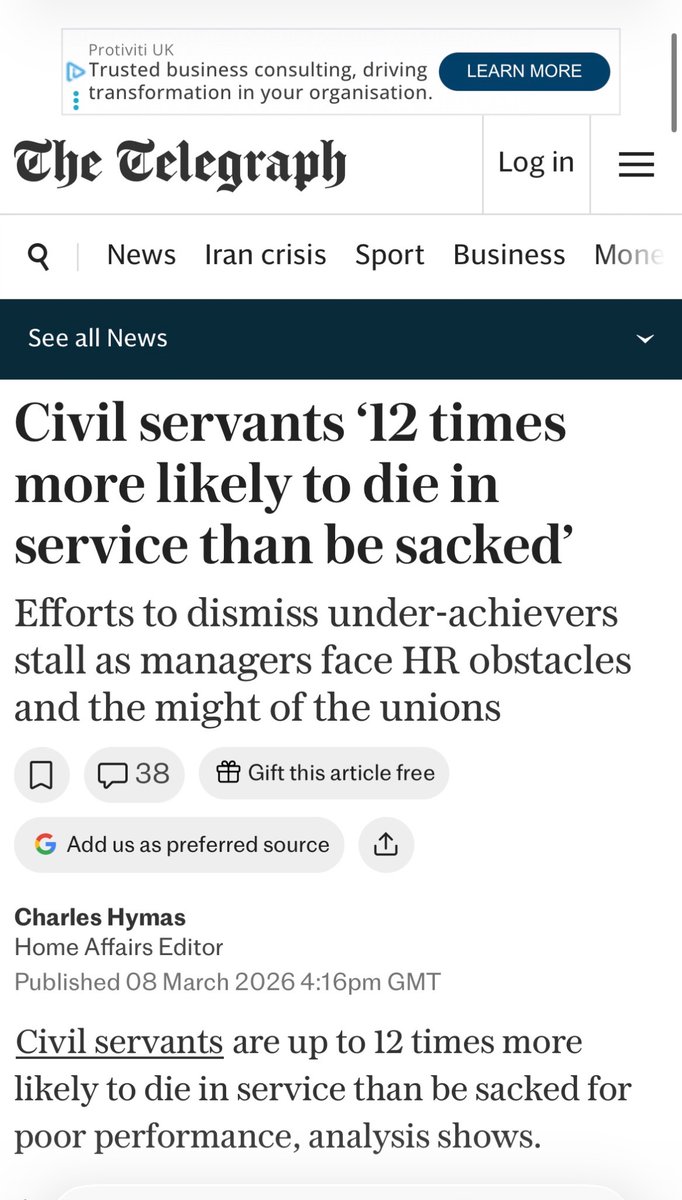
Striking statistic.
But the real question is not about individuals — it’s about how the system manages performance.
In many parts of government, management is treated as a secondary activity and leaders lack clear authority and incentives to address underperformance.
Until management capability and accountability are strengthened, these patterns are unlikely to change.
Our report on Effective Management of UK Government can be found here: https://t.co/WY9Fg3qbxM
@NeilDotObrien Question is why do systems produce such numbers?Often mngt treated as secondary activity & incentives poorly aligned with performance. So addressing underperformance hard even for capable leaders. Improving mngt capability & giving leaders authority to use is essential.
Numbers in forecasts matter.
But sustainable outcomes depend on good financial information, clear responsibility and aligned incentives — not just accounting figures.
https://t.co/BtdWskpd4p
@FT today carries a review of what Reform has learnt from its first taste of power. There is a broader and more systemic point to be made - Local authorities are legally required to balance budgets, but have limited control over revenue and growing statutory obligations.
That tension makes durable reform difficult — regardless of which party is in charge.
Genuine decentralisation would align responsibility with financial control. We set this out in our report 'Effective Decentralisation.' You can access a copy here: https://t.co/1O5BPrqKSe
@CapX Yes. Sensible people with experience of running things, with low egos working together honestly and with an actual plan can turn it around. It doesn’t have to be this way…and one day it won’t.
“Ben Judah is right in saying that ‘No 10 needs an overhaul’ but it is not the great expansion in political special advisers he advocates. Whether people liked or disliked what Margaret Thatcher did, it is generally agreed that she got things done. She did it by appointing the best available managers, from outside the civil service when necessary, delegating power to them and holding them accountable to a small centre in which she played the central, and often terrifying, role.” This from former Cabinet Secretary Robin Butler, as published in The Times today.
'rather more important than another change in personnel: the strategic transformation of the machinery of government, based on the implementation of the basic principles of good management'. @TimKnoxLondon getting to the heart of the matter in this @CapX article: https://t.co/IosdBfWyVv
When experienced insiders conclude that “it’s not about people but structures”, that should prompt serious reflection.
The UK has the worst of both worlds – a highly centralised government without the capacity, clarity, and management discipline to guarantee delivery.
As EGF showed last year, leading companies are showing the better way: put power in the hands of frontline teams, shrink the corporate centre and use that centre to set a clear vision and analyse data from across government. https://t.co/wYQlDzglPj
When experienced insiders conclude that “it’s not about people but structures”, that should prompt serious reflection.
The UK has the worst of both worlds – a highly centralised government without the capacity, clarity, and management discipline to guarantee delivery.
As EGF showed last year, leading companies are showing the better way: put power in the hands of frontline teams, shrink the corporate centre and use that centre to set a clear vision and analyse data from across government. https://t.co/wYQlDzglPj