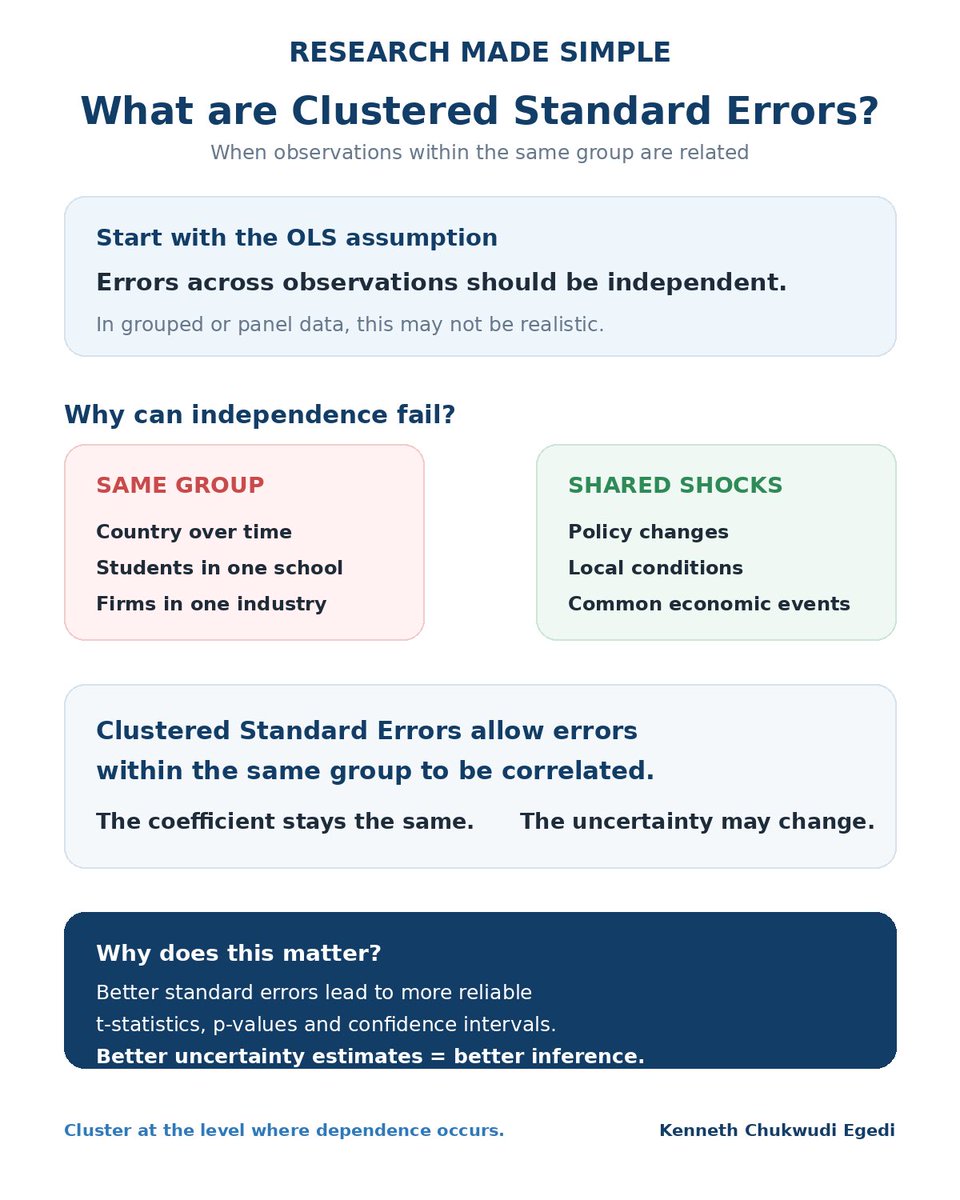
OLS assumes that errors across observations are independent.
But observations from the same country, firm or school may share common shocks.
Clustered Standard Errors account for this within-group correlation, giving more reliable inference.
#ResearchMadeSimple#Statistics
Your coefficient may stay the same, but the uncertainty around it may not.
Robust Standard Errors adjust how that uncertainty is measured when the usual assumptions are violated.
Same estimate. Better inference.
#ResearchMadeSimple#Statistics
A coefficient gives you one estimate.
A Confidence Interval shows the range of values that could plausibly surround it.
Narrower interval = more precision
If the interval includes 0, the result is usually not statistically sig. at the 5% level.
#ResearchMadeSimple#Statistics
You run a statistical test and get p = 0.03.
What does that actually mean?
It asks: if there were really no relationship, how unusual would a result like this be?
Smaller p-value = stronger evidence against “no relationship”.
#ResearchMadeSimple#Statistics
Standard Error (SE) is reported in almost every regression.
But what does it actually tell us?
The coefficient tells us what we found.
SE tells us how precisely we found it.
Smaller SE = greater precision.
#ResearchMadeSimple#Statistics
@ruffydfire Typos makes reading comprehension difficult to follow.
I want to believe you’re not the one behind this handle but please pay attention, it’s one too many.
Cheers.