Nothing like a Comm'r Peirce statement to get securities lawyers debating Reves and notes again! As @veda_labs has submitted to the SEC, decentralized on-chain lending protocols generally do not implicate Reves.
The discussion often begins with Reves’s family resemblance test. But that skips over the threshold question. Reves presupposes the existence of a note - an instrument evidencing a borrower’s obligation to repay a debt. Before asking whether an instrument bears a “family resemblance” to a security, we must first identify the note itself.
That was straightforward in a situation like BlockFi: customers transferred assets to BlockFi, making it the obligor, who deployed customer assets on its own balance sheet, rehypothecated them, and contractually promised repayment. Customers were ultimately relying on BlockFi’s creditworthiness. That is the paradigmatic debtor-creditor relationship to which Reves naturally applies.
Decentralized lending protocols such as @aave and @Morpho are fundamentally different. The protocol does not borrow customer assets, incur an independent repayment obligation, issue debt backed by its own credit, raise capital for its own business, or intermediate lending through its own balance sheet. Rather, it provides a non-custodial, rules-based mechanism through which users lend and borrow pursuant to predetermined smart contract logic.
That distinction is legally significant, not just a design difference. To be sure, protocols may make governance decisions regarding collateral eligibility, risk parameters, and other aspects of protocol design. But those decisions govern how the protocol operates; they do not transform the protocol into an intermediary borrower that incurs an independent obligation to repay suppliers.
Traditional notes evidence an extension of credit premised on the borrower’s promise to repay. Protocol lending instead relies on ex ante overcollateralization, algorithmic collateral management, and automatic liquidation. Repayment is designed to come from collateral, not from an intermediary's willingness or ability to satisfy its obligations. The lender’s principal risks are collateral risk, market risk, and smart contract risk, rather than the credit risk of a balance-sheet intermediary.
Ask: Who is the issuer? Whose motivations are relevant? Who is raising capital? Whose creditworthiness is the lender evaluating? Whose promise to repay is reflected in the alleged note?
In BlockFi, the answer to those questions was obvious. In decentralized lending protocols, it is not.
And that’s why decentralized lending protocols do not generally implicate Reves. The doctrine was developed to determine when an instrument evidencing an issuer's indebtedness should be treated as a security. Where there is no intermediary borrower, no balance-sheet financing, and no instrument embodying an independent promise to repay, the legal predicate for Reves is absent.
None of this is to suggest that every on-chain lending arrangement falls outside the securities laws. Protocol design matters, and different architectures may produce different analyses. But decentralized, non-custodial lending should not be analyzed simply by analogy to centralized lending businesses. They are fundamentally different models.
DeFi risk is moving from the smart contract layer to the operational layer.
"This is inevitable ... I actually think this transition is a good thing."
- @sunandr_ at @proofoftalk
Comm'r @HesterPeirce@SECGov just released a statement on vaults. The part that stood out to me:
"These new approaches to the deployment of assets hold great promise. Depending on their design, they can enable people to use the assets they own to generate income efficiently and cheaply. As securities move onchain, vaults and onchain lending strategies may become mainstream tools for managing investment portfolios."
Notice what's in that sentence. First, it presupposes that securities will move on-chain. Second, it suggests that when that happens, vaults won't just be a niche crypto product - they'll be core infrastructure for on-chain capital markets.
That is quite remarkable and we @veda_labs couldn't agree more. This is an exciting glimpse into the future of on-chain financial markets and exactly the conversation we should be having.
The pace of adoption for @krakenfx BTC Earn has shocking.
$233M across 20k users within one month has exceeded all of my expectations. @SentoraHQ has been crushing the curation game.
What this proves is the immense latent demand for BTC yield in enterprise. Unlike dollar-based yield programs, there is really no alternative in the market.
My unproven thesis is that centralized BTC yield offerings are less attractive to BTC holders because of the counterparty risk and trust assumptions they introduce.
Non-custodial solutions built on DeFi rails preserve the control that BTC holders require while enabling a transparent source of yield (though not risk-free, of course).
I imagine every enterprise sitting on a large amount of BTC is closely watching this product
NEWS: @krakenfx Earn Vaults have exceeded $400 million in deposits, making it the largest enterprise DeFi vault integration in the market.
→ 60k users
→ 4 Veda vaults
→ Strategies by @SentoraHQ
Flexible, non-custodial, and built to last.
Learn more: https://t.co/2y8Am7yt1v
This post touches on a lot of hard truths but the idea that this technology is only a marginal improvement on the world is wrong.
Giving people globally access to assets, credit, savings, etc. can literally reduce poverty.
Fewer extractive financial intermediaries means more resources go to things that are actually useful to society.
Even if finance is the only useful application of blockchain, it is sufficient. Is there any system more impactful than finance that has resisted the pull of technology for so long?
Crypto is collapsing the boundaries between financials institutions. Everyone is building the same thing. This is the Great Financial Convergence.
Historically, offering any kind of financial product required deep banking/vendor/regulatory infrastructure:
- Banks held deposits and made loans
- Exchanges enabled trading
- Payment companies helped merchants accept payments.
- Asset managers built investment products.
This is changing.
- Kraken started as an exchange, but is expanding into payments, cards, and consumer financial products.
- Stripe started with online payment acceptance, but is now building stablecoin infrastructure.
- Robinhood started as a brokerage, but is moving into crypto, tokenization, and onchain finance.
This is because crypto is turning financial services into modular software primitives.
Stablecoins make money movement global. Vaults make savings and yield embeddable.
Once these primitives exist, the old category boundaries matter much less. The important question is no longer:
“What kind of financial institution are you?”
It is:
“What distribution do you own, and what financial products can you assemble?”
This is why vaults matter. The most universal financial product is not trading.
It is a safe place for capital to sit and earn.
Stablecoins answer: “How does money move?”
Vaults answer: “Where should money sit?”
Together, they let any trusted platform become a financial product platform.
Crypto allows anyone to become a financial super-app.
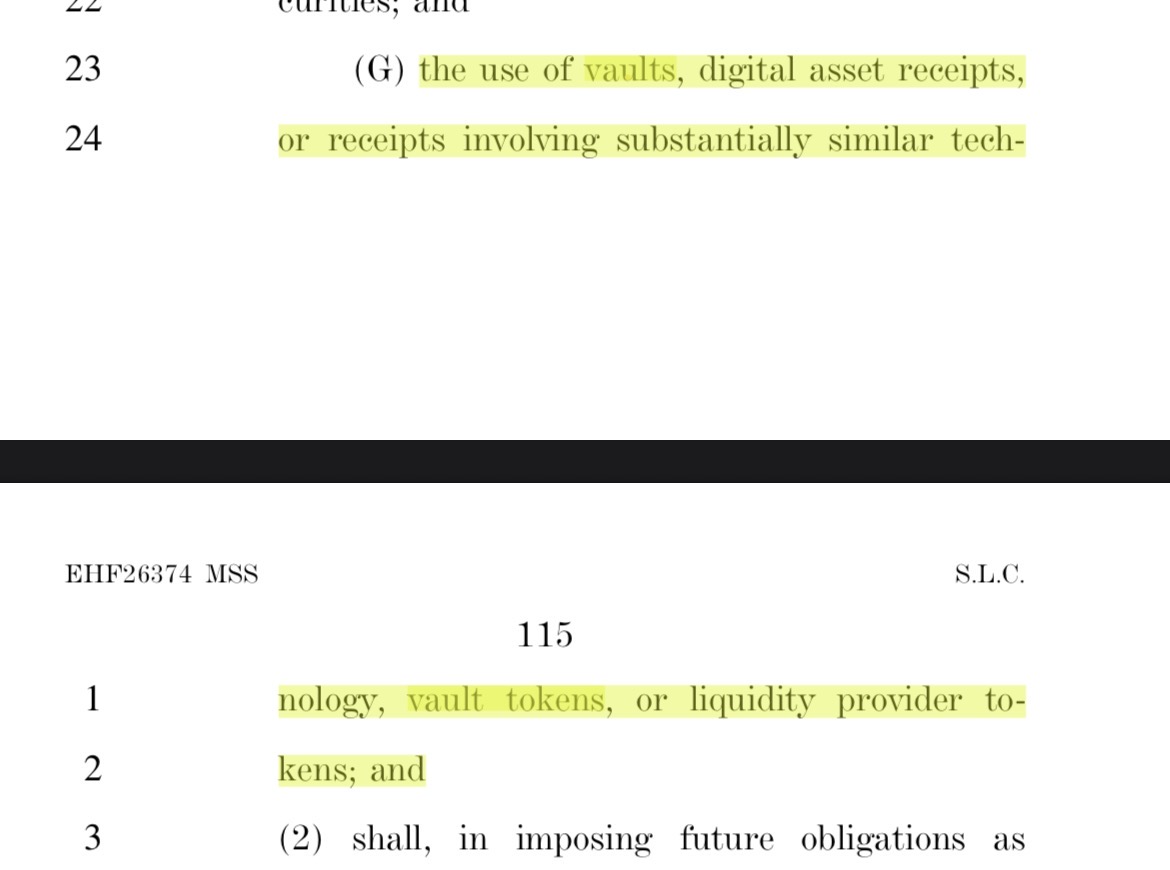
@veda_labs is happy to see the new draft of CLARITY explicitly reference “vaults,” “vault tokens,” and “digital asset receipts” as technologies for which existing regulations may need modernization. 👀
That is a significant conceptual shift. Congress is implicitly recognizing vaults as a legitimate and distinct category of blockchain infrastructure.
As we've written about, for years crypto regulation has assumed that investor protection must come from centralized intermediaries. But programmable, non-custodial smart contract systems can perform many of the same functions like custody, accounting, execution, liquidity provision, settlement architecturally, and enforced in code.
The bill does not say vaults are securities. It says the SEC should reconsider how legacy intermediary-era rules apply to these systems at all. Combined with the draft’s repeated emphasis on “rules-based,” “programmatic,” and “administrative or ministerial” systems, this is a meaningful shift in how policymakers are beginning to think about on-chain financial infrastructure, and important for the future of DeFi.
Lastly, I think we should consider ways to provide clarity surrounding what are commonly referred to as “crypto vaults,” particularly regarding Securities Act and Advisers Act touch-points. Crypto vaults are onchain software applications that are often designed to allow users to earn yield passively through the deployment of their assets into yield-generating opportunities onchain.
The Reap acquisition is a reminder that Kraken is becoming much more than an exchange.
Payward is assembling the primitives for modern financial infrastructure: custody, trading, derivatives, tokenized assets, stablecoin settlement, cards, and cross-border payments.
The strategic goal is not just more retail crypto volume. It’s becoming the infrastructure layer other fintechs, banks, wallets, and platforms build on top of.
Certora has been an incredible security partner and one of the best auditing firms I've ever worked with.
Excited to continue deepening our partnership to secure the future of vaults.
Security is our top priority at Veda. Alberto is joining us with the perfect background - co-author of ERC4626, a long history with vaults, and a deep expertise in the onchain world.
We're building a world class team to bring DeFi to the masses. DM's re open
NEWS: We're excited to share that @alcueca has joined Veda as our VP of Onchain Security.
Previously at OP Labs, he joins us with 8+ years of onchain experience spanning engineering and blockchain architecture.
Together we're putting security first, every day🔒
NEWS: @krakenfx DeFi Earn has exceeded $175 million in deposits across 3 Veda vaults.
Advanced strategy by @SentoraHQ
Balanced + boosted by @chaoslabs
Tap in → start earning dollars in just a few clicks
Available on Kraken, @krakenpro, and @Krak
Over 30,000 users are earning onchain with @krakenfx DeFi Earn:
→ $150M+ in deposits across 3 Veda vaults
→ Strategies by @SentoraHQ and @chaoslabs
→ No incentives: yield comes from real activity
One key reason @krakenfx DeFi Earn has grown so quickly is because it is natively multichain - powered by @veda_labs.
Multichain is becoming a basic requirement for enterprise products. Users simply need to access the best yield and rates wherever they may be.