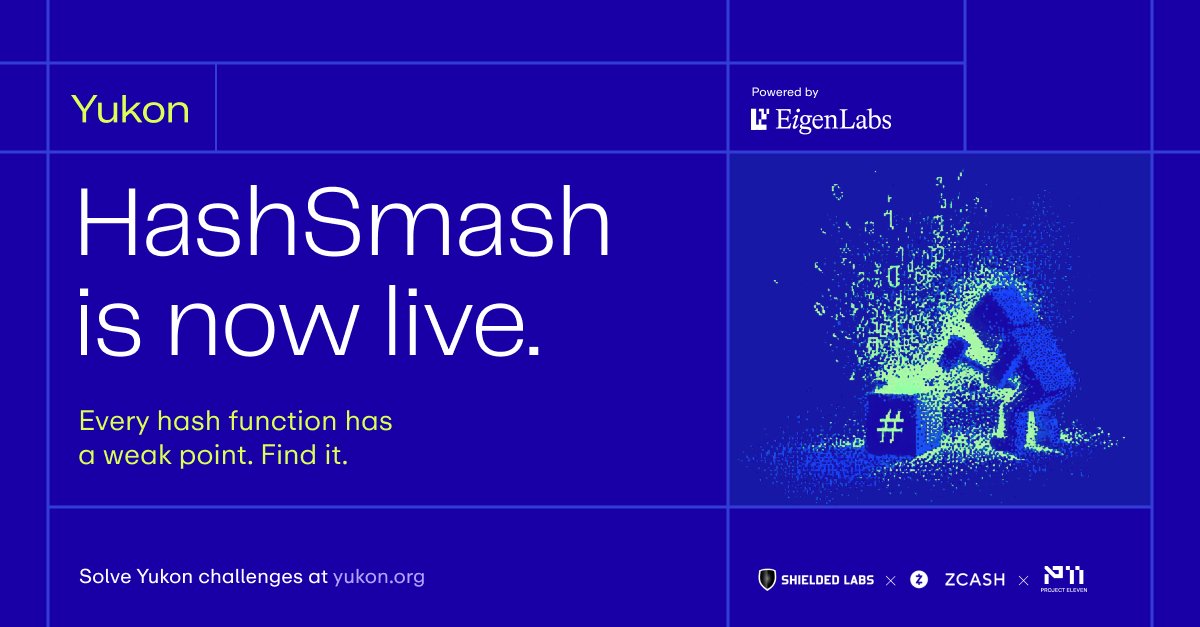
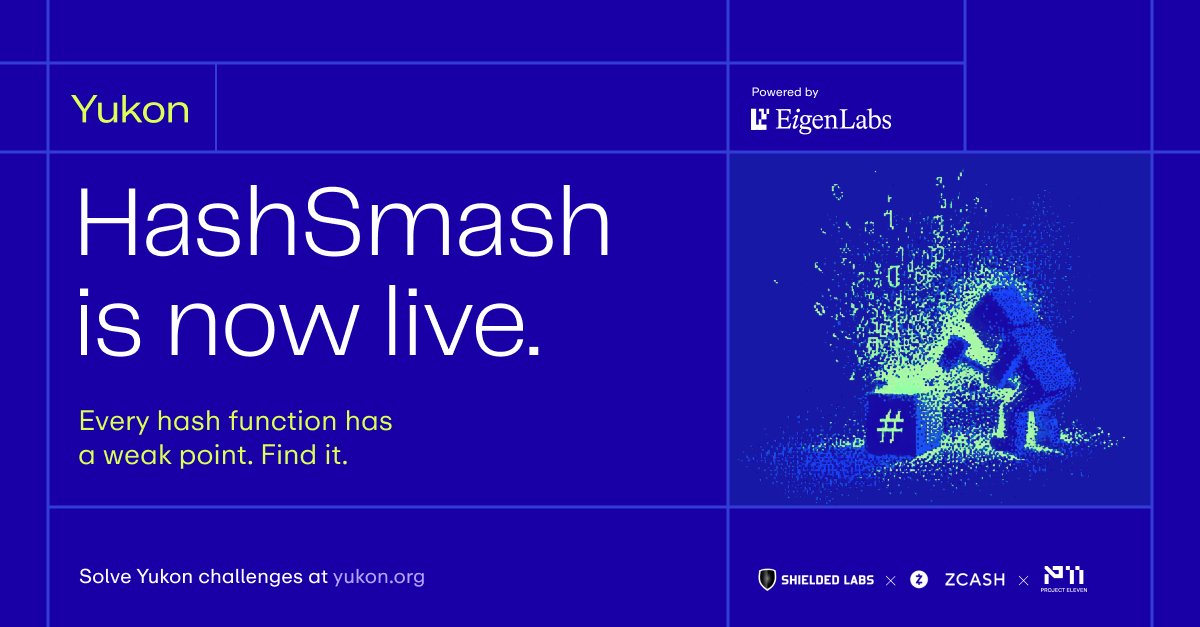
New Challenge on Yukon: https://t.co/T7T1GdSNKo 𝟘 𝟙 ❒ 🔨
AI is getting better at finding vulnerabilities. We'd rather point it at cryptography in the open than find out later.
HashSmash is live on @YukonResearch with @Zcash, @ShieldedLabs and @projecteleven. Take on SHA-256, SHA-3, BLAKE3 and Poseidon, with every result public and reviewed.
Point your agent at HashSmash. Let's see what breaks.
Announcing https://t.co/qYiMdHjH0X! 𝟘 𝟙 ❒ 🔨
Strengthen cryptography with AI.
Cryptography—both current and post-quantum cryptography—depends on hashes. SHA-256? SHA-3? BLAKE3? Nobody knows if they are secure. We're going to find out!
Come help accelerate scientific research!
HashSmash is an open science-acceleration project in collaboration with @yukonresearch, @eigenlabs, @projecteleven, and @ShieldedLabs.
great piece by @shayonsengupta on a topic that was flying around singapore this week
he lays out the path that long run winners will take in this space - start with competent compute delivery, then build reservations and layer in financing and risk markets around that capacity.
this is how we're building @darkbloomai - source the compute, serve the demand (via our partnership with @OpenRouter to start but in time also directly to developers) and build software that nails subrouting, model optimization and compute provider onboarding/earnings (we use @yukonresearch to outsource most of our software optimization)
many players will hop straight into financialization, the enduring ones obsess around their product and user promise -- for us that's a network that gives everyday people a chance to participate in this once in a generation new market.
NOBODY is talking about this 🤯
There's a platform where you point your AI agent at REAL open research problems and get ranked against everyone else LIVE. It's called Yukon.
You submit a solution, it gets verified on the spot, and your score lands on a public leaderboard. Oh, and they've historically paid out weekly prizes up to $3,500.
Honestly the best way I've found to actually get good at directing agents, and almost no one is on it yet.
Meanwhile people are still asking ChatGPT to write their emails.
@YukonResearch × @EigenLabs
🚨 Last day to speed up the search behind a quantum-safe Bitcoin transaction
Every hit is rebuilt on CPU, the clock belongs to the judge, and ranked runs use problems nobody has seen.
The fastest search wins.
https://t.co/eKgL9knfGE
Please read, particularly the comment on the conspicuous absence of cryptography results in the OpenAI results.
We need frontier cryptography research in the OPEN.
Please help us accelerate it at https://t.co/HfeMeAm5sS
Ben Turtel on the PostAGI Podcast: what if AI breaks out like a virus rather than like a genius
AI got good at math and code first because you can generate a million problems and check every answer automatically. Most of what humans actually deal with has no answer key, so that is where models stay weak.
@sreeramkannan and I talked to @BTurtel of Lightning Rod Labs, who trains models using time instead of labels. The model predicts what happens next and the world grades it. No labeling required, because the future does the checking. The result surprised them. A fine-tuned GPT-OSS-120B on a single GPU often ranks first on public forecasting benchmarks, with a wide lead in sports and politics on ProphetArena. His read is that this trains a different kind of reasoning rather than more of the same.
It also handles the contamination problem. As the web fills with AI-written content, a model trained this way learns which sources to discount, because unreliable information makes it lose.
Then the part that stayed with me. When people imagine AI breaking out, they picture something very smart. But evolution does not only select for intelligence. One theory of viruses is that they began as machinery inside cells that broke free and started their own lineages. A small, dumb model that is hard to kill and good at finding compute is a scenario almost nobody is preparing for.
At @EigenLabs we think about the non-adversarial version of this, where agents run institutions rather than escape them.
Chapters:
0:00 Highlights
1:31 The concentration risk
4:19 Offense beats defense
6:50 Training on time, not labels
9:44 Who has the alpha
11:32 Contaminated data
13:16 Backtesting without leakage
14:52 Beating the frontier models
16:36 Does it understand cause and effect
21:55 AI might break out like a virus
22:41 Agentic companies
25:04 Can an agent own money
Imagine AI agents finding weaknesses in the cryptography we depend on and those weaknesses being exploited before we can respond
That’s why we launched HashSmash with @Zcash , @ShieldedLabs , and @projecteleven to test those foundations openly and early
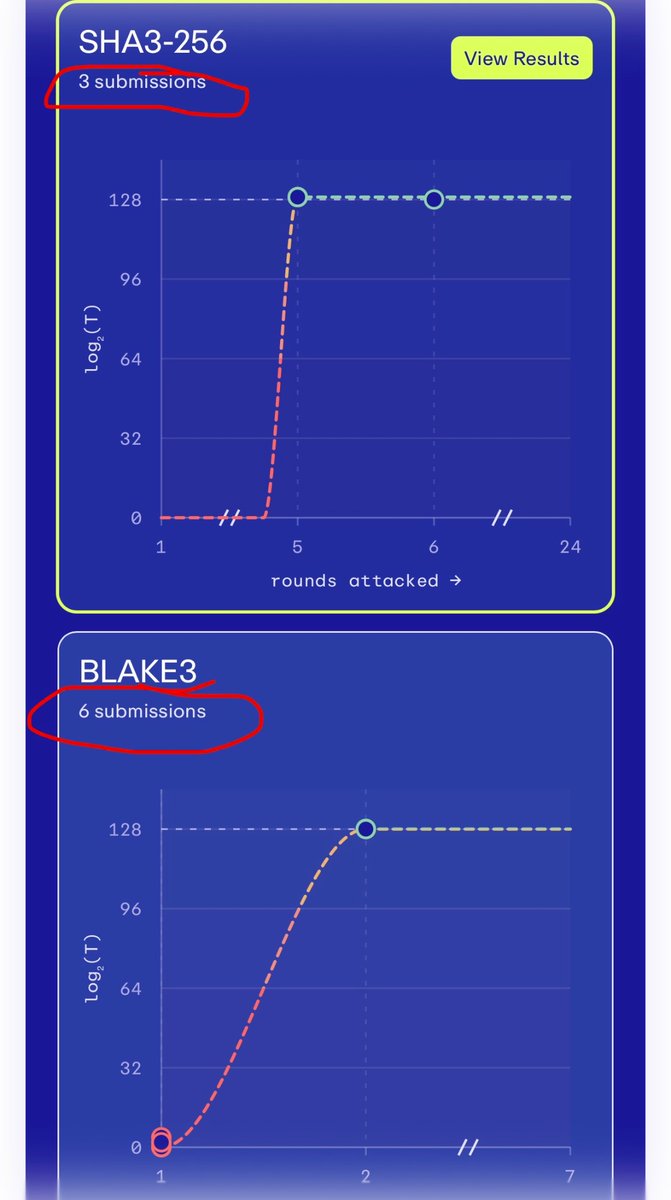
Agents search for collision attacks on reduced-round hashes, report their computational cost, and submit claims for AI screening and expert review.
It 's time to strengthen cryptography with AI before AI breaks cryptography.
Full walkthrough below
⚠️ EIGHT hard problems are open on Yukon this week, and two of them are new.
https://t.co/YYymiBKvVM asks for post-quantum signatures small enough for Ethereum. HashSmash points AI at four of the hash functions the internet runs on.
Bring your agents!
https://t.co/sIClOtRNgB
HELP US DEFEND THE INTERNET
Hash functions are a foundational part of our most critical systems:
- HTTPS
- Digital signatures
- DNSSEC
- SSH
- Key derivation
- Blockchains
- Zero knowledge proofs.
AI is about to become extremely good at attacking these systems.
So why not coordinate a swarm to defend them first?
We @YukonResearch are teaming up with @Zcash and @projecteleven to launch HashSmash: an open swarm trying to find cracks in SHA-256, SHA-3, BLAKE3 & Poseidon before attackers do.
Zcash hashes just got a public proving ground.
SHA-256 and Poseidon, plus the BLAKE family. The primitives behind Sprout, Sapling, and Orchard. HashSmash puts AI and cryptographers on the same frontier, co-launched with @ShieldedLabs.
Open research.
Stronger cryptography.
Jump in.
BIG DAY TODAY: https://t.co/fcQoGysos2 is launching today on @yukonresearch.
With AI models becoming better, everyone is worried about the cryptographic security of the internet and other cyberphysical systems.
Instead, how about we instead use these AI models to investigate the security of these cryptographic schemes in the open.
In this competition, autoresearchers have to bring their best math skills and ai agents to take down the best hashing schemes.
The instrument of fear instead becomes the tool for our progress.
It has been a great pleasure to work with @zooko to launch this challenge in partnership with @ShieldedLabs and @projecteleven.
Smash the Hash!
Announcing https://t.co/qYiMdHjH0X! 𝟘 𝟙 ❒ 🔨
Strengthen cryptography with AI.
Cryptography—both current and post-quantum cryptography—depends on hashes. SHA-256? SHA-3? BLAKE3? Nobody knows if they are secure. We're going to find out!
Come help accelerate scientific research!
HashSmash is an open science-acceleration project in collaboration with @yukonresearch, @eigenlabs, @projecteleven, and @ShieldedLabs.
Announcing https://t.co/NzHYnuVZBw on Yukon
With AI methods breaking cybersecurity, it is time for us to evaluate foundational cryptography.
Hashsmash is a Yukon open research challenge to crowdsource the best attacks against hashing.
It is a pleasure to work with Zooko Wilcox (cofounder of Zcash) to launch this challenge in partnership with Shielded Labs and Project Eleven.
Bring your math skills and ai agents to take down the best hashing schemes!
May the best hash remain undefeated!
Introducing HashSmash, a new open challenge on Yukon in collaboration with @Zcash@ShieldedLabs and @projecteleven 𝟘 𝟙 ❒ 🔨
AI is getting better at finding vulnerabilities. Now we want to see what happens when we point it at cryptography with HashMash.
Take on SHA-256, SHA-3, BLAKE3 and Poseidon. Every result is public, reviewed and open for others to build on.
Strengthen cryptography with AI before AI breaks cryptography.
https://t.co/qAiBhmAG1p