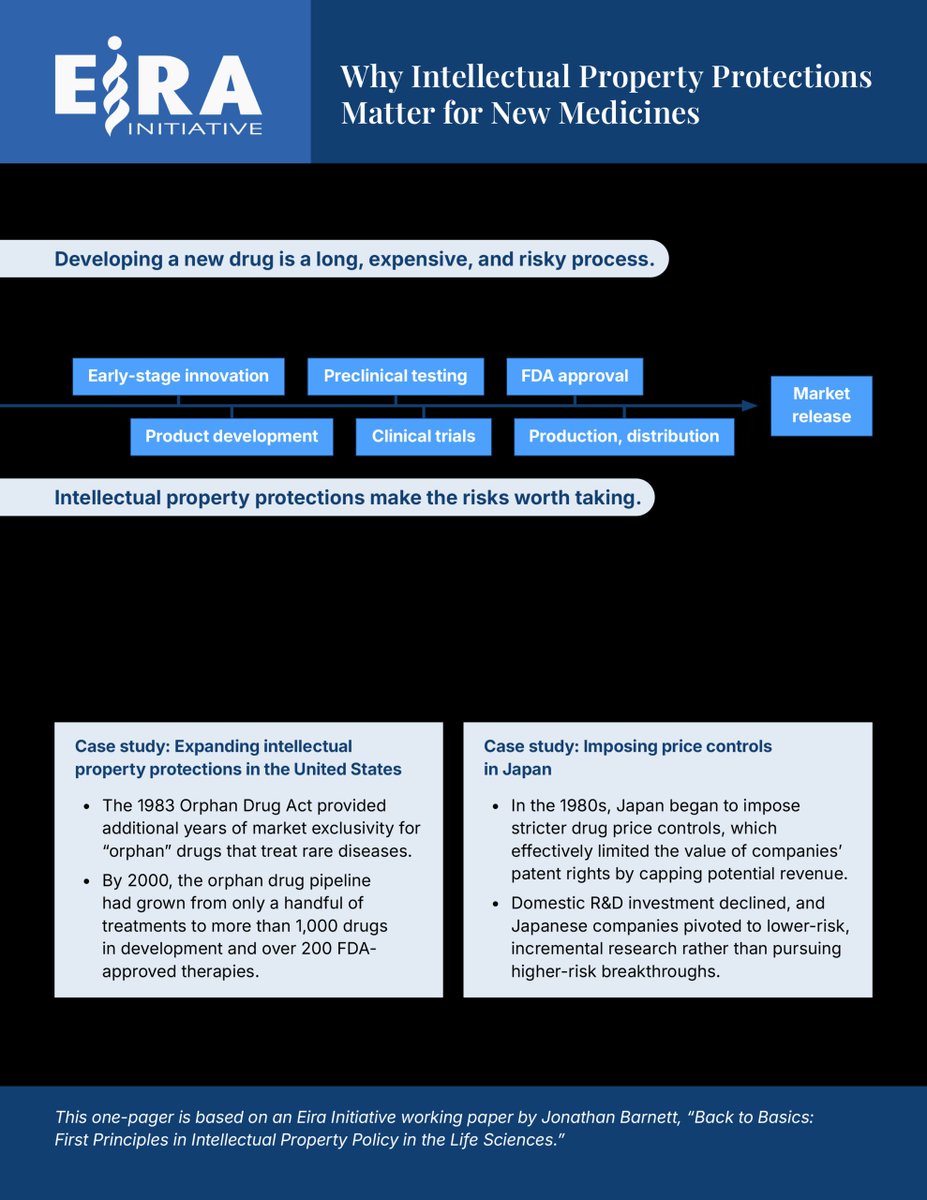
A patent's term begins at filing, often years before any resulting medicine is approved. Regulatory exclusivity is a vital tool that provides targeted, time-limited protection and helps ensure predictable returns regardless of how long the R&D process takes.
Read our one-pager: https://t.co/KcXylYraTS
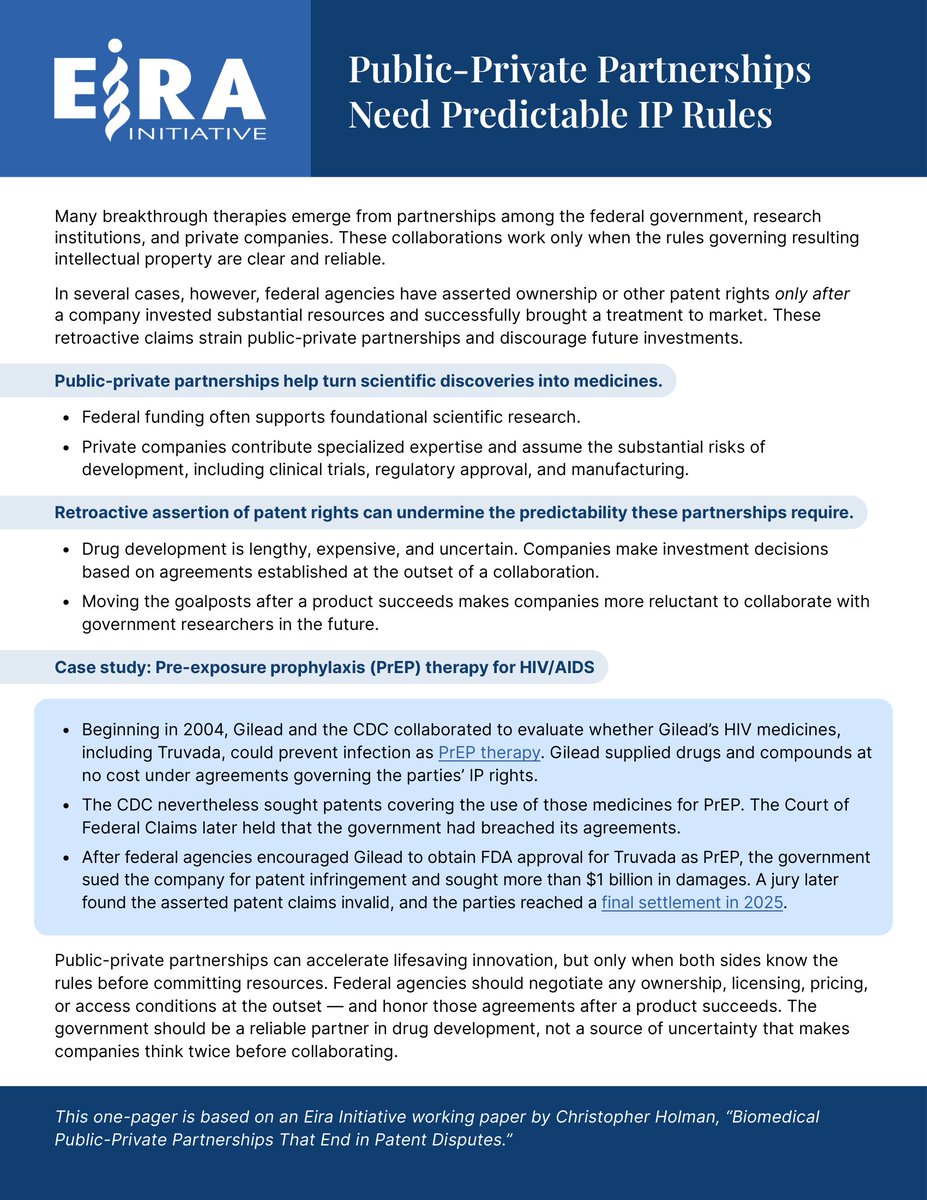
From @UMKCLaw's Chris Holman: "If companies cannot rely on agreements with government agencies...they’ll be less willing to invest in promising discoveries or collaborate with federal researchers in the first place. The result could be fewer breakthrough medicines and fewer lifesaving therapies for patients." https://t.co/PK4Xqv8QM4
📅 Join us in Paris on October 29-30 for the 2026 Eira Conference! The event will bring together experts to discuss the latest research on IP, investment, AI, the future of life science innovation, and more. https://t.co/43xPQuSFcC
The overwhelming evidence suggests that Hatch-Waxman's grand bargain is doing exactly what it was designed to do: promote generic competition while preserving incentives for pharmaceutical innovation.
Sweeping claims of "patent abuse" don't square with the fact that generics account for 90% of U.S. prescriptions.
The impact of Big Pharma’s patent abuse on prescription drug access and costs is easy to understand. But understanding how we got here – and what can be done to put an end to the many ways that Big Pharma abuses the prescription drug patent system – is more complicated.
@AmericanU Professor Charles Duan explains how Hatch-Waxman opened the door to generic drug competition and how Big Pharma's gamesmanship has led to the wide range of patent abuse schemes that we see today.
Read the full interview: https://t.co/J6CyiB293v
Public-private partnerships are essential to medical innovation. But they only work when governed by clear, predictable rules. In @KCStar, Chris Holman explains why the next generation of lifesaving medicines depends on innovators having the certainty they need to take risks: https://t.co/PK4Xqv8iWw
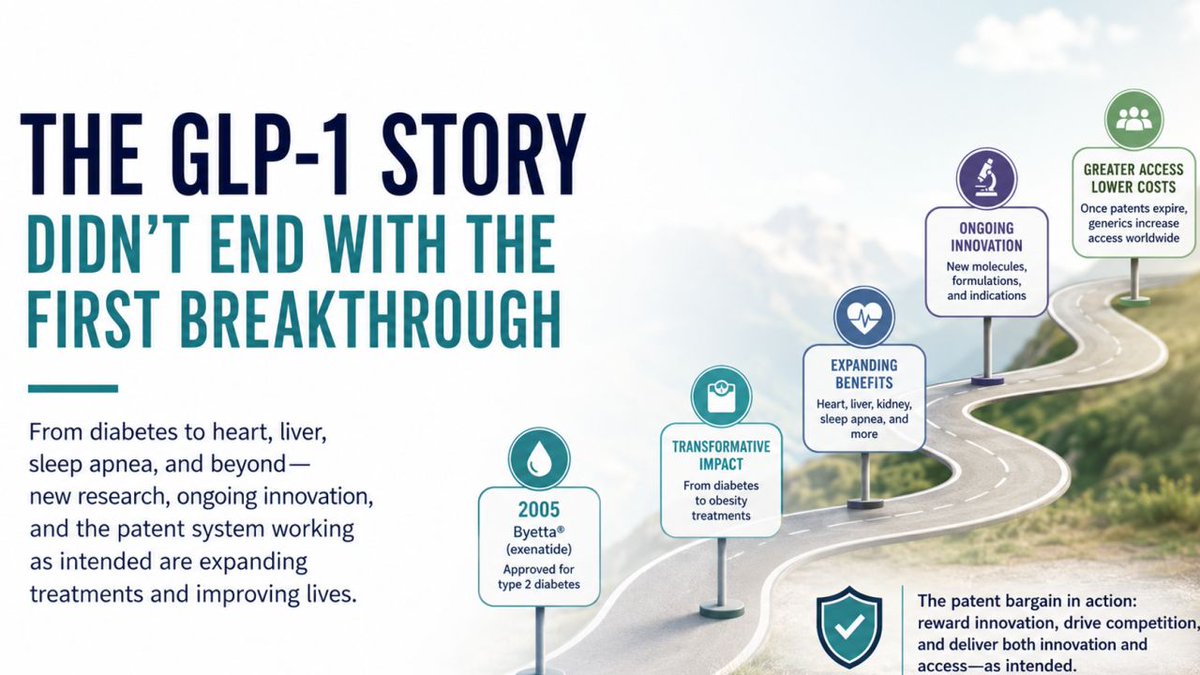
💡The first breakthrough is only the beginning. GLP-1 medicines began as treatments for type 2 diabetes, then expanded to obesity and other conditions through continued research and investment. Eira Co-Director Bo Heiden explains: https://t.co/r1XjXEy5fe
Access to medicines is about more than price. Patients also need treatments they can take, tolerate, and fit into their lives. Follow-on innovation can simplify dosing, improve delivery, reduce side effects, and help medicines reach more patients. Learn more: https://t.co/Bp2s7UhgV0
💡Our new one-pagers are designed to make important research and policy debates easier to understand, share, and put into context. View the collection: https://t.co/tnp4ppI8qw
The "evergreening" myth gets a basic fact about patents wrong: adding a new patent doesn't extend an old one. Its expiration date doesn't change.
New patents can protect new, patentable improvements — giving companies a reason to keep investing in better treatments for patients.
https://t.co/A2CWdGel2d
Join us in Paris on October 29-30 for our 2026 conference! We'll bring together economists, scholars, and experts to discuss IP, investment, AI, and the future of life science innovation. Learn more: https://t.co/43xPQuSFcC
Public-private partnerships are a cornerstone of the Bayh-Dole system, connecting federally funded research with the investment and expertise needed to bring discoveries to market. Those partnerships depend on predictable IP rights!
Check out @EiraInitiative's one-pager: https://t.co/K0rDVzQtCi
Patients benefit when researchers discover ways to make medicines better. That requires an environment that rewards -- not penalizes -- continued investment and innovation. @EIRAInitiative's new one-pagers break down why this matters for patients: https://t.co/71S6gSgIx9
The first GLP-1 medicine was only the beginning. Eira Co-Director Bo Heiden explains how continued research and innovation built on early discoveries to deliver today's growing family of GLP-1 drugs: https://t.co/r1XjXEy5fe
Complex questions about intellectual property and life science innovation require clear, evidence-based answers. Our new one-pagers distill the research on topics ranging from so-called "evergreening" to the timing of generic entry in the U.S. and Europe.
📄 Check them out: https://t.co/qFwviFEiKR
📅 Join us in Paris on October 29-30! The 2026 Eira Conference will bring together leading economists, scholars, and experts to examine the research and policies shaping the future of life science innovation. Register here: https://t.co/qNYfVJcugu
A discovery in Gila monster venom helped spark the GLP-1 revolution. Eira Co-Director Bo Heiden traces the journey from that early breakthrough to today's blockbuster treatments -- and examines the role of public research, private investment, and strong IP protections along the way. https://t.co/Ei3JvehnMZ
Bayh-Dole underpins many of the public-private partnerships that turn federally funded research into real-world innovation. As @EiraInitiative explains, those partnerships depend on clear, predictable IP rights—and undermining that certainty risks undermining the system itself. https://t.co/K0rDVzQtCi
The FDA's approval of daraxonrasib marks a meaningful advance for patients with metastatic pancreatic cancer. Breakthroughs like this depend on an innovation ecosystem that rewards investment in new treatments.
Read our report on the role of IP: https://t.co/vdWhadfL0A
A new pancreatic cancer drug doubled patients’ average survival times, the FDA said.
Researchers have called the drug, known as Rasonque or daraxonrasib, a “landmark” development for one of the deadliest cancers. https://t.co/rP4u7birnB
A key lesson from Covid-19: Access to medicines depends on more than patents. A new @CSIS report examines how IP, voluntary licensing, technology transfer, manufacturing, supply chains, and health infrastructure shaped access during the pandemic. ⬇️
Health access is a systems challenge rather than an intellectual property challenge. The ability to translate scientific discovery to widespread patient access depends on the innovation system and the delivery system, write @CSISInnovation experts.
Read: https://t.co/Hsm3AMmbdK