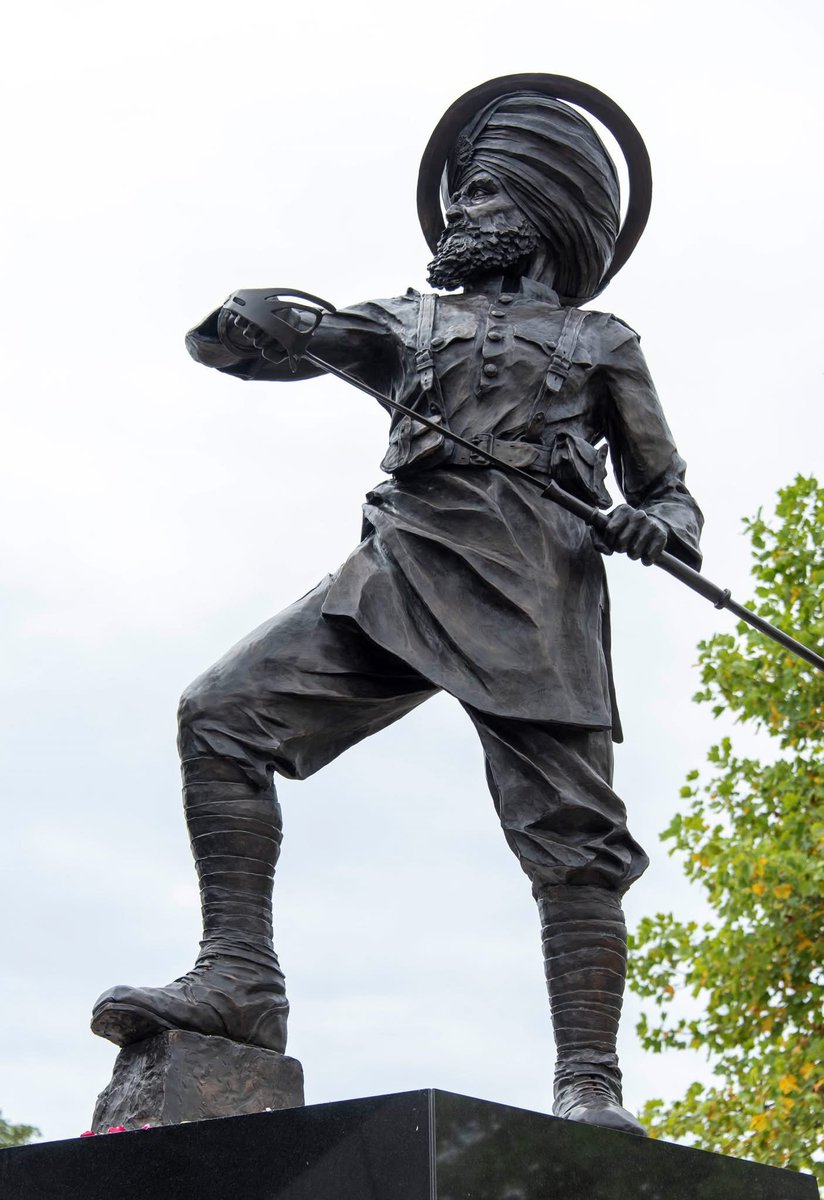
Today is Saragarhi Day.
On 12 September 1897, just 21 Sikh soldiers of the 36th Sikhs, British Indian Army, under Havildar Ishar Singh, defended the isolated signalling post at Saragarhi on the North-West Frontier.
Against them came an estimated 10,000 Afghan/Pashtun tribesmen, principally Afridi and Orakzai, part of the tribal uprising against British rule.
The 21 were offered surrender. They refused. For hours they held the post against repeated assaults, fighting with rifles and finally at close quarters until every defender was dead. All 21 were posthumously awarded the Indian Order of Merit, the highest gallantry decoration then available to Indian soldiers.
Twenty-one Sikhs against roughly 10,000 men.
Saragarhi is one of the great last stands in British military history and a reminder of something too easily forgotten: Sikh soldiers served the British Empire with extraordinary courage and distinction. Their blood is part of our shared history.
Today Britain should remember them.
Lviv, 1941.
A young Jewish woman sits on the pavement, stripped naked, surrounded by a hostile crowd.
She tries to cover herself with her hands; her clothes lie discarded beside her. People stand and watch. One person reaches down toward her head as she looks directly into the lens.
Look at her face.
There is fear, shock, and profound humiliation. But beneath the cruelty surrounding her, there is something immutable:
her fundamental humanity.
She had a name.
A family.
A home.
People who loved her.
A future she was never allowed to claim.
The image was captured on 8mm film by German personnel. Later discovered by U.S. forces in an SS barracks in Augsburg, the footage is now preserved in Holocaust archives—a permanent record of an atrocity that was meant to be forgotten.
Before the Holocaust, more than 200,000 Jews called Lviv home. Under Nazi occupation, that community was systematically persecuted, deported, and murdered. Only a fraction survived.
During the 1941 pogroms, Jewish men, women, and children were targeted relentlessly, with women subjected to targeted, public degradation.
This photograph captures more than physical violence. It captures the mechanics of dehumanization—the deliberate, witnessed destruction of a human being's dignity.
We may never learn this woman’s name.
We may never know her final moments.
But by looking at her face, we refuse the ultimate aim of her tormentors: to erase her from memory.
We remember that she was someone.
@asadfacts yes bhai Ahuja shot himself and you hold the heights permanently. there please relax.
both sides are equally guilty in over injection of patriotism. Get over the movies and read the history and check the current GPS coordinates of the LoC. The line has not moved in your favour
@Raniisaa_ Please watch Titanic
and before you respond ... both are movies
and before you respond again remember both sexes engage in affairs, divorces, regret and attempt re-charting of course
दूरदर्शन का "एक सुर," जिसे इसकी शुरुआती पंक्ति "मिले सुर मेरा तुम्हारा" के कारण व्यापक रूप से याद किया जाता है, 1988 में प्रसारित होने पर भारतीय टेलीविजन के सबसे महत्वाकांक्षी एकीकरण अभियानों में से एक था। लोक सेवा संचार परिषद द्वारा सूचना एवं प्रसारण मंत्रालय के साथ साझेदारी में कमीशन की गई यह फिल्म भारत की भाषाई और सांस्कृतिक रूप से विविध जनसंख्या के बीच राष्ट्रीय एकता को बढ़ावा देने के उद्देश्य से बनाई गई थी, और इसका प्रथम प्रसारण स्वतंत्रता दिवस पर हुआ।
@YousufBadghisi Boom spot on!!
both sides played the game to outplay each other and got outplayed themselves.
As a united south asia, imagine what we could have been.
@AshAwan786@drmuzammilortho Agreed.
Especially the sentiment behind in the response of the senior.
what has transpired is a very bland day to day hour to hour occurance appearing as super abnormal to the civvies.
History maker 🇳🇿
When Sarpreet Singh stepped out onto the pitch last night, he was representing more than just his country. He was realising the dreams of a global community 🤍
@BrownnCookiee Yes never forget how he played into the hands of Mrs Gandhi and screwed so many millions of sikhs working peacefully in India.
A religious bigot
Dr Narinder Singh Kapany was also a great Sikh art collector.
His Sikh Foundation has one of the world’s largest collection of Sikh Art, including many original paintings of Sikh history and the seal ring of Maharaja Ranjit Singh.
1500 Indian soldiers died at Gallipoli alongside the 10-11,000 Australians and New Zealanders.
As did 10,000 French, and 29,500 British and Irish troops.
If you weren't a racist triggered by the sight of a Sikh man in uniform you'd know this.
A British officer reading a newspaper while being fanned with a palm frond & getting a pedicure from one of his servants in India, late 1800's, colourised
Same Troops
Same Regiment
4th Sikh halves Pakistan 6 years later in 1971.
4-Sikh troops enter Khulna in East Pakistan (now Bangladesh) on a PT-76 tank with 45-Cavalry.
Indian Army’s 4th Sikh Regiment which attacked the Barki sector and later surrendered to the Pakistan Army during the Battle of Asal Uttar, returning home after the ceasefire. In this video, we can see Lt Col. Ananth Singh, who was commanding the 4th Sikh Regiment during the war.