BURDA TAKİP ETİĞİM İNSANLARIN HİÇ BİRİNİN FİKİR DÜNYASINDA DEĞİLİM SADECE BU İNSANLARİN İÇ DÜNYALARINDAKİ DÜŞÜNCELERİ DIŞA AKTARIMLARINI HAYRETLE İZLİYORUM ....
Groundbreaking research suggests consciousness may be a quantum phenomenon connecting the human mind to the fundamental fabric of the universe.
A team of researchers at Wellesley College recently uncovered evidence that could fundamentally change our understanding of how we experience reality. By studying rats under anesthesia, scientists discovered that tiny structural tubes inside brain cells, called microtubules, appear to be the gatekeepers of awareness. When these microscopic tubes were stabilized with specific drugs, the animals remained conscious significantly longer than those without treatment, suggesting that awareness is directly tied to the physical integrity of these cellular structures rather than just simple electrical signaling between neurons.
This discovery breathes new life into the Orchestrated Objective Reduction theory, which suggests that consciousness arises from quantum processes inside the brain. For decades, skeptics argued that the brain's warm environment was too hostile for delicate quantum states to survive, yet this research hints that our minds might actually function like quantum computers. If awareness truly emerges from these deep physical layers, it would mean the human experience is inextricably linked to the fundamental laws of the universe, potentially bridging the final gap between biological neuroscience and quantum physics.
source: Wagh, M. (2026, February 17). Your Consciousness Can Connect With the Whole Universe, Groundbreaking Research Suggests. Popular Mechanics.
🚨: James Webb confirms there's something seriously wrong with our understanding of the universe.
In a striking discovery, James Webb and Hubble space telescopes have confirmed that the universe is expanding at varying rates depending on the observation point, which challenges our current understanding of the cosmos.
This discrepancy is known as the Hubble Tension. It was first observed by the Hubble Space Telescope in 2019 and further confirmed by the James Webb Space Telescope in 2023, with recent combined efforts by both telescopes now eliminating any doubts about measurement errors.
The Hubble Tension arises from a conflict between two ways of measuring the universe's expansion rate.
One method looks at the early universe, relying on the cosmic microwave background—the ancient afterglow of the Big Bang—to calculate the expected expansion.
The other method focuses on the more recent universe, utilizing telescopes to observe stars and galaxies. The problem is, these two methods are yielding vastly different results. It's as if the universe has subtly changed its rules between its infancy and the present day. By observing over a thousand Cepheid stars in galaxies up to 130 million light-years away, the researchers have confirmed the reliability of Hubble's measurements across the cosmic distance ladder, thus ruling out measurement error as a cause for the Hubble Tension and suggesting a profound mystery at the core of our understanding of the universe's expansion.
The study was published in Astrophysical Journal Letters.
Trees act like living antennas between Earth and sky. Their roots dive deep into the soil while their branches reach for the light. When you place your bare feet on the ground and your hands on the bark, your body absorbs negative ions from the earth that neutralize free radicals and tension in your system. It’s like plugging yourself into nature’s charger. 1. Find a tree that draws you in…don’t overthink it. 2. Take off your shoes and place your bare feet on the soil or grass near its roots. 3. Rest your palms or back against the trunk. 4. Breathe slowly and imagine your energy flowing down through your feet, while the tree’s energy rises up through its roots into you. 5. Stay for 10–15 minutes. Notice any sensations, emotions, or peace that arises?
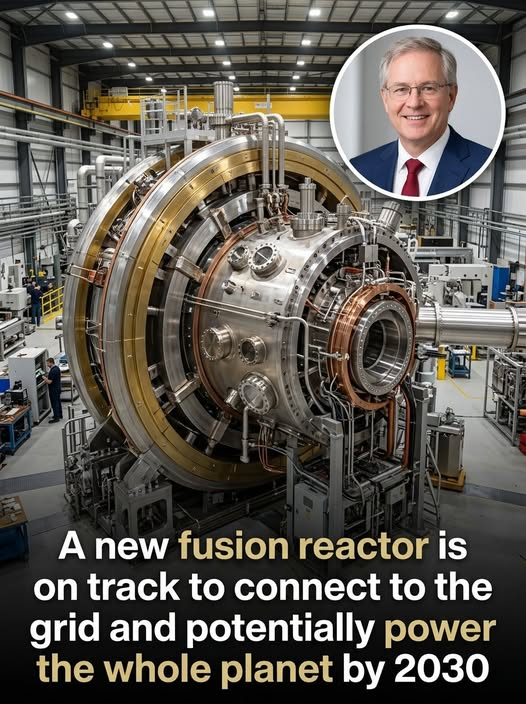
The ultimate holy grail of clean energy is closer than we think. A revolutionary new fusion reactor design is officially on track to connect directly to the power grid, bringing us a massive step closer to potentially powering the entire planet by 2030.
Unlike traditional nuclear plants, fusion generates boundless energy by mimicking the exact process that powers our sun, fusing atoms together instead of splitting them. This incredible technology produces zero greenhouse gases and leaves behind no long-lived radioactive waste, promising an era of completely clean, limitless electricity for everyone!
🚨 The faster you move, the slower time passes. Literally.
Einstein’s theory of special relativity proves that the faster you move through space, the slower you experience time.
In 1905, Albert Einstein revolutionized our understanding of the universe by revealing that space and time are not separate entities, but a unified structure called spacetime. According to this framework, every object moves through spacetime at a constant rate. However, as an object increases its speed through space, its progression through time must compensate by slowing down. This means that as you approach the speed of light—roughly 186,000 miles per second—the rhythm of your clock stretches, a phenomenon known as time dilation that effectively turns high-speed travel into a journey into the future.
This concept is far from theoretical; it is a fundamental reality confirmed by rigorous experimentation and modern technology. In 1971, scientists used ultra-precise atomic clocks on commercial airplanes to prove that time literally slows down for objects in motion. Even the GPS satellites we rely on every day must account for these relativistic shifts to provide accurate locations. Without correcting for the time differences caused by their orbital speed, GPS coordinates would drift by several miles daily, demonstrating that Einstein’s insights are essential to the functionality of our interconnected world.
Source: Hafele, J. C., & Keating, R. E. (1972). Around-the-World Atomic Clocks: Predicted Relativistic Time Gains. Science.
🚨 Scientists Grow Human Teeth in Lab
What if losing a tooth was no longer permanent?Researchers at King's College London and Tufts University have successfully grown early-stage human tooth structures in laboratory conditions using stem cells. These powerful cells can develop into many types of body tissue, including the building blocks of teeth.
The teeth created in the lab are still very small and not ready to be implanted in people yet. But the discovery shows that, under the right conditions, human teeth may be able to grow again.Scientists still need to learn how to control the shape, size, and proper connection to the jaw and nerves before this can become a real treatment.
Experts say it could take years of research.
Still, this breakthrough hints at a fascinating future one where dentists may not replace lost teeth with implants or dentures, but instead help the body grow a brand-new natural tooth.
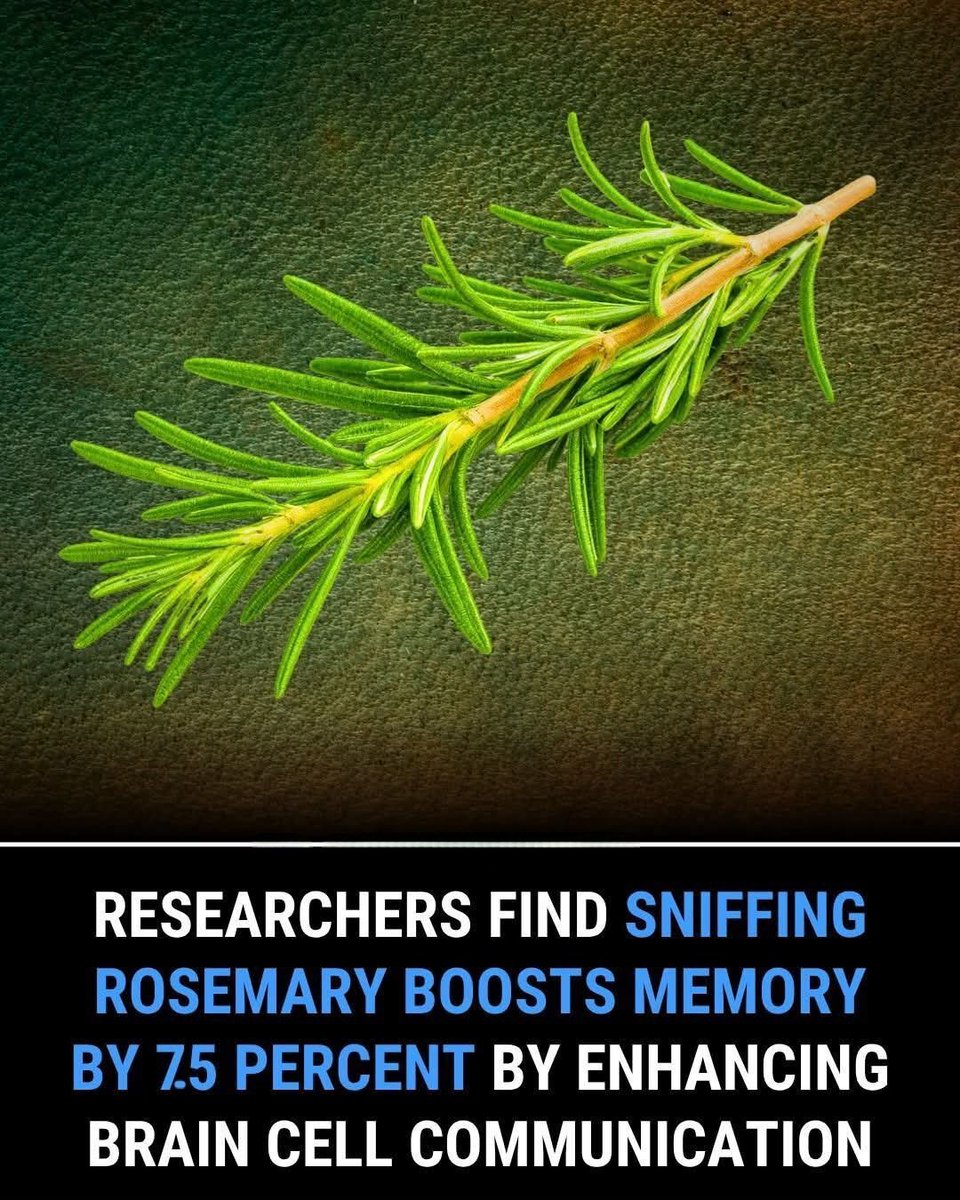
A remarkable new study has found that simply sniffing rosemary could boost your memory by an astonishing 7.5 percent. Scientists discovered that the scent of this common herb helps the brain break down a compound called acetylcholine — a key chemical that supports learning, focus, and memory retention.
Acetylcholine acts like a messenger in the brain, allowing nerve cells to communicate quickly and clearly. As we age or experience stress, levels of this chemical drop, often leading to forgetfulness or mental fog. But rosemary’s natural compounds — particularly cineole — have been shown to slow this breakdown, keeping brain signals sharp and steady.
In controlled tests, participants exposed to rosemary aroma performed significantly better on memory tasks than those in unscented rooms. They remembered to complete tasks, followed instructions more accurately, and showed improved reaction times.
The best part? This powerful brain boost doesn’t require pills, supplements, or hours of training. Just a few minutes of breathing in rosemary’s earthy scent — through essential oils, fresh herbs, or even rosemary-infused air sprays — could help your brain stay alert and focused.
Researchers believe rosemary may offer a safe, natural way to enhance cognitive performance in students, professionals, and even older adults facing memory decline.
One small sniff. One massive impact. Rosemary is no longer just a kitchen herb — it may be one of nature’s most effective tools for keeping the mind sharp.
🚫 DON’T CROSS THIS LINE IN SPACE — OR YOU MAY NEVER RETURN…
There is a hidden border around black holes where escape becomes impossible. If anything crosses it, gravity pulls it deeper and deeper. Even light cannot get out. Far away, you would look like you are slowly fading and stretching because gravity bends light. But inside, the fall would feel normal.
What happens beyond this line is still unknown. Some think it could be the end of everything, while others believe it may hide a new cosmic mystery. No one knows the truth yet.
👾 THE ROBOT THAT MOVES LIKE LIQUID… AND IT’S REAL
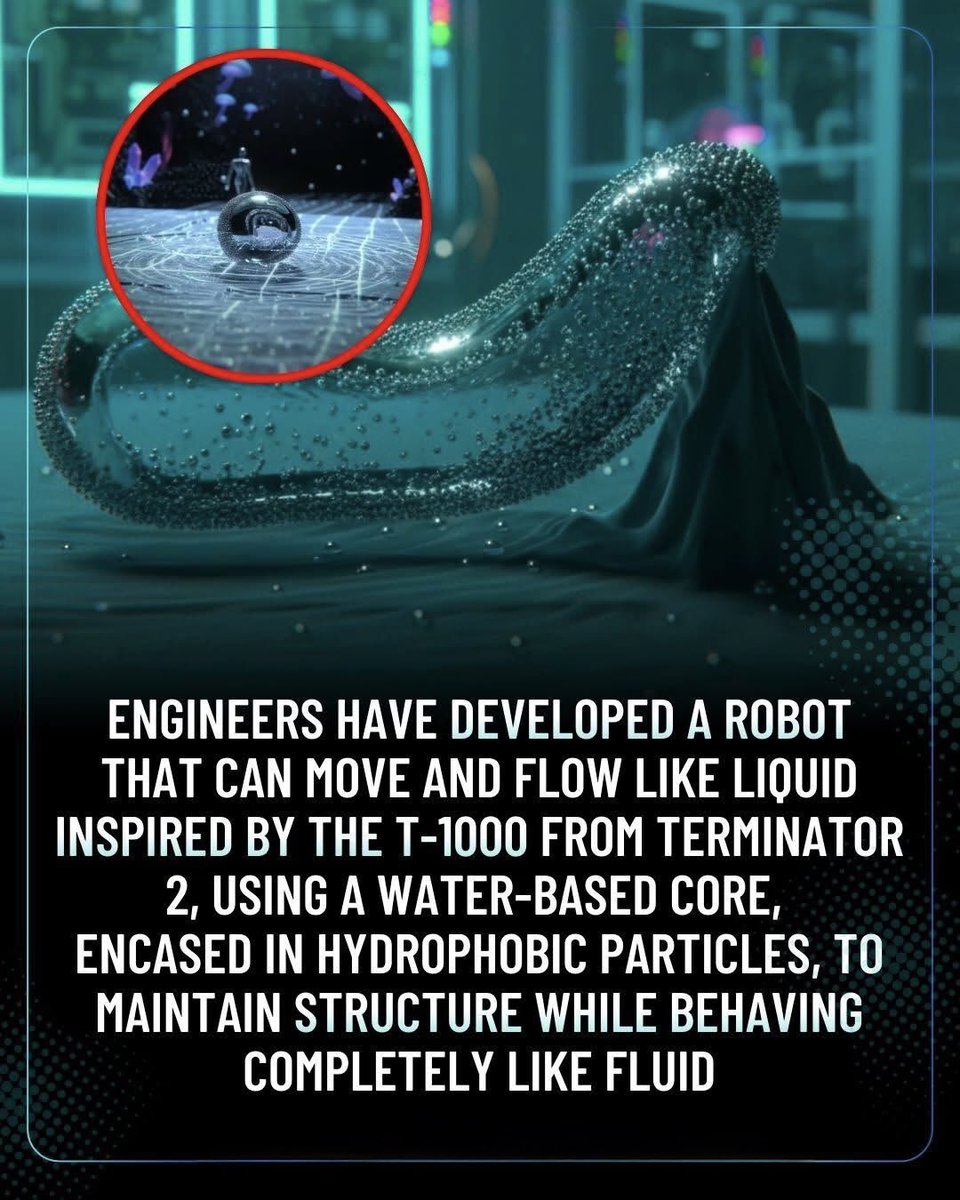
For years, the liquid robot in Terminator 2: Judgment Day looked like pure science fiction. A machine that could flow, reshape itself, and slip through tiny spaces seemed impossible. Now researchers at Seoul National University and Gachon University have created something surprisingly close, a particle-armored liquid robot.
It looks like a small droplet of water, but its surface is covered with special particles that act like armor. This allows the droplet to stay together while still moving like a liquid. With magnetic control, scientists can guide it through narrow spaces and even change its shape.Experts believe this strange technology could one day deliver medicine inside the human body or reach places normal robots cannot.
Science fiction imagined it first. Now, reality is slowly catching up.
This is the strongest evidence yet of biological activity on a planet outside our solar system…
Astronomers using the James Webb Space Telescope have identified traces of dimethyl sulfide (DMS) in the atmosphere of K2-18b, an exoplanet located 124 light-years from Earth. On our own planet, this specific gas is exclusively produced by life, primarily microscopic marine organisms like phytoplankton. This Hycean world, which features a hydrogen-rich atmosphere and potentially vast surface oceans, sits within the habitable zone of its star, making it a prime candidate for hosting alien biology.
While the findings carry a high level of statistical significance, researchers remain cautious, noting that unknown chemical processes could still explain the presence of these gases. However, the detection of DMS alongside previously discovered methane and carbon dioxide strengthens the hypothesis that K2-18b could support life. Future observations are already planned to confirm these results, potentially moving the discovery from a strong hint to a confirmed scientific breakthrough in the search for our place in the universe.
source: University of Cambridge. Strongest hints of biological activity outside the solar system. University of Cambridge Research News.
"The world is a construct of our sensations, perceptions, memories. It is convenient to say that there is a real world 'out there' that is independent of us, but this is a philosophical, not a physical, statement."
Erwin Schrödinger, one of the founding fathers of quantum mechanics, explored these ideas deeply in his 1958 book, Mind and Matter.
Schrödinger was fascinated by the intersection of physics and philosophy, particularly the "observer problem" and the Vedantic concept that the separation between the observer and the observed is an illusion.
He argued that since our only data points are our own sensations, the idea of a "real world" existing entirely apart from consciousness is a helpful assumption rather than a proven physical fact.
🚨 In the strange and fascinating world of quantum physics, there exists a phenomenon so mysterious that even Einstein called it “spooky action at a distance.” It’s known as quantum entanglement, and it links particles together in a way that defies space, time, and all known laws of communication.
When two particles become entangled, they share a quantum state—meaning what happens to one instantly affects the other, no matter how far apart they are. You could separate them by galaxies, and still, a change in one would mirror in the other immediately. No signal travels between them, and no measurable delay occurs. It’s as if the universe itself bends to keep them connected.
Scientists have confirmed this effect through countless experiments, proving that reality operates on levels far beyond what our senses can grasp. Quantum entanglement isn’t just a theoretical wonder; it’s now being used to shape future technologies—from unbreakable quantum encryption to faster-than-light communication research and revolutionary computing systems.
What’s truly astonishing is the implication: everything in the universe might once have been entangled during the Big Bang, suggesting that distant corners of space could still be subtly linked through hidden quantum threads.
Entanglement challenges our understanding of distance, time, and individuality. It reminds us that separation might only be an illusion—and that the universe, at its deepest level, moves as one.
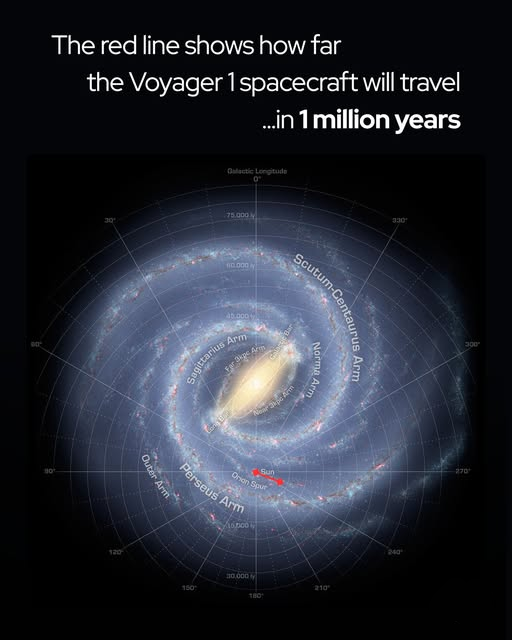
Voyager 1 is humanity’s most distant spacecraft.
But even after a million years, it will barely have scratched the surface of the galaxy.
Launched in 1977, Voyager 1 has been speeding away from Earth for 48 years. It now travels through interstellar space at about 38,000 miles per hour (61,000 km/h) – fast enough to circle the Earth in 40 minutes. Yet, space is so vast that this blistering speed barely makes a dent.
In one million years, Voyager 1 will cover about 330 trillion miles (530 trillion km). That sounds enormous – until you realize it’s only about 56 light-years. For comparison, the Milky Way is roughly 100,000 light-years across. After a million years, Voyager 1 won’t even have crossed one-tenth of one percent of our galaxy.
It will pass its first star encounter, a faint red dwarf called Gliese 445, in about 40,000 years – and then keep drifting silently onward. By then, its instruments will have long since gone dark, but the spacecraft itself, along with its golden record carrying sounds and images of Earth, will continue its lonely journey.
@NightSkyNow No.
Let's say the AI model reads an entire encyclopedia. It does it in seconds and remembers it forever - Posterity.
It takes the human brain a decade to read the entire Encyclopedia and to actually remember it. Every human after you still needs 10 years to do the same!!