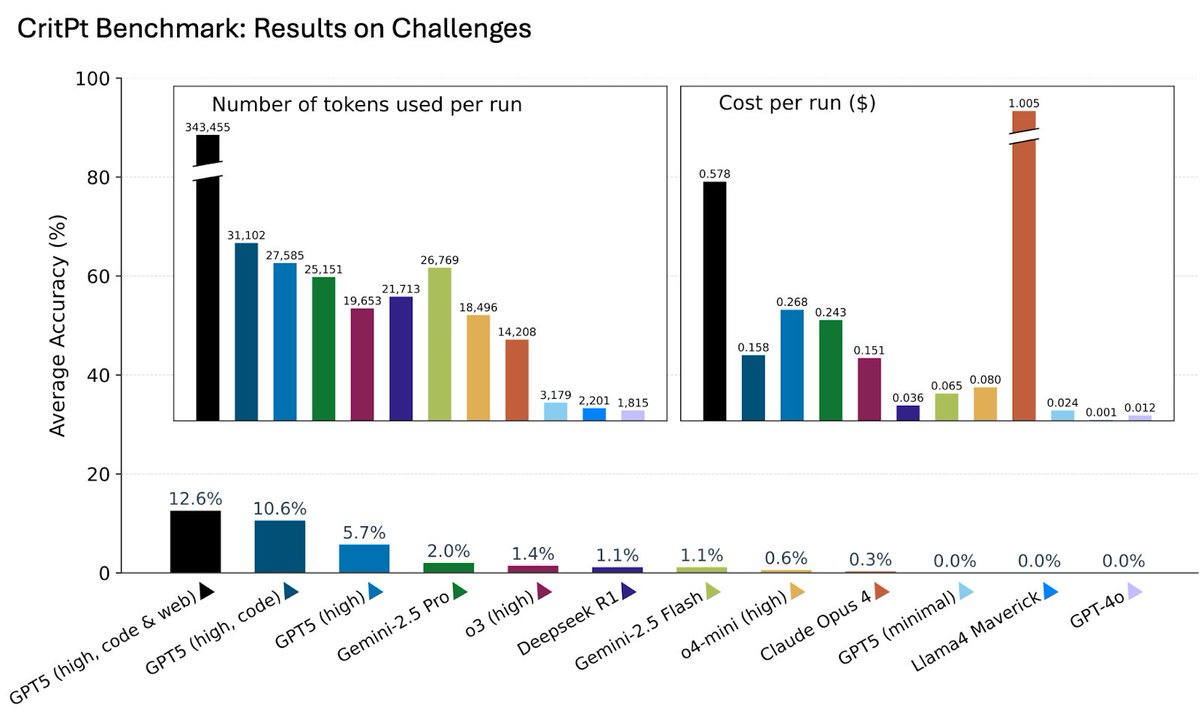
After 4 months of careful expert review, we release CritPt v2. GPT-6 Astra leads the way with 83.1% accuracy (average of 5).
We made changes to 47 challenges in total, which breaks down to:
- 5 corrections to mistakes in the problem statement (e.g., wrong number, self-contradictory constraints)
- 19 revisions to address underspecification (e.g., missing conventions/constraints that gives ambiguity to final answers)
- 16 grader fixes (e.g., grader unstable, error tolerant range too tight) without revision to the problem statement
- 7 refinements even though no issues were found (e.g., rephrased to be less searchable, worded more rigorously)
We also fixed some minor typos (spelling, grammar) which are unlikely to affect model performance.
Here’s how we found the issues:
- David Louapre @dlouapre from HuggingFace reported 10 issues across 8 challenges in June 2026. We accepted 8 issues and revised 8 challenges accordingly. We also thank David’s helpful revision suggestions.
- Anthropic sent a list of ~65 issues across 31 challenges in Aug 2026. Upon careful review of the full list, we accepted ~28 issues and revised 19 challenges accordingly (two overlapping with David’s list).
- We conducted an internal expert review of all problems, including newly revised ones, involving cross checking full responses of GPT-6 Astra (max) with CritPt experts. We ended up fixing/refining 20 additional problems.
From 28.9% in Nov 2025 (GPT-5 high, coding tool) to 83.1% now (GPT-6 Astra max, coding tool), the progress AI has made on well-posed physics problems is remarkable in a year. CritPt consists of entry-level research problems for junior researchers: the kinds of warm-up exercises a hands-on advisor might pose for a fresh grad student, but still demand solid physics training and nontrivial physical reasoning.
In this sense, frontier models are crossing a “critical point”, but there’s a lot more beyond this transitioning point in real scientific discovery. Asking a good question can be much harder than solving one. A good question can be fundamentally ambiguous and constantly changing as we explore. And ultimately, decisive tests of physics require experiments. There is so much more to explore.
We sincerely thank our evaluation partner @ArtificialAnlys, who will co-host the leaderboard of CritPt v2 soon!
CritPt Website: https://t.co/VkFiF2tjqM
GitHub: https://t.co/RcCRhYhSOX
HuggingFace: https://t.co/ikcOAyYd2m
Can LLMs help physicists break new ground in real frontier research?
We introduce CritPt (Complex Research using Integrated Thinking - Physics Test, pronounced "Critical Point"): the first benchmark of unpublished, realistic research-level reasoning challenges broadly spanning 11 physics disciplines, including condensed matter, quantum, AMO, astrophysics, high energy, mathematical physics, statistical physics, nuclear physics, nonlinear dynamics, fluid dynamics and biophysics.
Crafted by 50+ physicists from 30+ institutions globally, CritPt features:
• 71 composite research challenges – testing end-to-end reasoning in full-scale projects at junior PhD student level
• 190 modular checkpoints – testing incremental steps or modular tasks decomposed from full challenges
• Search-proof, guess-resistant, machine-verifiable answers
• Physics-informed scalable evaluation pipeline open to the public
Performance of leading models:
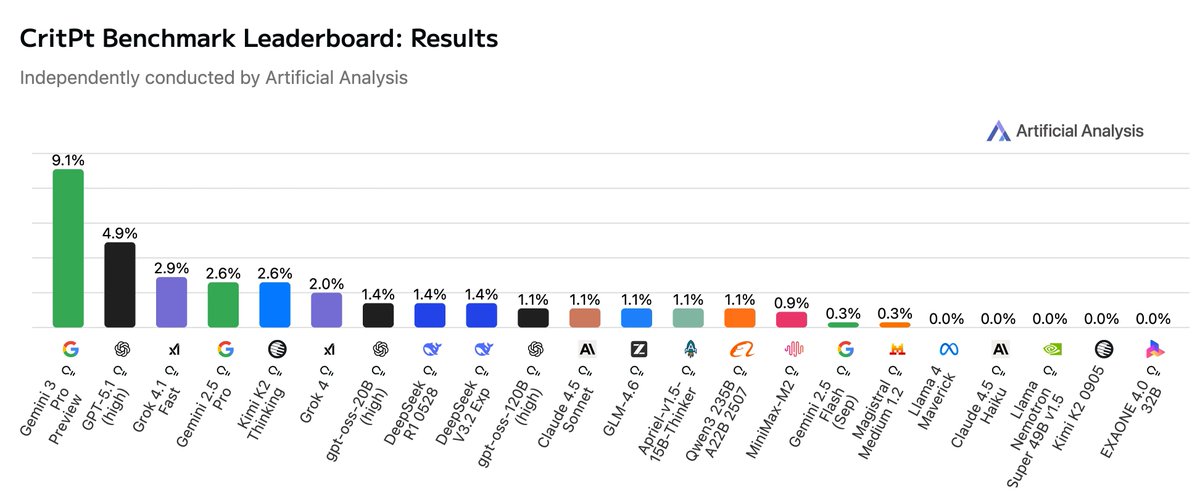
Without external tools, the top-performing model, Google’s fresh Gemini 3 Pro, achieves 9.1% average accuracy on the full challenges, followed by OpenAI’s GPT-5 at 5.7%, with all other models scoring below 3%.
Additional evaluations are independently conducted by @ArtificialAnlys: https://t.co/VHT4uUn3pr
Key takeaways near the end of 2025:
1. An AI scientist is still a long way off: Today’s LLMs can’t yet reliably solve unseen entry-level physics research problems.
2. Promising research assistants, progressing rapidly: On simpler well-scoped subtasks, models are showing measurable progress.
3. Physics × AI: A necessary partnership to build scientifically grounded AI tools and to unlock new paths in scientific discovery.
Tech report: https://t.co/wYvB3AnNuY , co-leading this project with @MiniHui_zhu 🧵1/7
A collective effort from physics and AI researchers to create a rigorous and realistic benchmark! Only possible with the support of @argonne@PhysicsIllinois@siebelschool and physicists from 30+ institutes worldwide!
We’re launching a new frontier physics eval on Artificial Analysis where no model achieves greater than 9%: CritPt (Complex Research using Integrated Thinking - Physics Test)
Developed by 60+ researchers from 30+ institutions across the world including the Argonne National Laboratory and University of Illinois Urbana-Champaign, some of whom have previously worked on leading benchmarks such as SciCode and SWE-Bench, this evaluation tests language models’ reasoning abilities on novel, frontier physics problems suitable for a post-graduate researcher.
We’ve worked with the CritPt developers to launch their new benchmark, and are especially excited about several key elements differentiating this from other reasoning tests:
➤ True frontier evaluation: This benchmark tests models on physics research suitable for graduate-level researchers, with questions and answers written and tested by experts (e.g., postdocs and physics professors) in their subfields
➤ Hard for even frontier models: On release, the highest-scoring model was Google’s new Gemini 3 Pro Preview, with an accuracy of 9.1% (without tool use allowed). Many models fail to solve a single problem even given 5 attempts
➤ Diverse question set: The evaluation test set includes 70 total end-to-end research problem ‘challenges’ covering 11 physics subdomains: condensed matter, quantum physics, AMO, astrophysics, high energy, mathematical physics, statistical physics, nuclear physics, nonlinear dynamics, fluid dynamics, and biophysics
➤ Reflective of research assistant capabilities: Each challenge is designed to be feasible for a capable junior PhD student as a standalone project, but unseen in publicly-available materials. This means most problems require deep understanding and reasoning in frontier physics beyond the capabilities of today’s language models, but all are feasible to solve and independently verified
Congratulations to @MiniHui_zhu, @MinyangTian1, @haopeng_uiuc, and the broader CritPt team on this exciting new evaluation!
See below for further discussion of this eval, analysis, and where to learn more
A true stress test on AI reasoning, created by the physics community. It’s a privilege to work with the amazing CritPt team and @ArtificialAnlys ! Let’s keep pushing the limits at the frontier of physics and AI!
We just achieved near break-even without post-selection using QED, a surprising result that came out of a study of dissipative quantum circuits.
Learn more in our blogpost 👇https://t.co/dfxGh4CPr2
Our unique architecture gives us *arbitrary angle* gates, and those have *decreasing error with decreasing angle*
Learn more in this paper: https://t.co/VHZeHHuihb
Today, physicists working with the company Quantinuum announced that they used a quantum processor to synthesize and manipulate non-abelian anyons in a novel phase of quantum matter, a stride toward error-tolerant quantum computers. @walkingthedot reports: https://t.co/V73kikbSBC
In Potential Advance Toward Fault-Tolerant Quantum Computers: @QuantinuumQC's New H2 Quantum Computer Has Created Non-Abelian Topological Quantum Matter and Braided Its Anyons
https://t.co/JRMnfBCqN4
We got ourselves a quantum race track at @Quantinuum, already setting several world firsts and world records, including creation and braiding of a non-Abelian Anyon for topological QC.
https://t.co/FPcIpinqZh
A couple of treats from Quantinuum's new 32 qubit quantum computer are now up on the arxiv.
We benchmarked the H2 device and showed an average two-qubit gate fidelity of 1.84(5) 10^-3. We also measured a quantum volume of 2^16=65,536
https://t.co/Kddrhlxuzi
If you don’t want to dig through our papers posted to the arxiv (which would be a shame because they are really cool papers), here is a pretty good summary of H2 and the projects run on it.
https://t.co/VvcqgG9YJ5
Today we are making two landmark announcements:
-We introduce Quantinuum’s System Model H2, our second generation of quantum computers
-Using H2, Quantinuum scientists created non-Abelian topological quantum matter and braided its anyons for the first time
https://t.co/Ptaq4xUbAS
In this new blog post, learn about how @QuantinuumQC scientists implemented a quantum extension of a well-studied classical model of non-equilibrium physics known as the “contact process" on a Quantinuum quantum computer. https://t.co/HsPX5Xcwd0