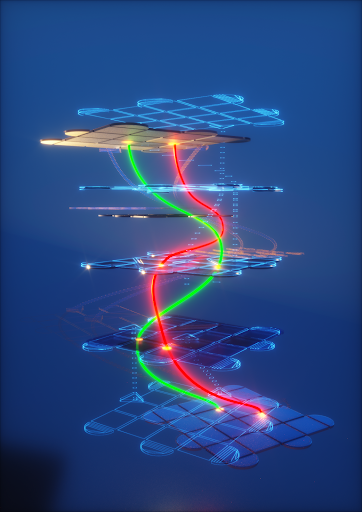
Photons traveling in vacuum do not interact. However, on a superconducting processor, microwave photons can be made to interact and form bound states. In @nature, we report on the surprising stability of these photon bundles.
https://t.co/G5Dudl6pxc
We just put on arXiv a long haul work on "bending" the time-dynamic of the surface code. We demonstrate error suppression from distance 3 to 5 for three different implementations on Willow. The three offer uniques venues for new hardware.
https://t.co/6kneXIk7F8
Two new papers from our team detailing how we optimize our gates and measurements. Our work on beyond-classical computation, Majorana edge modes, non-Abelian braiding and quantum error correction was enabled by these optimizations.
https://t.co/aXrMmkhKyP
https://t.co/vJx6QrBEAU
As an experimentalist, seeing our work studied by other is extremely rewarding! I am really happy to see that our work sparked interest in the community!
We have performed large-scale classical simulations of @GoogleQuantumAI experiment on few-particle bound states in non-integrable XXZ circuits, finding more anomalous features in the dynamics: https://t.co/tIxyysRRIa Thanks to @LeverhulmeTrust for support
Remember that paper from the end of last year that claimed it could factor 2048 bit integers using 378 qubits? At the time, I mentioned to Tanuj Khattar that a nice starter paper would be to just simulate it and verify it doesn't work. Here's the result: https://t.co/894rHMLDWX
@letonyo@cdf1530 I read to quickly my bad! I didn’t caught the pessimism of the initial quote.
Personally, I would say that quantum simulator have already delivered amazing experiments.
@letonyo@cdf1530 What do you think will be the most important one?
Imho, it pretty hard to predict “the most important one” and I would say the answer probably differ for different sensibilities.
Many-Body physics is really a natural applications for quantum devices
Very exciting to see @NoahGossQuantum highlighted for his work on qutrit CZ. This work is particularly close to my heart as it’s the culmination of my time at @BerkeleyLab . I really hope that we will see more qutrit results in the future!
The theorist at @GoogleQuantumAI have put together a manuscript detailing when quantum circuit are “classically hard”. They also show that the IBM 127 qubits experiment result is indistinguishable from a 28qubits classical simulation https://t.co/cDcebTCgkD
We prefer XEB at @GoogleQuantumAI :p
Joke aside, I think for elements fidelity everyone has converged to some randomized benchmarking (and variant) and the comparison between plateforme is possible.
Folks, isn't it about time we had a Quantum standard?
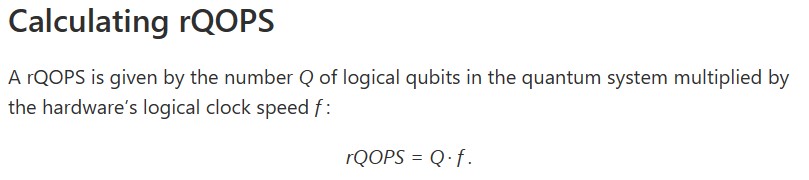
@IBM & @QuantinuumQC use #QuantumVolume & IonQ_Inc uses #AlgorithmicQubits. Now @Azure Quantum has a metric called #rQOPS that counts operations that remain reliable for the duration of a practical quantum algorithm
@postquantum@BosonBulmer We spent a lot of time trying to push both classical and quantum execution of the RCS! Tensor network methods have proven to be quite good for these problem
Analogue simulation with transmons has a nice future! It's really exciting to see SC becomes such a nice platform for quantum simulation. Very nice work from @MIT EQuS group
Check out the latest arXiv submission from MIT EQuS and Lincoln Lab on “Probing entanglement across the energy spectrum of a hard-core Bose-Hubbard lattice” using a 4x4 array of superconducting transmon qubits: https://t.co/gEruBAbUsZ.
Broadbanding of parametric amplifiers is an impedance matching problem. Check out @GoogleQuantumAI Intern Ryan Kaufman (@TeamHatLab) work on JPA with 500 MHz bandwidth using filter synthesis techniques https://t.co/7u9FjHP4h7
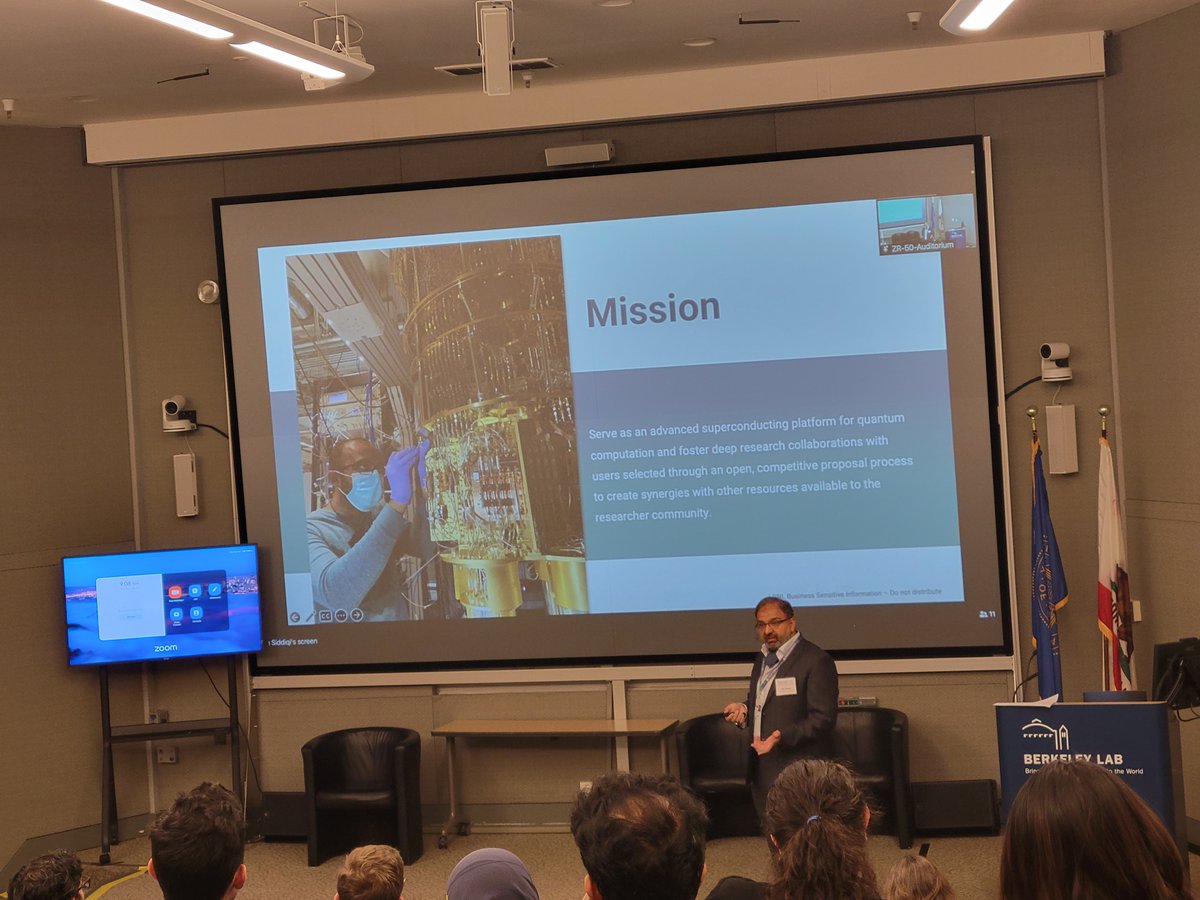
The Advanced Quantum Testbed @BerkeleyLab is wrapping up the first 5 years🥳& looking ahead! Funded by @doescience, AQT is marking the occasion today w/ collaborators & colleagues in national labs, academia, & industry. https://t.co/VoqY15O5FU
#AQTatBerkeleyLab#QuantumComputing
Our work on the braiding of non-Abelian anyon (the first experimental realization!) is finally out in Nature.
It's quite amazing to see experiments observing these non-Abelian anyons that have escape experimental probe for so long.
Today in @Nature, @GoogleQuantumAI and collaborators have braided non-Abelian anyons for the first time. Unlike all particles observed so far, the state of two non-Abelian anyons changes when they are swapped, opening an exciting path in quantum computing
https://t.co/TF4piHRhQG