PhD candidate in Ying Ge's Lab at UW-Madison.
Passions include: top-down proteomics, multidimensional LC, MRMS, ion mobility and safer bio therapeutics.
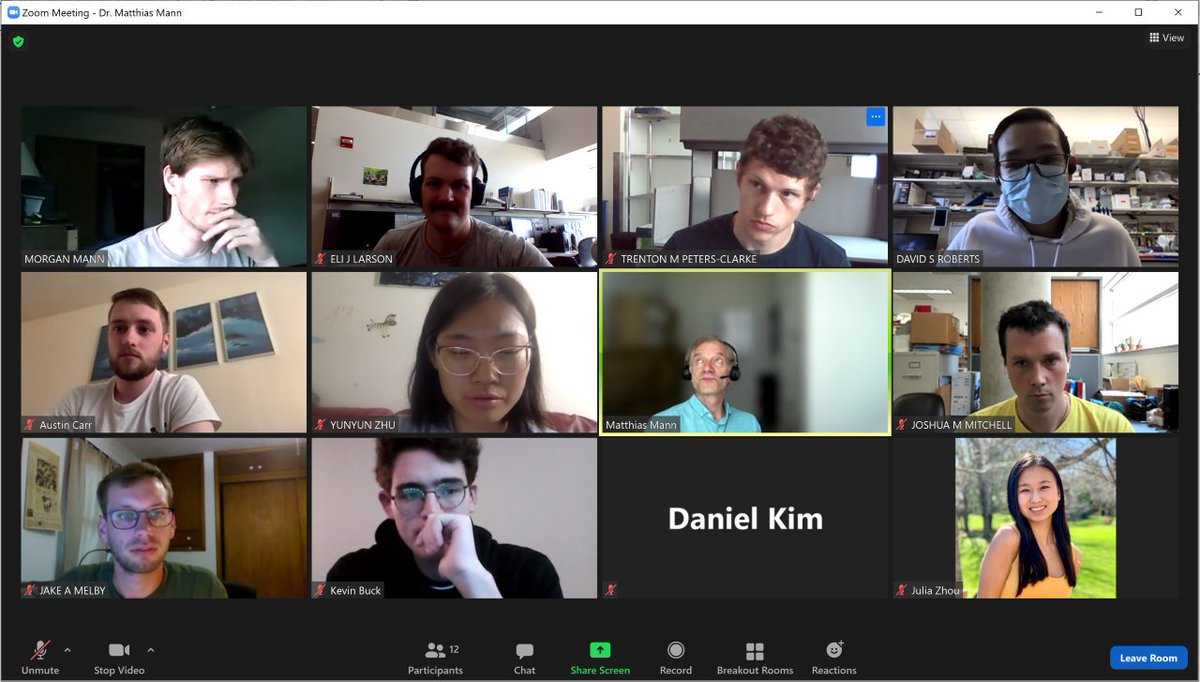
Second monthly UW Mass Spec Seminar in the books! Very exciting to hear the work of Drs. Matthias Mann and Ying Zhu in the field of single-cell proteomics, and special thanks to the speakers for generously giving their time to meet with grad students too.
@NBorotto We've chatted with the Bruker team about this, and if I recall correctly the Pro should between 3-4x better ion transmission efficiency. Looks like the timsTOF SCP should have 5-fold further improvement over the Pro
Very excited to share this new work! TIMS, MS1, MS2, and MS3 for a cysteine ADC in only 3 minutes! Special thanks to @DSRoberts007, @jakemelby3 and all the coauthors. A fruitful collaboration with AbbVie and Bruker using the incredibly versatile timsTOF Pro!
Interested in high throughput, multi-attribute analysis of antibody-drug conjugates using trapped ion mobility? Check out our paper published today in @an_chem https://t.co/yaYrsIG2hP Big congrats to Eli, David and all the other co-authors after a lengthy review process 🎊
@NBorotto Thanks, same to you! It looks like we're using different timsTOF generations. I think the difference in transmission of large ions comes down to design differences between the TIMS cell equipped in the timsTOF and timsTOF Pro.
@ProteomicsNews We're very happy with the timsTOF Pro's size range, Bruker's designed a great instrument. Preliminary results show that we can go larger too!
@ProteomicsNews @massspecpro@DSRoberts007@jakemelby3 What we're calling MS3 happens after ADC subunits are dissociated using increased isCID energy (what we've called MS2), then the dissociated subunits are fragmented in the collision cell
My 1st first author paper was published today! We used Azo and the timsTOF Pro to develop a fast and reproducible bottom-up method to characterize the heart proteome from small amounts of tissue. Check it out! https://t.co/Lwacz4M5K9
Interested in learning about MASH Explorer and updates on new features? Come swing by our virtual open house next Friday! Link to sign up here: https://t.co/1vlNLFxTMZ
How long should an LC column be for effective biotherapeutic separation? A lot shorter than you might think. Excellent work from the University of Geneva, Solvias AG, Waters, and Pierre Fabre! https://t.co/qqJppqMIBl
@alex_me_jones @Ge_Lab_UW We have a timsTOF Pro and found the switch very intuitive (constantly switched between top-down and bottom-up) Some bells and whistles like nanospray and a service key to edit TOF voltages may help, they are not essential to collecting good quality tims-MS and tims-MS/MS spectra
@alex_me_jones We in the @Ge_Lab_UW have been working on that. Regarding your points: 1) Yes, 150 kDa native complex has worked extremely well for us in the native state intact, monitoring dissociated subunits, and primary sequence. 2) It is possible to do with standard instrument hardware.
Excellent Biemann Medal award talk by @yingge2121 today. We in the group are all very proud of Ying's accomplishments and look forward to the great things yet to come!
@slavovLab Research Gate. You can send a direct request to the authors. I've yet to find an author who isn't thrilled to share their work and open up to potential discuss.
Excellent work by the software development team of the Ge group! The software has been an indispensable tool, and I highly recommend trying it out on for your next foray into top-down data analysis.