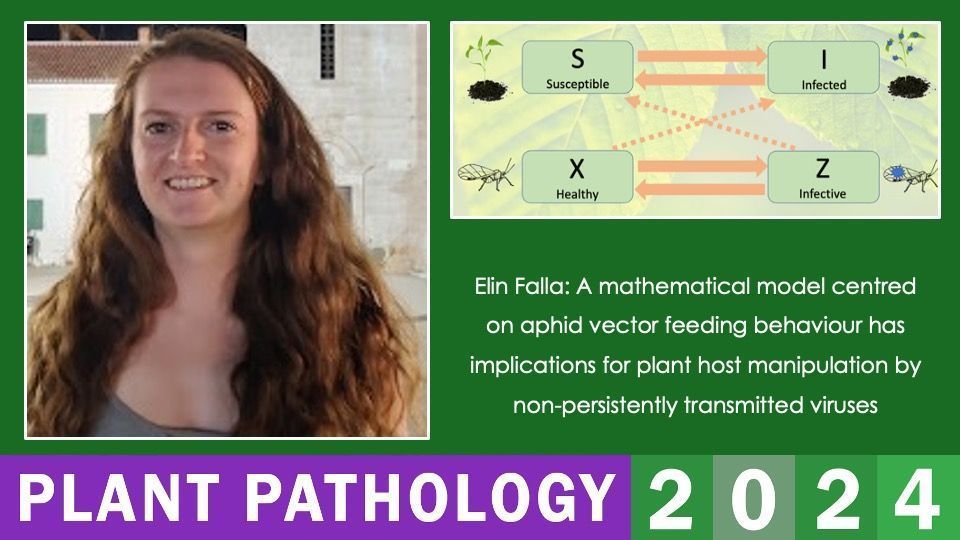
My first first-author paper is out in @PLOSCompBiol! Read about why including aphid vector behavior is important for modelling NPT plant virus transmission, in particular when the virus is manipulating plant host phenotype: https://t.co/kFgoi7WYQc
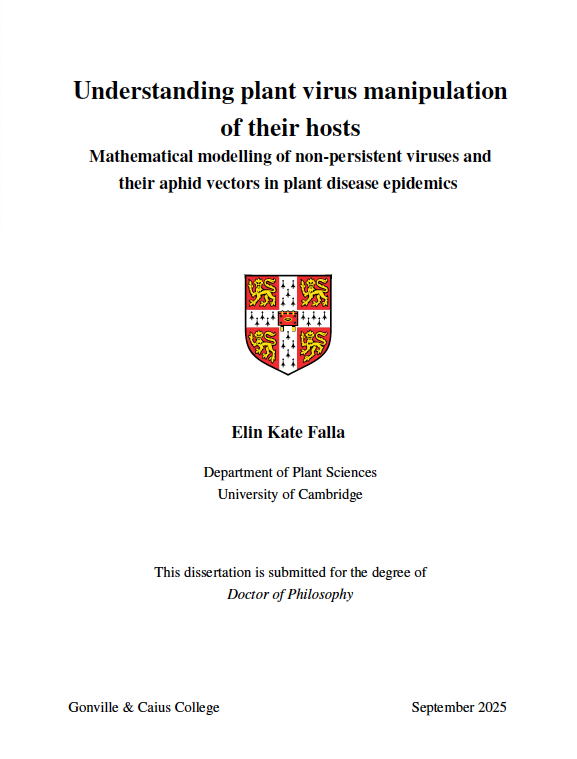
I'm incredibly pleased to say I have passed my PhD viva, with no corrections required.
I am very thankful to many people, particularly my supervisor @nikcunniffe and my partner, friends and family who have supported me throughout.
Thanks also to @CaiusCollege and @camplantsci
The preprint of my second first-author paper (with
@nikcunniffe) is out! Read to find out how planting virus-resistant companion plants can control the spread of non-persistently transmitted plant viruses: https://t.co/L6sisWEh9R
@plantsci@CaiusCollege@Cambridge_SBS
My first first-author paper is out in @PLOSCompBiol! Read about why including aphid vector behavior is important for modelling NPT plant virus transmission, in particular when the virus is manipulating plant host phenotype: https://t.co/kFgoi7WYQc
❓Why should models of non-persistent plant virus transmission include aphid vector dispersal & feeding behaviours?
🗣️ Explained by @ElinFalla at today's @livunimaths Mathematical Biology seminar
📄 To find out more, see associated @PLOSCompBiol paper: https://t.co/ydo6NqL1am
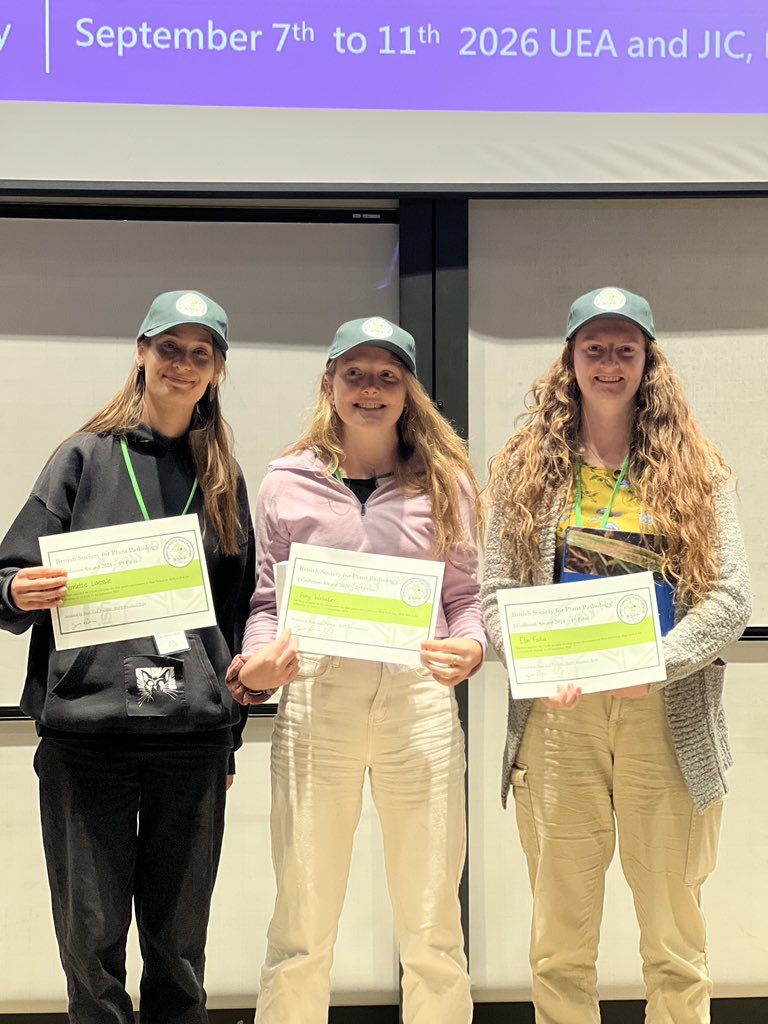
My talk at the Plant Pathology conference #PPATH24 won the PH Gregory Prize for best student talk! Thanks to @BS_PP for organizing such a great conference
Very excited to be at @BS_PP ‘s Plant Pathology conference for the next few days, and honoured to have been selected to give a talk on my PhD work in the PH Gregory Prize session today! #PPATH24
I’ve been in Spain this week to give a talk on my PhD work at the European Conference on Mathematical and Theoretical Biology. Thanks to the organisers for hosting such a great event in the (very very) sunny Toledo! #ECMTB24
The preprint of my very first first-author paper (with @nikcunniffe) is out!! Have a read to find out why models of non-persistent plant virus transmission should include aphid vector dispersal and feeding behaviours @cambridgesbs @plantsci@CaiusCollege
https://t.co/EDLfiYez5R
🌿 Fact: 80% of the food we eat comes from plants. Protecting plant health is crucial for food security, as 20-40% of global food production is lost to pests and diseases annually. 🌱 #PlantHealthWeek#PlantHealthDay@DefraGovUK@APHAgovuk