I spent over two decades in counterterrorism and I’m still involved in many ways, so here are my views on what I see has happened over the past 24-36 hours in the UK:
Five British men in their twenties were arrested on Sunday near RAF Fairford on suspicion of explosives offences and the preparation of a terrorist act. On Monday they were released on police bail.
That’s not what the terrorism clock looks like when the investigators are still in charge of it.
Under ordinary UK criminal law a suspect can be held for 24 hours, stretched to 36 by a superintendent, and to 96 hours by a magistrate.
But under section 41 of the Terrorism Act the first hold is 48 hours, not 24 hours. A judge can then extend it, in stages, up to 14 days without a charge. If the case merits it, it can even be pushed to 28 days. That 14-day cap exists for exactly this kind of file of vans, an airbase the United States uses, a possible foreign hand, explosives (if there were any) and interviews that are not finished on the first night.
Counter-terrorism police said the inquiry isn’t over. They said conditions apply. They said a state link has not been ruled out. Those sentences he said only make sense if the evidence trail was still live. A live trail is why Parliament built the two-week window.
But watching the guy read out the statement showed me in his body language, tone and eye movements that releasing those five men was NOT his or his department’s decision.
Walking five men after roughly a day is what you do with a pub fight, not with a suspected terrorist attack on a bomber base.
I’ve sat in enough interrogation rooms to know the difference between a custody clock and a political ceiling. Nobody had to shout an order down a phone. Someone in the political building above the investigators decided that charging British nationals on Monday, with Iran already denying it, Washington watching the runway, and a Labour conference where the main topics of discussion were prioritizing Palestinian and other refugees settling in the UK, was uglier than bail and a holding statement.
The law allowed them to keep the door shut. Yet the door opened anyway in half of the most minimum time.
That’s the story. That for me is the only story here. Not “they were innocent.” Not “the case collapsed.” The statute was not exhausted, but the appetite was.
The real question is who, and most importantly, why?
If you could take a min to read this &, if it takes your fancy, then re-post it… I’d be so grateful. 🙏🏻
I’m doing my utmost to #SaveSquareChapelArts for the good people of Halifax & beyond, & I need all the help you lovely lot can give me.
Thank you! x
https://t.co/68ArbRZsRD
Remember when they sold us the slogan, “Go paperless, save trees, save the planet”? Now we've gone digital, and it's consuming enormous amounts of water, destroying ecosystems, harming bees, and contributing to environmental damage on a scale paper never did.
Starbucks paid zero tax in 2025 on sales of £556.3m. They got a £13.7m tax credit instead.
What's the benefit of having Starbucks in the UK?
Either tax them on their sales or give the sites to independent British cafes instead.
Stop letting foreign multinationals plunder our country.
The UK’s largest solar farm proposed on 2,000 acres of prime farmland between Perth & Dundee. The equivalent of 1,250 football pitches of food-producing land.
If the Scottish government cared about food security and the Scottish countryside, they will not let this happen.
Thames Water's finance director given a £1,000,000 signing on bonus.
Water industry depravity hits an all time low. Their contempt for customers and the environment clearly knows no bounds.
When are govt going to intervene and put a stop to this? @andyburnham@angelaeagle
https://t.co/WB23sNU4hS
A farmer in Shropshire is selling his farm this September and nobody has died.
Two hundred and twenty acres. A hundred and forty ewes, seventy suckler cows, a shed with one end held up by a telegraph pole, and a tractor bought new in 1994, which is the last thing on that farm that was bought new. His grandfather bought the place outright in 1961. He is 54 and has never had a penny of debt.
The books say the farm lost eleven thousand pounds last year. It lost money the year before as well.
He is not bad at this. The government's own review, chaired by Minette Batters, found nearly a third of British farms were loss-making in 2024.
On paper the same farm is worth £1.9 million.
Pasture in his county averaged £8,600 an acre last year, and not a pound of that was set by anything he grows. Two blocks within nine miles went to buyers he has never met. One for solar. One described in the particulars as a natural capital opportunity.
His mother is 81 and lives in the bungalow at the top of the lane. When that comes across with the other half of the ground, the two halves clear the £2.5 million threshold, and twenty per cent of the excess is a bill in six figures on a business that has not made money in three years.
His son is a radiographer in Telford and is not coming back. He said so once, kindly, and never made his father ask twice.
So it goes now, while he can still choose which fields and to whom. He is selling the good ground first, because you cannot raise a bill off the rough.
The Treasury collects nothing from any of this. The sale happens years before the tax event, so there is no tax event left to have.
What Britain loses is a hundred and forty lambs and seventy calves a year, off ground that will never produce food again, in a country that already imports forty per cent of what it eats and has just had its worst cereal harvest since records began.
That is one farm. There are thousands of them, doing the sums at the same kitchen table this month.
The beef on your shelf this Christmas will come from Brazil, and the price will be higher, and nobody will connect the two.
Just a reminder that we’re still footing the bill for politicians’ food and alcohol in their workplace, the House of Commons. That shouldn’t be happening. They’re not schoolchildren; they’re grown adults who can bring their own lunch and refrain from drinking on the job.
I have heard many people in the water industry and indeed some in government repeating the lie, why I wonder?
Of the £91 billion being spent by water companies over the next 5 years £90 billion of it, that's 99% it is being funded directly from bill payers pockets, from your bank account and mine, not shareholders.
Which raises the obvious question, what actually is the point of the shareholders, why do we need them?
Interview starts 2 hours 45 minutes into the programme.
https://t.co/3xp9Vh9RHC
I don’t want to "download the app" to pay for parking. I don’t want to "create an account" to see a menu. I don’t want to "provide feedback" on a 30-second interaction. I just want to exist in the physical world without a digital leash.
We keep waiting for someone to invent a machine that cleans the air, stores carbon, produces oxygen and grows food.
We already did.
It’s called a tree.
“I work the front desk at a small doctor’s office, and I wish people could see what happens on the other side of the phone.
Every day, older patients call us confused.
They are told to use the patient portal, upload documents, check lab results online, fill out forms before the visit, and confirm everything through a link.
Some of them do not know what a portal is.
Some do not have a smartphone.
Some have one, but they are afraid to click the wrong thing.
Last week, a man in his late 80s called about his test results.
He said, “Ma’am, I don’t mean to bother you, but the computer says I have a message and I don’t know how to open it.”
He sounded ashamed.
That broke my heart.
He should not have to feel ashamed for needing a human being.
Technology can be helpful. I understand that.
But when people who built this country are made to feel helpless because everything became a login and a password, we have gone too far.
Not everything needs to be an app.
Not every answer should be hidden behind a screen.
Sometimes people need a voice.
A patient person.
A real human who says, “Don’t worry, I can help you.”
Progress should not leave seniors behind.
Because one day, the world will move faster than us too.
And I hope someone is kind enough to slow down.
~Unknown
Dear @EnvAgency.
In February this year, after 4 years of asking you to look after the Aldersbrook, I led a team of volunteers to do your job for you & clean out tonnes of silt & leaves, as well as hundreds of bags of rubbish. Through the effort of community volunteers & donations, & at zero cost to the taxpayer, we turned a forgotten silted up ditch back into a river again.
Last nights intense rain storm showed why our actions are the very definition of “strengthening water resilience”. A huge amount of rain fell in a short time, but the restored section of the Aldersbrook has been able to hold 100’s of thousands of litres more water, stopping this water running into the Roding, & thereby *reducing* local flood risk. The first photograph below is of the Aldersbrook after the rains this morning- a big contrast to the area before we did the work.
Perhaps more importantly, this water, instead of running straight off into the Roding & hence the sea is now being held in the Aldersbrook & gradually released so it can be used by nature. It is feeding marshes, trees & wildlife, topping up groundwater & helping to reduce our flood/drought cycle. If you want to strengthen water resilience, we need thousands more projects like the Aldersbrook around the country.
So the question I ask you, Environment Agency, is why you are threatening me with two years imprisonment, rather than offering to meet & discuss how we can work together to restore the Roding & its tributaries, which could become a blueprint for you cooperating with local river guardians nationwide?
SHE FOUND THE NHS TRUST WAS COOKING ITS DEATH RATES, SO THEY TRIED TO COOK HER INSTEAD
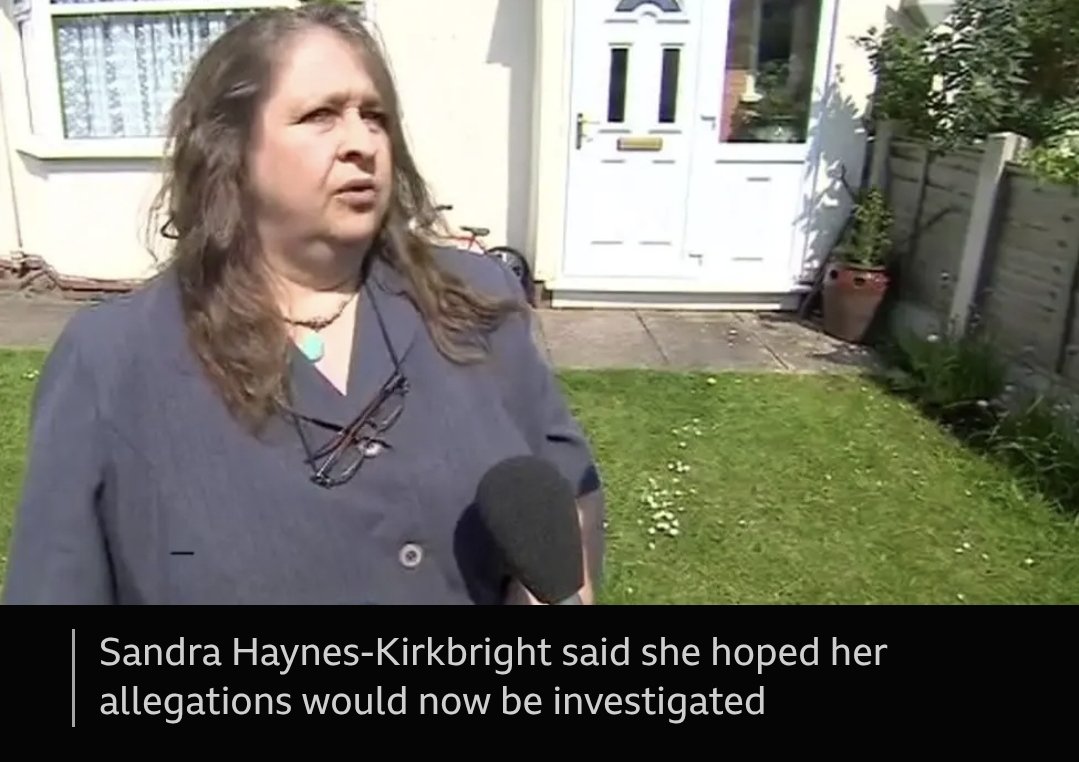
Sandra Haynes-Kirkbright ran clinical coding at Royal Wolverhampton NHS Trust @RWT_NHS from 2012 to 2016. Boring job title. Log the deaths. Code them correctly. Keep the mortality data honest.
Then she noticed the data wasn't honest.
She told the Daily Mail @DailyMailUK she was effectively brought in to "fix" the trust's mortality figures, and that every rule in the book got broken trying to make that happen. She didn't play along.
So in classic NHS fashion, she became the problem instead of the cover-up.
Suddenly colleagues complained about her management style. A disciplinary investigation appeared out of nowhere. She got suspended.
Bullying and "unprofessional behaviour" allegations followed, the standard care package handed out to anyone who notices something inconvenient.
Chief executive David Loughton @david_loughton knew about her concerns.
Did he launch a whistleblowing investigation like he was supposed to? No.
He told two executive directors to make sure her concerns didn't interfere with an inspection from health regulator Monitor. Priorities.
Her own line manager, finance director Kevin Stringer, ran the disciplinary process so badly an independent review later called it unfair.
Years on, consultants Verita finally looked properly.
Verdict: a lack of proper governance and management at senior levels, and the trust failed to follow due process.
The trust's response was a typical in corporate non-apology. They acknowledged the findings, then pointed out none of it was related to patient safety, care, or experience.
As if nearly sacking the person who flagged dodgy death-rate data is just a filing error.
This is the pattern every time. Raise a concern, get treated like the threat, wait years for someone in a suit to confirm you were right all along.
Sources: @DailyMailUK@ExpressandStar@ITVCentral