🧵 In the forthcoming issue of @ForeignAffairs, I argue that the time has come to build a collective defense alliance in Asia—the Pacific Defense Pact—initially comprising Australia, Japan, the Philippines, and the United States.
American policymakers have “too often failed to press on China’s pain points or even develop options for doing so.” Read @elyratner and Nick Danby on why Washington must “be ready to go on offense.”
https://t.co/IRtfP2qV8e
“China’s success in cornering the Trump administration was not simply a result of the United States’ failure to secure its supply chains,” write @elyratner and Nick Danby. “It reflected a profound failure of U.S. strategy.”
https://t.co/IRtfP2qV8e
China “has been a clever practitioner of finding the gaps and seams in American power,” write @elyratner and Nick Danby. By contrast, American policymakers have “too often failed to press on China’s pain points or even develop options for doing so.
https://t.co/IRtfP2qV8e
The Indo-Pacific is now, more than ever, a vital theater of competition—one in which U.S. allies could play a decisive role in deterring regional adversaries.
@elyratner, @DavidFeith, @AmbVMKwatra, and @LisaCurtisDC will join @AsiaLens at the CNAS 2026 National Security Conference for a panel on burden sharing and cooperation in the region.
American policymakers have “too often failed to press on China’s pain points or even develop options for doing so.” Read @elyratner and Nick Danby on why Washington must “be ready to go on offense.”
https://t.co/IRtfP2qV8e
NEW in the July/August issue of @ForeignAffairs: For decades, U.S. strategy has failed to build competitive leverage over China. Nick Danby and I lay out how to change that, from chips and trade to the dollar and energy. https://t.co/A4f13Vd9HW
On Hegseth’s soft-pedaling of China, in @nytimes:
“Trump’s accommodation of China may yield more military engagement in the near term, but it will also invite greater PLA coercion against U.S. allies. That’s not a recipe for strategic stability.”
https://t.co/AalEt2Z21G
My contribution:
— China is a lower priority in Trump’s 2nd term; views inside more mixed.
— “All of this comes together to create this softer policy we see now, philosophically this group appears geared toward a more accommodationist approach to China.”https://t.co/uPmxJgRK5a
President Trump is in Beijing for a state visit to America’s chief global competitor, and increasingly, its chief geopolitical rival.
Trump has long targeted China as an economic foe of the U.S. while cultivating a relationship with President Xi Jinping.
@nickschifrin reports.
Really enjoyed this discussion with Mark Wu during a recent visit to the @FairbankCenter on U.S. defense strategy in the Indo-Pacific. https://t.co/4vf5XKtjEJ
The Trump administration is pursuing a policy of accommodation toward China that will leave the U.S. with “less leverage, fewer partners and wider gaps to close.”
My latest in @FT: https://t.co/eH6l6dTbI8
Thank you @elyratner for the vote of confidence in #Taiwan. We’ll do all we can to acquire the right arms & transform our military for effective deterrence. Still more to be done. Timely passage of the special budget by the LY is crucial.
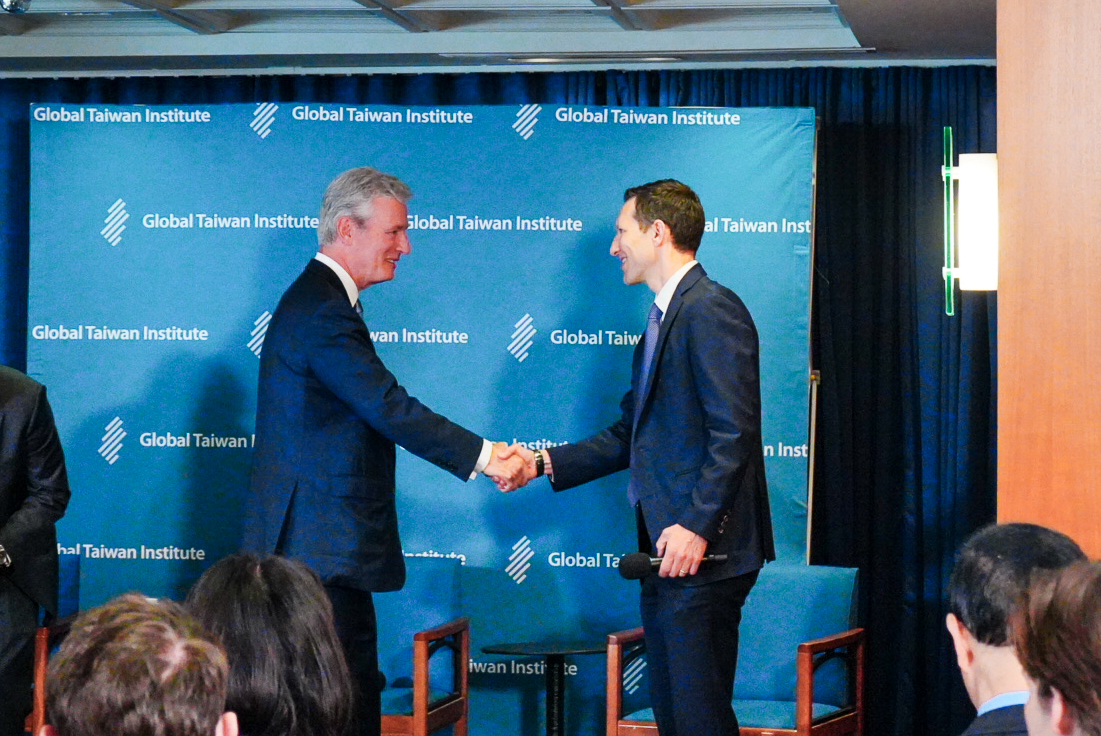
@elyratner, Vice-Chair of #GTI's US-Taiwan Task Force, argues that after serious reform, #Taiwan is able to play a critical role in #deterrence against future crises.
Watch the entire US-Taiwan Task Force Launch event: https://t.co/8MaatHfU6R
#USTaiwan
Enjoyed this conversation on how U.S. businesses should be thinking about the geopolitics of Asia. It capped a great day of discussions with faculty and students @HarvardRajawali and @Kennedy_School.
@elyratner joins the Rajawali Foundation to examine U.S. strategy in the Indo-Pacific, highlighting key geopolitical risks, private sector implications, and the region’s strategic and economic importance.
https://t.co/f8qUcKk8ZM
Honored to lead this bipartisan U.S.-Taiwan Task Force with Ambassador @robertcobrien — an exceptional group of former officials and experts committed to strengthening U.S.-Taiwan relations. Full details: https://t.co/hExCzzo7k6
#GTI today announced the members of its #US#Taiwan Task Force, a #bipartisan coalition of national security experts from #Washington and #Taipei, chaired by Amb. O'Brien, and vice-chaired by Dr. Ratner. @elyratner@joshrogin
Press release: https://t.co/jax7qW54o3
@Mike_Cherney@Heritage@elyratner “While this may not lead to major contributions to a regional conflict, Wellington still has huge contributions to make in curbing China’s malign influence in the Pacific islands,” Ratner said.
https://t.co/1zwBOaBXl3
Washington can't let this period of geopolitical flux put cross-Strait deterrence at risk.
In a new piece for @NikkeiAsia, my former Pentagon colleague Lauren Dickey and I lay out concrete steps Congress can take to help strengthen Taiwan's self-defense capabilities.
"Every resource consumed in Iran is now unavailable for the Pacific, where the United States faces its most consequential military challenge," @Joe_m_costa and @ElyRatner write. https://t.co/bctwGI81dl
Trump's war in Iran is degrading U.S. readiness for China—our most consequential military challenge. And the problem runs far deeper than munitions stockpiles.
In today's @washingtonpost, @Joe_m_costa and I argue that: "the strategic bill is coming due."
https://t.co/QnEgYqSpeP