My NEW report from @CSIS!
Coming in at a svelte 147 pages, the report argues that China’s advancement across high-tech sectors has directly strengthened the country’s international power and influence, and that other governments need to respond pragmatically to reduce the downside costs and raise the upside opportunities to make the most of these developments.
https://t.co/P9PKswAox9
"the real explanation is far simpler. The party is sticking to this path because the leadership believes it is working. It sees the same troubling data...but it has reached wildly different conclusions." https://t.co/dOx9OQOrAV
“We do have significant dependencies. The challenge isn’t to eliminate those; it’s to reduce them to a level where they couldn’t potentially be used as a chokepoint.”
https://t.co/2QlMlZA9mw
“Debt servicing payments alone are expected to account for 19.2 per cent of the central government’s general public budget this year, up from 12 per cent in 2014, according to a new study from the Conference Board.”
https://t.co/gWi2DFoSjt
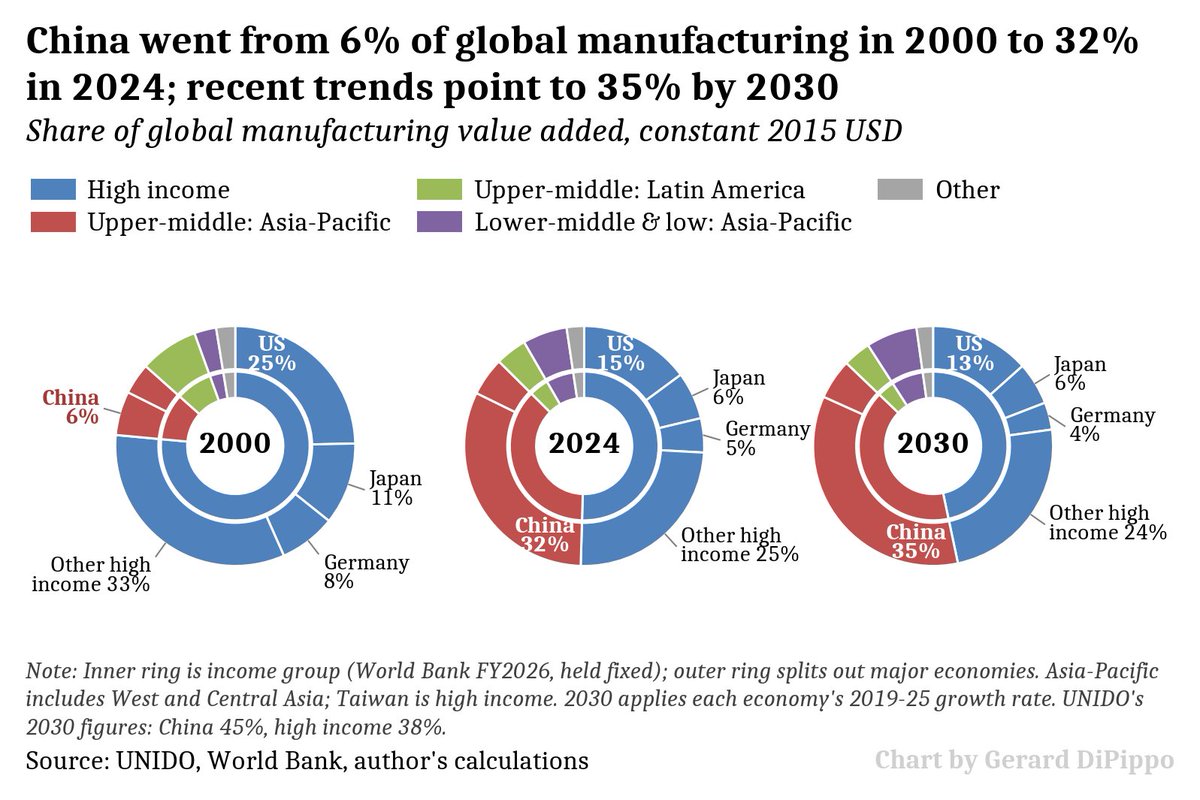
People understandably cite this UNIDO chart, claiming China will account for 45% of the world’s manufacturing value added by 2030, but it’s wrong and shouldn’t be cited.
It comes from a 2024 UNIDO paper, which @JKynge cites in his new @ChathamHouse report on China and European industry. (His report is worth reading. My issue is only with the UNIDO figure!) UNIDO says it took each country’s average manufacturing growth over 2010–19 and projected it forward from 2024. But if you do that with UNIDO’s own data, China reaches 38% in 2030. The published numbers only come out if you use 2000–19 growth instead, which assumes China’s 13% annual growth from the post-WTO boom suddenly resumes in the coming years (it won’t). This appears to be an error in the UNIDO report. The UNIDO chart also says “industrial production,” but its numbers match manufacturing value added.
China’s manufacturing growth has since slowed to around 5%. If we apply each economy’s 2019–25 manufacturing growth rate, China reaches 35% by 2030. In current dollars, China’s share peaked at 30.5% in 2021 and was 28% in 2024 because of deflation and a weaker yuan.
China’s manufacturing sector is the biggest in the world, and it’s still growing. But it won’t reach 45% of global manufacturing in 2030. That would require China’s manufacturing output to grow about 14% a year for five years. Even if the rest of the world’s manufacturing didn’t grow at all, China would need 11% a year. It hasn’t grown that fast in any year since 2011.
h/t @JonathonPSine, who pointed out some of the UNIDO issues last year.
Thanks SO MUCH to @CSIS_Tech Matt Pearl & Lauryn Williams for having me on Cache Me If You Can to discuss last week's Trump-Xi summit -- tariffs and trade, rare earths & critical mineral supply chains, competition over advanced technologies, and the prospects for cooperation on AI.
https://t.co/DxhU08oDyy
Podcast Episode: China Field Notes, with Scott Kennedy
"China’s Changing Commercial Landscape on the Eve of the Summit: A Conversation with Eric Zheng"
In this episode, @CSISCBE Director @KennedyCSIS is joined by Eric Zheng, President of the American Chamber of Commerce in Shanghai.
Listen to the episode here: https://t.co/vpkc8iZFzz
Thank you to the @AustriainUSA & @SchneebauerP for hosting @LyleJMorris & myself for wide-ranging discussion on the Trump-Xi summit & implications for the rest of the world.
Today, we hosted our Indo-Pacific Roundtable with partners from other embassies. Participants benefitted from expert economic & political analysis. We heard many perspectives: Given the importance of US-China relations across a wide range of topics & regions, coordination is key.
HAPPENING TODAY: Is China's Economy Broken?
Register here: https://t.co/6B2dwI6hDF
Join CSIS for a in-person event with Logan Wright of the Rhodium Group (and a CSIS non-resident senior associate) to discuss his new book Broken China: How the Economic Miracle Shattered and What It Means for the World (Polity).
Trustee Chair Scott Kennedy will lead a conversation concerning the political and economic implications of Dr. Wright's research for China and the rest of the world with panelists Dinny McMahon (Trivium), Tianlei Huang (PIIE), and Zoe Liu (CFR).
Last week, Presidents Donald Trump and Xi Jinping met at the White House for the Chinese leader’s first state visit to the U.S. in more than a decade. CSIS experts assess the outcomes of the summit and what it means for the future of U.S.-China relations.
More: https://t.co/nT4hM3Jw2b
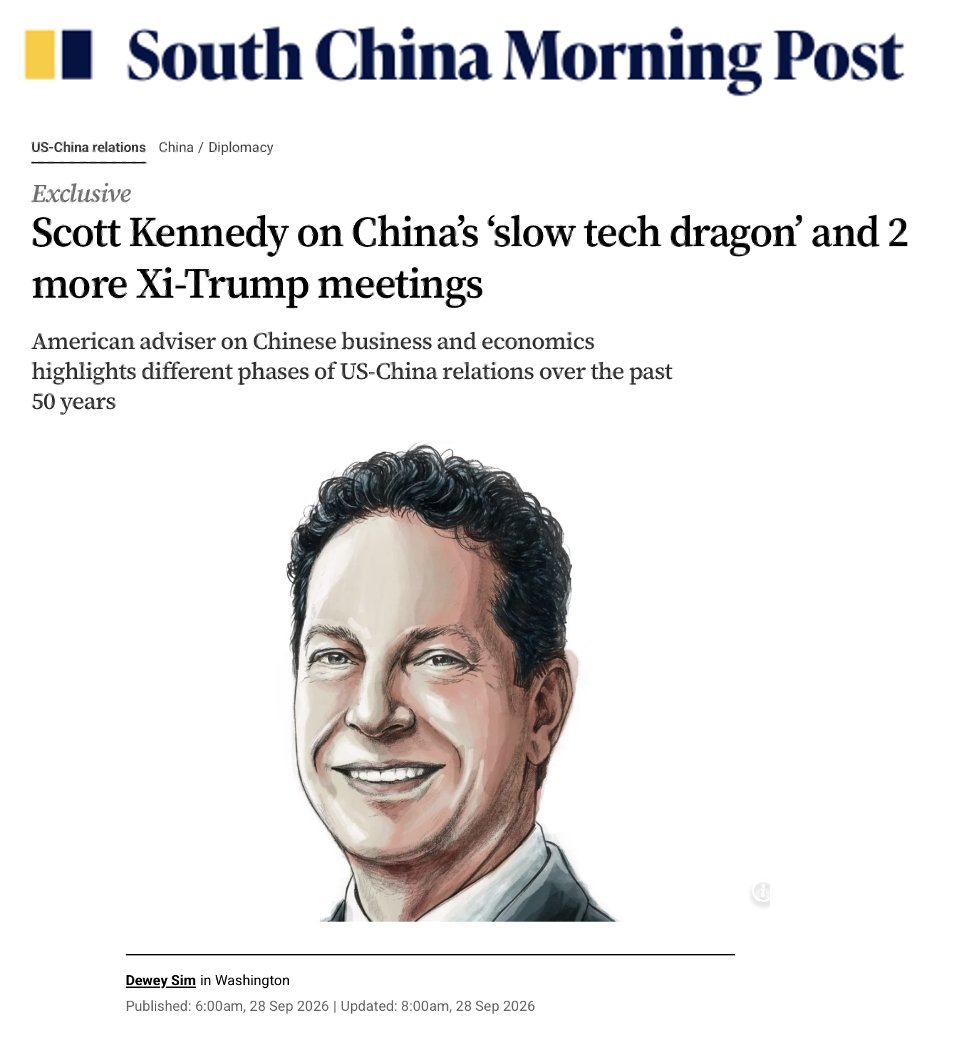
For Trump, the G2 means "two guys," for Xi "two governments." I appreciate the opportunity for an in-depth discussion of US-China relations, the summit, and China's economy with @SCMPNews@deweysim.
https://t.co/JoOEpMTZBS
For Trump, the G2 means "two guys," for Xi "two governments." I appreciate the opportunity for an in-depth discussion of US-China relations, the summit, and China's economy with @SCMPNews@deweysim.
https://t.co/JoOEpMTZBS