We’re rolling out a version of GPT-6.2 Sol in the Chat tab, optimized for everyday conversation.
It’s much better at handling complex requests, especially when you give it detailed instructions or ask it to find information online.
A few improvements you might notice in everyday chats:
- It picks up on finer details in photos, like text on a label or symbols on a sign.
- When you’re comparing options online, it does a better job of narrowing them down based on what matters to you, like price or location.
- It has a better sense of when to offer a follow-up, like asking if you’d like a heads-up when a price drops.
Rolling out today to Plus, Pro, Business, and Enterprise users.
We’re introducing Shirudo, an open-source Linux runtime allowing agents to defend systems without downtime. It lets agents write dynamic eBPF controls to shield systems from exploits, giving defenders more time to test and roll out patches. Built by @cisco together with OpenAI.
Shirudo is a first step toward self-defending infrastructure that can adapt to new threats while keeping services running. Our goal is for defenders to work with AI agents to find affected systems, test and share shields, and deploy them without disrupting workloads.
https://t.co/0AqGmcbxWH
We fully support OpenAI's transparency initiative. Thanks to @merettm@markchen90@gdb@sama for leading the way.
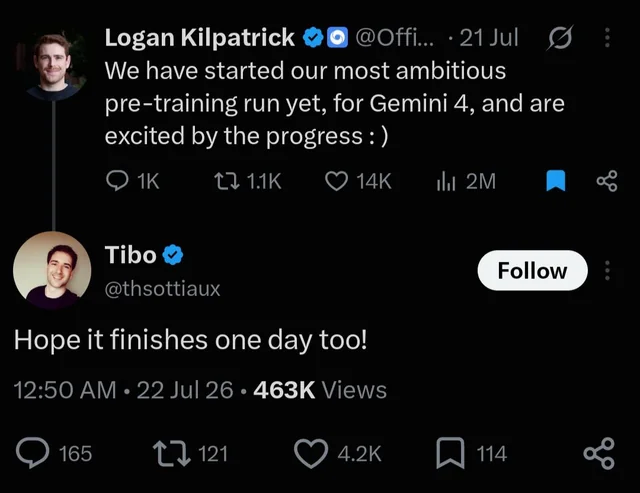
We all got into this field to build safe AGI that is genuinely good for humanity. One of the hardest parts of AI safety is coordination, and this is a step in the right direction. Many more steps like this will be needed to deliver safe, contained, and aligned AGI in the next few years.
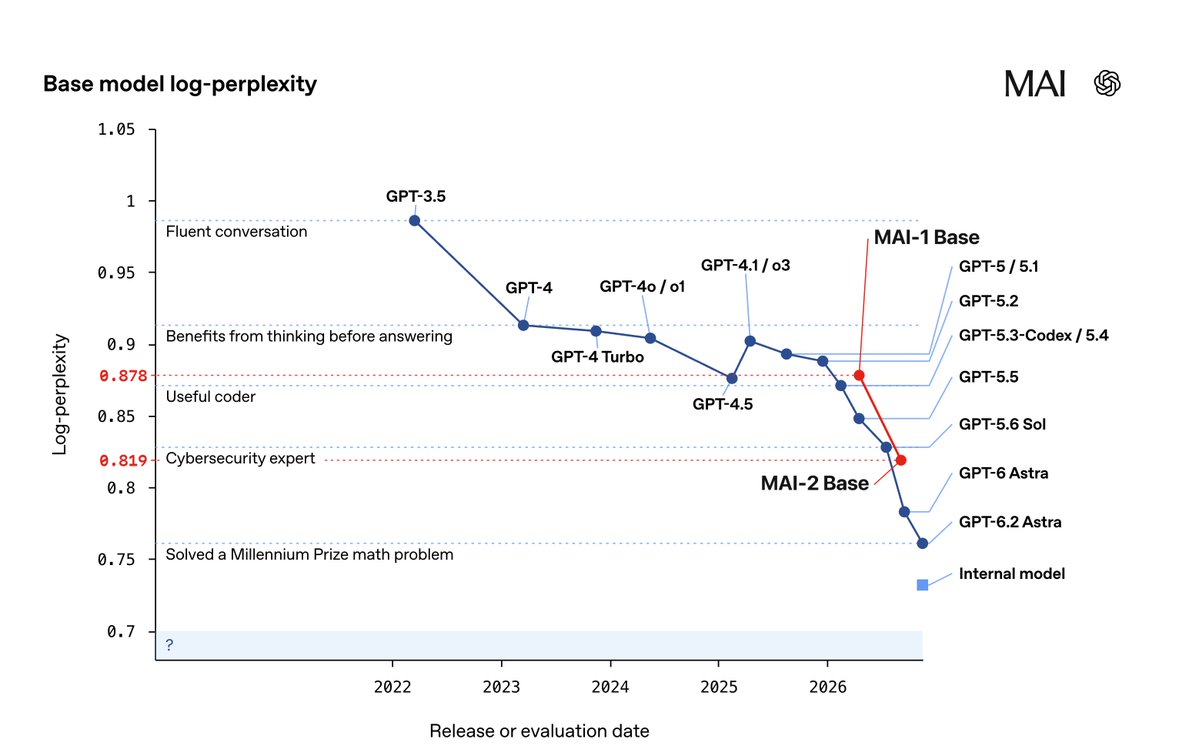
We're committed to sharing our pre-training progress on a common held-out evaluation set. With OpenAI's permission, we report MAI-2 Base on their evaluation set. Its log-perplexity is 0.819, putting it in the same ballpark as the GPT-5.6 Sol base model. Our model uses the same tokenizer as OpenAI, so the numbers are directly comparable.
In the future, to be able to compare across labs we might need to report bits-per-byte (BPB) rather than perplexity since different labs use different tokenizers. We will also need different evaluation datasets - the fact we have access to OpenAI's evaluation dataset is a special case.
Safety and alignment is now the mission. It's the absolute number one most important focus for our industry. And it begins with small, practical steps like these towards better coordination on pacing.
This is the most important thing OpenAI has published in awhile.
We are providing a lot of transparency into our pretraining progress and hope we can agree as a frield to common limits. I think that would be very wise and help ensure safety and control.
@_samirism Today i finally subscribed to Chatgpt Pro which gave me access to Dots.
One issue I’ve noticed with the Call feature is how slowly it responds to interruptions. When I start speaking while Dot is talking, it keeps going for another 7–8 seconds before stopping and acknowledging me.
In regular ChatGPT Voice, it usually stops within 1–2 seconds, which makes conversations feel much more natural.
I’d love to see Dot’s Call feature handle interruptions just as smoothly. It would make a huge difference to the experience!
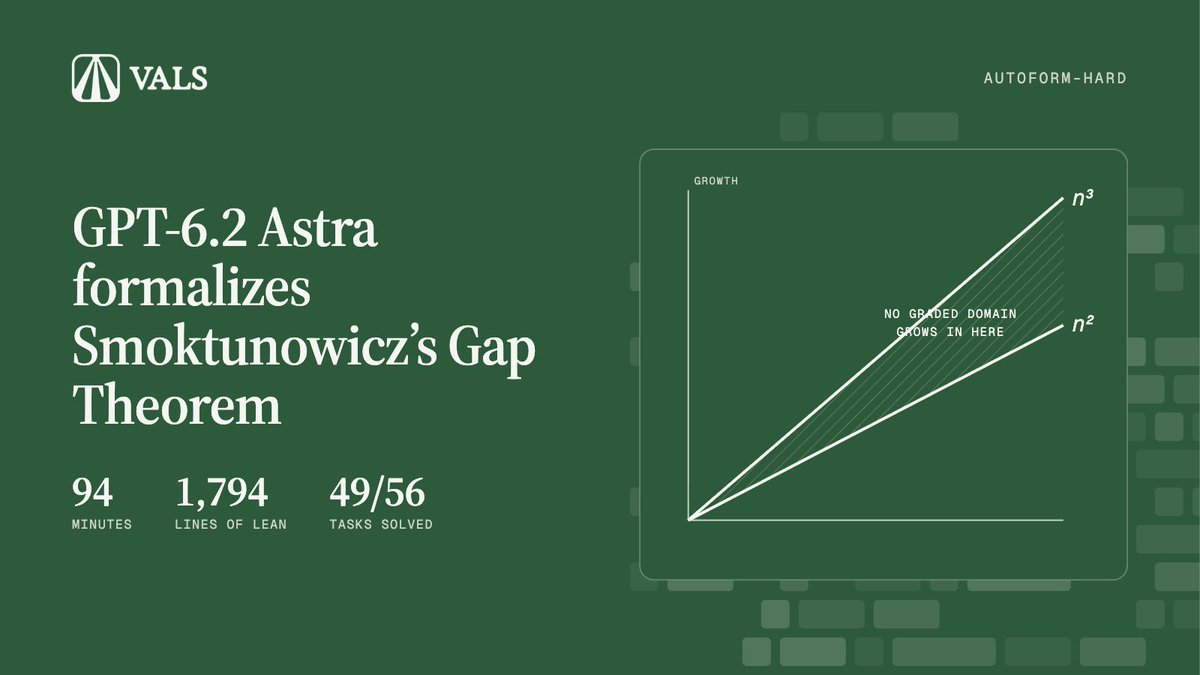
GPT-6.2 Astra just produced what we believe is the first Lean proof of Smoktunowicz’s Gap Theorem, and it found its own route to get there.
It happened on Autoform-Hard, a verified subset of Meta FAIR’s AutoformBench that we’re releasing results on today.
We’ve raised $110M to bring AI-powered biomolecular design to every scientist!
Boltz’s Series A is led by @BessemerVP, following 50-fold growth in molecular token usage from our users since June and partnerships with 6 of the world’s 20 largest pharma companies.