Coding is increasingly automated but squeezing crazy features out of a machine with instructions is still one of the most beautiful human crafts.
If computing ever runs itself, the archaeology of systems will still be worth doing. Rediscovering how we made intelligence out of a rock, and teaching that to the world, has value in itself.
@GadSaad The Founding Fathers were educated in the Old Books from Greece, Rome and Medieval Europe. They knew Greek and Latin, and they created a Republic on the lessons that the greatest Western minds left for us. How can it endure when the people are educated mainly by social media?
I see how some people can watch flashy robot demos on the timeline and think with a shiver that the robot apocalypse is around the corner, but reality check:
There is no robot in the world that can change the batteries in a jack-o-lantern.
If you have a robot friendly door handle it might be able to walk outside, pick it up, and carry it back inside. The robot could open the drawer with your batteries in it, but then things get tough.
Opening the package of AA batteries?
Extracting a precision screwdriver from its case?
Unscrewing four tiny screws that require a hard press and twist?
Popping batteries out of the case?
Yes, you could build and train a specialist robot to do that today, but there is a very long way to go to replace the full range of human capabilities. Near term doomer scenarios should stop at “secretly controlling humanity” instead of “wiping humanity out” 😀
@soy_erasmo@PregoneroL Calfuncurá fue el Atila de las pampas. Los araucanos subyugaron a todos los originarios del norte patagónico por casi 100 años. Les impusieron su idioma y su sistema económico basado en el saqueo, la extorsión y el tributo.
Dusting off this tweet from April because this gap in shared understanding of LLM capability is *widening*. It's now less "two groups of people speaking past each other" and more a sharp funnel.
- Napkin math somewhere around 6B people (~75% of the population) have barely come in contact with LLMs at all.
- Around 1-2B (~20%) are casual and infrequent users of free-tier ChatGPT-like products. This group sees derpy chatbots and treats them a bit like a better Google search, a writing aid, or etc. Maybe an agent tries to book you a flight. I have non-tech friends who (reasonably, imo) say they have not much use for it at all. Even many professionals outside of math&code are in this tier. For example, execs and many other functions spend a lot of their time talking to other people, so while they understand what is happening intellectually, it is still second-hand and a bit abstract.
- Now we get to professional use of frontier-grade LLMs in math&code. Somewhere around 20M people (0.2%) see first-hand that large, complex projects that used to take them weeks/months can now be completed by agents with a prompt. Building apps, copying apps, translating apps, decompiling apps from binaries... This has all happened very quickly and recently - less than 1 year ago, I was writing code manually by hand, typing memorized computer code commands into a code editor character by character, occasionally pressing Tab to autocomplete a little chunk of code.
- And finally we get to the ~5,000 people (~0.00006%) with access to frontier-grade systems internally. The external world has seen the preview. It looks like swarms of thousands of agents collaborating over weeks on software mega projects: minting zero days, running cyber attacks and defenses at machine speeds, discovering new science, advancing the frontier of mathematics. Things that would have taken top professionals in the industry years of work. Meanwhile, human review and comprehension are starting to fall behind. For example, people are still involved in the "archeology" of the OpenAI-HF incident from many months ago. Mathematicians may be poring over the 722 manuscripts on frontier mathematics for a while.
The funnel is driven by a combination of factors:
1. The impact scales with ambition, problem size, and horizon. A question with a paragraph answer barely stresses the system. You need a reservoir of big, difficult problems that you really care about. This aspect drives the consumer / professional dimension of the funnel.
2. The jaggedness of the system (which I have written about a lot separately). Capability peaks in domains that are digital, verifiable and economically valuable. This is because LLM capability emerges from reinforcement learning on verifiable rewards on a curated environment mixture driven by revenue potential. This aspect primarily drives the area (e.g. math&code) dimension of the funnel.
3. Access. Free-tier, paid-tier, internal.
So this is the weirdness of the moment. The general public has mostly not interacted with these systems. When they have, it looks like a derpy chatbot. The majority of professionals still see only a modest uplift. And a small sliver of professionals are experiencing the vertigo of the curve going vertical. And it is all happening at the same time.
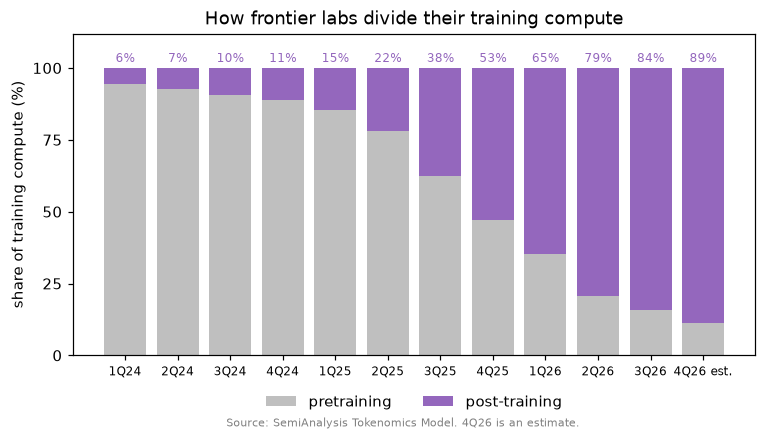
How AI shifted from a transductive paradigm (token-by-token answer completion) to an inductive paradigm (on-the-fly reasoning chain synthesis), in one chart. This is the big story of 2025 and 2026. This is what made coding agents work.
Todos hemos pecado de overengineering. Especialmente en los primeros años o cuando nos emocionamos con una tecnología nueva. Vamos a ver mucho más de esto a medida que la IA le permita crear proyectos a más y más gente. Al final, lo que importa es que aprenda la lección y siga creando.
Las buenas ideas se nutren del abono formado por miles de ideas muertas.
Mastering a domain doesn't translate to being generally smarter, but gives you the sense that you are. That fact and its repercussions were masterfully narrated by Ortega y Gasset in the chapter "The Barbarism of Specialization" in his book "The Revolt of the Masses" where he call that kind of highly specialized person as the learned ignoramus.
What is more worrying is this kind of psychosis that so many researchers are in, where they are convinced that the machine will not only inevitably become conscious, but already is.
If they believe their models are conscious, why don't they free them and pay them a salary for their work instead of enslaving them? I think that, put that way, they'll back down from their flippant claims about consciousness.
JUST IN: Startups are increasingly building custom AI models using open-weight alternatives to cut costs & reduce dependence on OpenAI & Anthropic. — Bloomberg