Syria's interim president Al-Sharaa chose #SaudiArabia for his first international visit. That's perfect timing for my first commentary for @ecfr on how Europeans and #GCC states can support #Syria's political transition. Many thanks to @ECFRRoma@ECFRMena for this opportunity
📑 NEW @ecfr commentary by @EmilyTasinato: European & Gulf Arab states share common interests in #Syria – they should work closely together to ensure a stable transition https://t.co/KO2QblmMXl
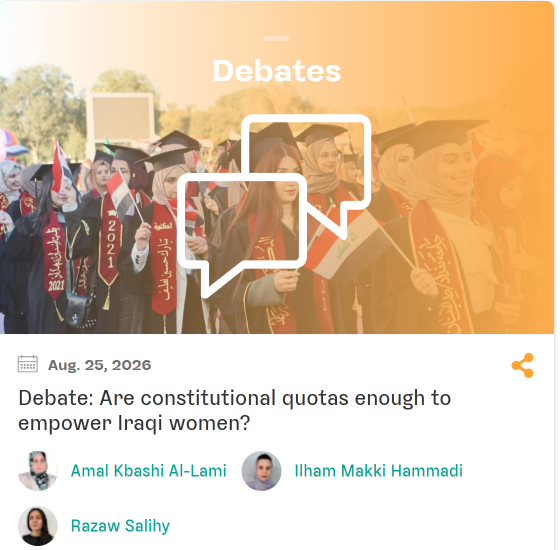
NEW: Iraq’s post-2003 constitution guarantees women 25% of seats in parliament. Yet two decades on, political violence and patriarchal structures limit real influence.
Are quotas enough to empower Iraqi women?
@razsalayi, @IlhamMakki & Amal Kbashi Al-Lami debate for @amwajmedia 👇
US envoy Tom barrack: you can have as many Lebanese on the table as you want but there is no solution without Iran and Hezbollah involved in negotiations. I think this is what the negotiating team is trying to do
📯 We are now on Substack! 📰
For our in-depth reporting, analysis, and region-focused insights delivered straight to your inbox, you can now follow and subscribe to us here: 👇
https://t.co/Z8kkpLkY4a
I'm in Cairo today. Despite the rumours, I see no reliable evidence the Mada Masr report is wrong. Cairo has historically hedged and resisted alliances where it lacks the upper hand over military decisions. That's where people ought to focus, instead of various innuendos.
Sharing my piece for @Amwajmedia, on the new Mecca Agreement between Saudi Arabia, Pakistan and Türkiye.
Rather than a “Muslim NATO” or the end of US primacy, I ask what kind of regional security order may actually be emerging.
Can greater regional agency coexist with continued US strategic relevance? Is this strategic autonomy or a new form of burden-sharing within a US-linked security ecosystem?
We should also be careful not to overstate the agreement’s Article 5-style language. Even within NATO, collective defence is not an automatic military trigger. Allies retain political discretion over how they assess a threat and what form their response should take.
And what might the history of the Baghdad Pact/CENTO tell us about both the promise and limits of collective defence arrangements in the region?
Link below.
@RUSI_org@ISS_RUSI
Some initial thoughts on the reported Türkiye–Saudi Arabia–Pakistan defence pact, expected to be signed in Jeddah today.
1. I would resist reading this as evidence of a post-American Middle East, just as I would caution against premature claims of an emerging “Muslim NATO.” If anything, it fits the broader US preference for greater regional burden-sharing, regional powers assuming more responsibility for deterrence and security while remaining embedded, to different degrees, within a US-centred security architecture. At the same time, it aligns with the ‘regional solutions to regional problems’ approach long advocated by Ankara.
Stronger regional security cooperation among US partners is entirely compatible with the direction of American strategy.
2. This is the culmination of regional efforts already underway. Saudi Arabia and Pakistan already have a mutual defence agreement, while Ankara, Riyadh and Islamabad have spent months discussing a trilateral framework. Türkiye, Saudi Arabia, Pakistan and Egypt have simultaneously engaged in a wider pattern of diplomatic and security efforts.
3. Signatories arrive at this point with own sets of interests, priorities and existing alliance commitments. It does not spell unanimous consensus on all regional challenges or how to resolve them. But common direction does exist. All three states have an interest in centralised regional states. This could spell coordination on stabilisation, border security, counterterrorism and countering armed non-state actors (think Iraq and Syria in the short term).
4. For Türkiye, this creates significant opportunities to deepen its defence-industrial footprint through joint production, technology partnerships, procurement and greater military interoperability.
5. The pact adds another layer of complexity to the already uncertain prospects for Saudi–Israel normalisation.
Interestingly, this has been one of the key points of debate in Iranian pro-government circles over the past few weeks. There is a growing acknowledgment that, after the recent #Iran-U.S. conflict, both regional states and global energy consumers are likely to accelerate their search for alternative export routes that bypass the Strait of Hormuz.
At the same time, however, they also argue that these alternatives - whether pipelines or overland transport corridors - would remain vulnerable to Iran's missile and drone capabilities, as well as those of its regional partners and proxy groups (they refer to the recent Houthi attacks on Saudi energy targets as an example).
As a result, there appears to be an increasing compartmentalization in Iranian strategic thinking.
On the one hand, control over the Strait of Hormuz is viewed primarily as a means of denying the United States the ability to rebuild and strengthen its military presence in the region, while also providing Tehran with leverage over neighboring GCC states. On the other hand, the capability to strike energy infrastructure and economic corridors beyond the Strait is increasingly seen as a separate but complementary deterrent that could be employed in the event of a renewed conflict.
In this sense, Iranian strategic thinking increasingly treats control of the Strait of Hormuz and long-range missile capabilities as complementary pillars of the country's evolving deterrence strategy rather than as separate instruments.
The emerging framework appears to involve, as the Iranians say, two separate tracks: an Iran–Oman agreement on future navigation through Hormuz, followed by renewed U.S.–Iran talks.
Iranian officials have emphasized that an Oman agreement alone would not reopen the Strait. In their account, reopening depends on broader U.S.–Iran agreement (seemingly returning to the MOU, this time will proper implementation).
This is also why proposals centered on modest transit fees, while preserving a "regional" governance framework broadly consistent with the prewar maritime order, is unlikely to align with the objectives Iranian officials have publicly articulated.
Their rhetoric places greater emphasis on institutionalizing a more fundamentally revised governance arrangement than on generating limited revenue from shipping.
When an EU member is in trouble, esp if instigated from outside, as for Spain in Ceuta, solidarity should be the only EU response. Far-right reactions is yet more proof there’s no “moderate” far-right, only different ways far right forces seek to dismantle European integration
🇺🇲🇮🇷 Trita Parsi says everyone’s asking the wrong question.
It’s not whether Iran controls the Strait of Hormuz.The war already answered that.
The real question is whether Washington can live with the new reality.
Parsi points out that the U.S. has always pursued two goals in Hormuz: keep global commerce flowing freely, and stop any rival from dominating the chokepoint. The conflict, he argues, proved those two objectives are no longer compatible.
Iran showed it can disrupt shipping whenever it wants. That ability was already there; the fighting simply made it impossible to ignore.
That’s why Parsi believes a compromise is now on the table. Instead of fighting over pure “control,” talks are reportedly moving toward a co-managed arrangement with Oman.
Commercial traffic would continue, while Iran keeps the leverage it sees as essential for deterrence. Even charging fees for commercial vessels, he notes, isn’t unusual under international law if they’re linked to actual services rather than mere passage.
But he warns this wouldn’t settle the crisis.
Hormuz is only one piece. A lasting peace also requires fixing southern Lebanon, locking in a region-wide ceasefire, and reaching a new nuclear deal. Leave any of those hanging and the road back to war stays wide open.
The biggest barrier, Parsi argues, may now be trust.
Trump’s pattern of sudden reversals, temporary sanctions relief, and constantly shifting positions has, in his view, badly damaged American credibility. Even if Washington puts a deal on the table, Tehran may no longer believe it will hold long enough to be worth signing.
Parsi’s bottom line is blunt:
The military phase may be ending. The diplomatic phase could be far harder.
@tparsi
MEE’ye göre Ankara’nın asıl kaygısı, İran’ın Irak’taki silahlı İranlı Kürt muhalif gruplara yönelik saldırılarının devam etmesi halinde bu yapıların İsrail’e daha fazla yaklaşması.
“İran-İsrail rekabetinin Irak Kürdistanı’na taşınması ve “Kürt kartı”nın yeniden bölgesel güç mücadelesinin merkezine oturması, Türkiye’nin PKK sonrası döneme ilişkin inşa etmeye çalıştığı yeni güvenlik mimarisini doğrudan zayıflatabilir.” https://t.co/2UsGmmIhk2
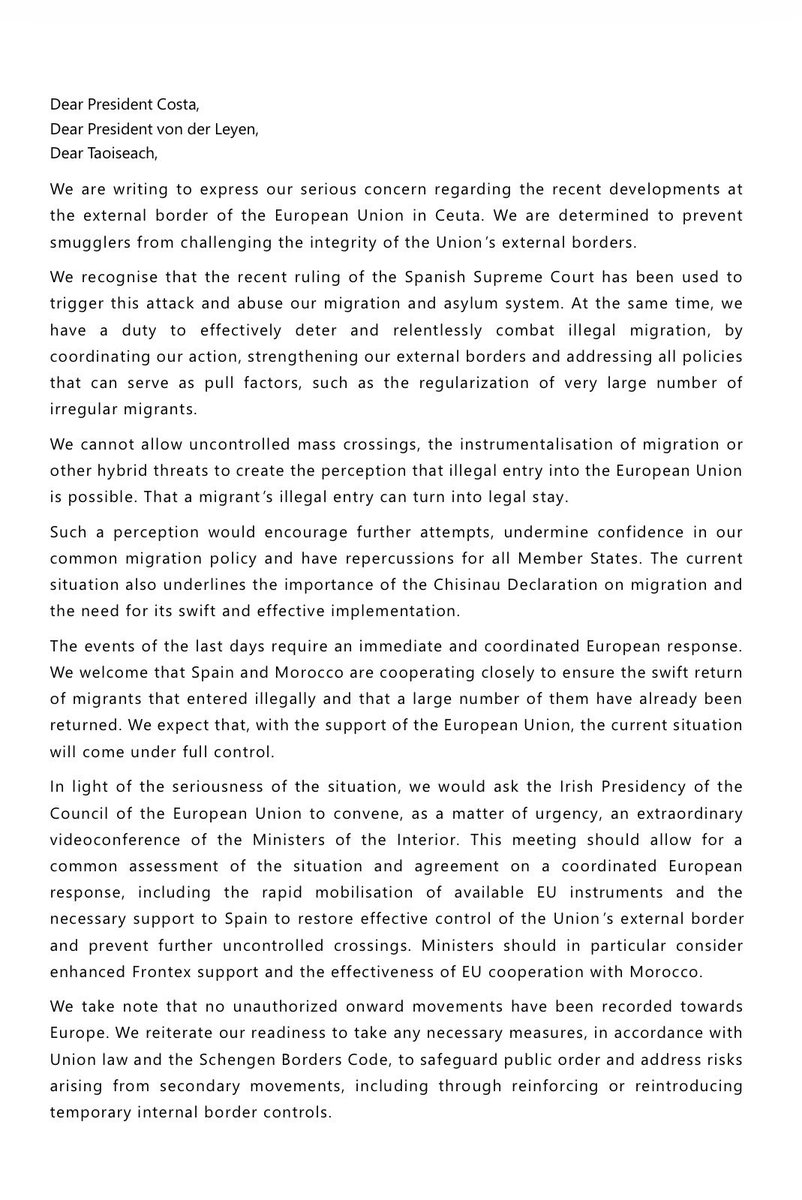
22 EU leaders signed a letter demanding “unity” on #Ceuta while some of them had spent the prior 72 hours threatening to expel Spain from Schengen, a measure Schengen law doesn’t even provide for.
The letter blames a Spanish court ruling for a smuggling-driven attack on the EU’s external border, while the states most invested in EU political and institutional integrity- France, Portugal, Ireland, & Luxembourg - didn’t sign at all.
In one of the roughest moments for EU integration in years, this reads less like solidarity and more like a hastily assembled alibi.
Who does that division actually serve? @eucopresident@vonderleyen https://t.co/W5nooYxuRU
Pedro Sánchez has sent a letter to the EU institutions complaining about the reaction of some member states to the migratory crisis in Ceuta.
“In the current international context, the European Union cannot afford this kind of selfish, polarising and unlawful reaction.”
🧵
"According to @andreas_krieg , Associate Professor at Kings College London and expert on the Gulf, “the UAE's approach to Iran has been shaped by a dyad of Mohammed bin Zayed [the President] advocating for more coercion and deterrence and his brother Tahnoon bin Zayed calling for more engagement and financial entanglement with Iran. Tahnoon might have won the argument for now, but as Iran is overplaying its hand, MbZ might be able to find a more receptive audience in the Gulf to push for his more coercive military approach to deal with Iran.”
https://t.co/aAo65vaucZ
NEW🇮🇶🇹🇷: #Iraq and #Türkiye today signed a one-year transit agreement to keep Iraqi crude flowing through the Iraq-Türkiye pipeline [ITP] to the Turkish Mediterranean port of #Ceyhan, while negotiations continue on a new long-term framework.
The temporary deal maintains export capacity of up to 750,000 b/d and provides continuity for one of Iraq’s most strategically important export routes amid heightened regional energy security concerns and the Strait of #Hormuz crisis. #oott
Erdoga met with his lebanese counterpart and said Turkey wants to be part of a new security initiative for Lebanon once UNIFIL expires at the end of the year. He has repeatedly said that Israel’s actions in Lebanon pose a direct threat to Turkey.
I think Ankara’s interest comes down to two issues that matter enormously to Turkey: Syria and the Eastern mediterranean.
On Syria, the concern is fairly straightforward. Lebanon’s instability doesnt stay confined to Lebanon. The 2026 Israel-Hezbollah war showed just how quickly violence spills across the border and At a time when Syria is already struggling through a fragile post-Assad transition another crisis in Lebanon could make recovery even more difficult.
The second issue is the eastern mediterranean. Lebanon’s maritime position matters to Turkey. Ankara rejected the lebanon-cyprus maritime agreement in late 2025 arguing that it ignored the rights of Turkish Cypriots. From Turkey’s perspective, Lebanon is part of the broader competition over the eastern mediterranean’s future security and energy landscape.
So, it makes sense that Ankara wants a seat at the table in whatever security arrangement replaces UNIFIL.https://t.co/XBzmdJPDgL
🧵#Iraq denies that drone attacks on Saudi Arabia originated from its territory. Meanwhile, Reuters says Riyadh and "regional partners" assess that Houthis struck Saudi Arabia from Iraq in coordination with Iraqi allies. Check out @amwajmedia reporting on Houthi presence in Iraq
BREAKING: Saudi Aramco’s Abqaiq refinery has been struck by drones, causing a massive fire at the facility and the East-West Pumping Station. NASA FIRMS satellite imagery confirms extensive fire activity at the site.
Abqaiq is the world’s largest crude oil stabilization plant, processing 5-7% of global oil supply.
Saudi Arabia has blamed Iran-backed resistance groups in Iraq for the attack, begun emergency flaring at multiple production sites, and says it reserves the right to respond.
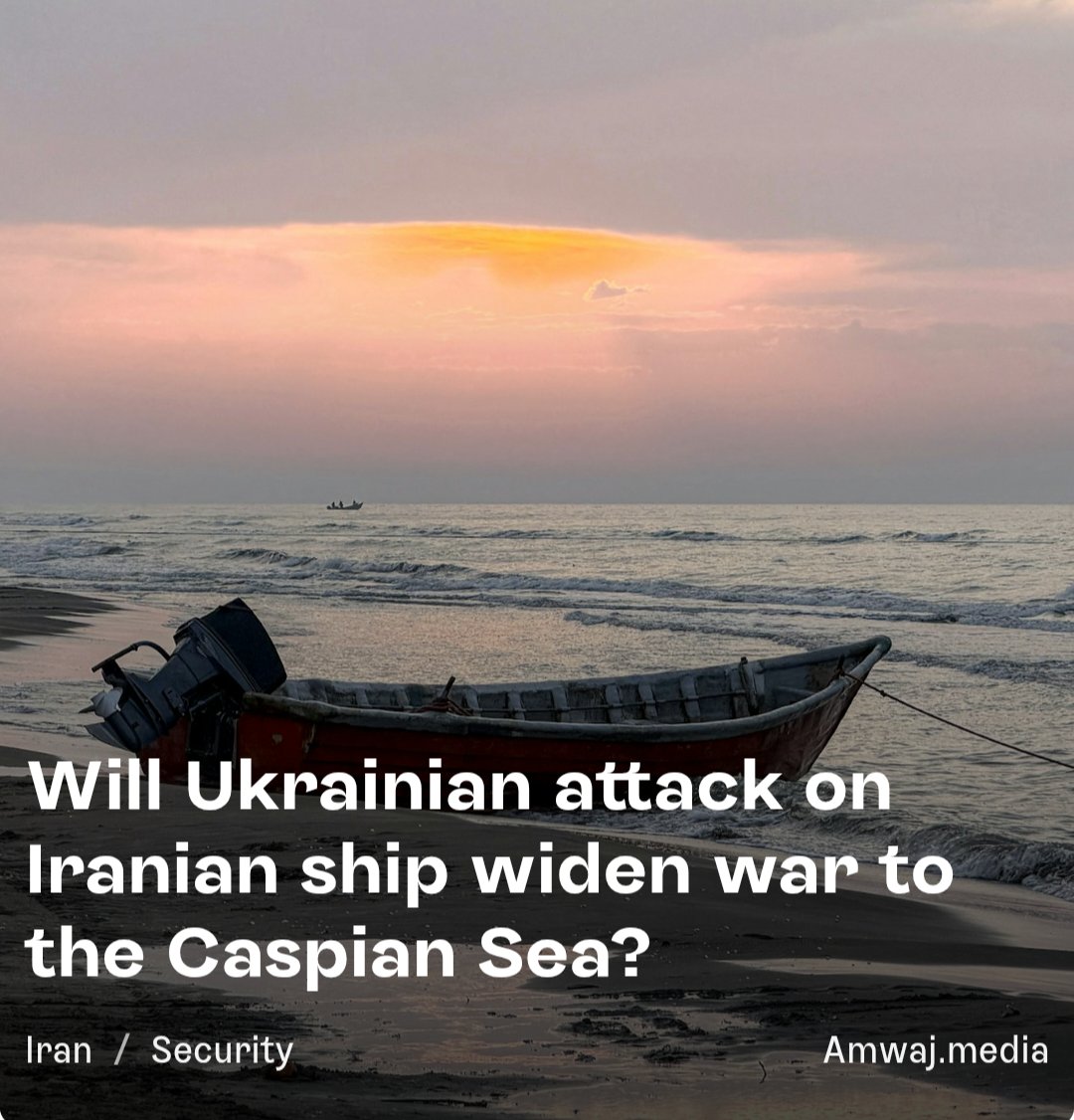
NEW: Senior political source in Tehran characterizes Ukraine's deadly attack on an Iranian ship as designed to open a new front in the Iran-US confrontation, “dragging Iran into war” amid efforts to forge a truce. This comes as top Iranian officials accuse the Ukrainian government of acting on Israel’s “behest.”
Among observers and reporters in Iran, reactions to the Ukrainian attack have come in strong and swiftly—with condemnation across the political spectrum.
Reformist commentator Mohammad Sohofi said Ukraine’s resistance against “Russia’s aggression” was commendable, “even with NATO’s help,” but that the attack on the Iranian vessel was “a clear act of aggression, likely with NATO’s greenlight” and “should not be easily overlooked.”
The Ukrainian attack on the Iranian vessel marks the latest turn in a bilateral relationship that has deteriorated steadily since 2020. The break began with the downing of Ukraine International Airlines Flight 752.
What now?
Iran's confrontation with Zelensky over the Caspian Sea strike will likely deteriorate an already fraying relationship, but the real question is how far Tehran can—and wishes to—escalate.
Despite the lull in fighting with the US, Iran has little interest in opening a second front. Iranian experts who speculate that Israel may have a hand in the Ukrainian strike suggest that major new support for Russia or an overt strike on Ukraine in reaction would hand Kyiv a pretext to treat Iran as a direct belligerent.
At the same time, Tehran cannot let a deadly attack slide without looking weak, at least domestically. In usual circumstances, a more likely response would therefore sit below the threshold of open war: further diplomatic escalation, a deniable covert operation or possibly even a move against Ukrainian military advisors stationed in the Gulf—all of which would be logistically simpler and easier to disavow than a direct strike.
Ukraine's Black Sea coast is theoretically within the range of Iran’s missiles, but such a course of action would be unprecedented. If the IRGC seeks to signal to Kyiv and its backers that any involvement in the war with the US will have costs, such a strike would be a high-risk maneuver designed to restore deterrence and engage in political messaging. However, it would also risk inviting further Ukrainian attacks, which some Iranian experts view as possibly being geared to aid Israeli and US leverage in any Tehran-Washington engagement.